

Bill Ackman's new 'SPARC'; Dave Lashmet's warning about Structure Therapeutics; Greetings from Lithuania
1) Longtime readers may recall that my college buddy Bill Ackman created a SPAC in 2020 called Pershing Square Tontine Holdings (PSTH), which raised more than $4 billion.
Bill evaluated many deals and ultimately decided to merge with Universal Music Group, but the SEC shot it down. Bill ended up closing down his SPAC in July 2022 and returning investors' capital.
But, in an interesting twist, Bill (who is the most persistent person I've ever met) is back with a new concept called a SPARC, or "special purpose acquisition rights company," which is much better than a traditional SPAC – and there's a bonus for those who held PSTH stock and warrants until the end, as described in the prospectus filed with the SEC:
Our company is not a SPAC and we are not raising capital from public investors at this time. Instead, we are distributing, at no cost to the recipients, subscription warrants, which we refer to as special purpose acquisition rights, or "SPARs", to purchase our shares at a future date in connection with our business combination.
We are distributing an aggregate of up to 50,000,000 SPARs to the former holders of the Class A common stock of PSTH and an aggregate of up to 11,111,111 SPARs to the former holders of the distributable redeemable warrants of PSTH, in each case based on ownership of PSTH Class A common stock and distributable redeemable warrants as of July 25, 2022, the final date on which PSTH securities traded, as further described herein.
The SPARs aren't yet trading so you can't invest in them now, and it's unclear what they're worth. However, what Bill is doing here is very innovative and shareholder friendly – and could disrupt the entire SPAC industry – so it's worth keeping an eye on...
This post on the Class V Group blog explains why: Bill Ackman has it right. Excerpt:
For a very small subset of very special companies with a particular goal for a public offering, we believe this structure is among the most company-friendly, investor rational process improvements to come around in a long time...
The SPARC structure is very different. Investors receive a right to buy shares at the same price as the sponsor, in this case funds from historically successful Pershing Square, once they know what the target company is. Rather than of holding their collective noses and jumping in, investors can actually see that the pool not only has water but that the temperature and chlorine levels are to their liking.
Don't like it? Don't invest; the look cost you nothing. Do like it? Ok, see what the valuation looks like after a brief exploratory trading period and then make the call. Really like it? Buy just as you would on the open market with any new issue. Huge incremental knowledge shifts the balance of power to the investor...
We believe that SPARCs indeed solve almost all of the things we hate about SPACS, elements that honestly were problems for both issuers and public investors. Only the 3rd parties were winners in most cases...
SPARC strike us as a genuinely thoughtful, fair, wicked-clever innovation that merits a close look by the subset of issuers for which it was designed.
Puck's William Cohan wrote about it as well: Ackman in Full. Excerpt:
"It addresses all of the problems of SPACs," he explained. "I feel very good about the final product." The Special Purpose Acquisition Rights, or SPARs – yeah, sorry – will be distributed soon to those equity holders who were still in the Tontine at the time it was wound down in July 2022. It's a who's who of the Smartest Guys in the Room, including Guggenheim Partners, Susquehanna Capital, D.E. Shaw, Highbridge Capital, Blackstone and Goldman Sachs, among many others.
So while his public solicitation of Twitter/X might make it seem like Ackman is up to his old media-whipping tricks, his message is actually a simple one: his SPARC is open for business. He's on the prowl. And thanks to the public markets, he essentially has unlimited capital for a deal to supplement the up to $3 billion that his hedge fund is prepared to invest once he finds a deal that he likes. "We have the entire capital markets as our partner in buying a company," Ackman told me. "We just have to be the lead and take the risk and do the work. And as long as people agree with our assessment, everyone else will invest. It really is an innovative thing."
Indeed, he thinks he's created a free option, either for the investors who get the SPARs, or for other investors who buy the SPARs as they are traded in the market. "They say there's no such thing as a free option," he continued. "This is actually a free option. And I think it's going to be a valuable free option because we're going to do a good deal."
The ABC Option
In any event, the publicity campaign has worked. Wall Street knows Bill's acquisition company is open for business. More realistically, he said, the first investment will more likely be for a company in the portfolio of a big private equity firm such as Blackstone or KKR. He thinks it's a hard time for these companies to go public now, given the choppiness of the market. It's also a hard time for them to be sold to a strategic buyer, because of the tougher regulatory environment, and it's a hard time for them to be sold to another private-equity firm because it's tough to get financing for the deal.
"What's cool is we can do that," Ackman said, especially since there are no underwriting fees and no M&A fees (unless bankers bring him the deal, or if they represent the seller). He noted that Pershing gets warrants for up to 5 percent of the stock, struck 20 percent out of the money, based on how much money is raised. But he thinks it's all a bargain, and the best deal out there for a private company that wants to sell. "It's the cheapest way to go public," he explained. "It's more certain. There's a guaranteed outcome. The stock is going to trade better because everyone's opting in. And we're an anchor investor that's not going to sell."
2) Last week I saw a compelling pitch for Structure Therapeutics (GPCR), which is developing a pill version of the revolutionary new GLP-1 weight-loss drugs like Ozempic (which must be injected once a week).
I was intrigued because, with only a $3.1 billion market cap, Structure could be a home run in this white-hot sector if its drug is approved.
But I know nothing about drug development... so I turned to one of the world's leading experts in this area: my friend and colleague Dave Lashmet, who writes the Stansberry Venture Technology newsletter over at our corporate affiliate Stansberry Research. In Venture Technology, he identifies public companies with promising early-stage products and technologies for his subscribers.
Sure enough, Dave was very familiar with GPCR, but wasn't a fan. He replied to my e-mail, writing:
It's a potential train wreck for a number of reasons.
First of all, it's a tiny company competing against giants Novo Nordisk (NVO) and Eli Lilly (LLY). Best case, there's only a 1% chance it can compete with them in a decade.
Also, while it has a U.S. address in South San Francisco, we think it's really a Chinese company, as its CFO, CSO, CTO, VP for research, VP for trials, and virtually everyone else resides in Shanghai (see leadership team here). And I don't have to tell you about the dangers of Chinese companies...
Lastly, I am very suspicious that the company might have suppressed the side effects in the Chinese phase I clinical trial results that it reported.
Both Lilly and Pfizer (PFE) were side effects in their GLP-1 pill phase II trials.
Meanwhile, GPCR's dose curves are nonsensical. It's taking a radically different dose than it tested in phase I trials into phase II. We can't see the logic of this.
Thank you, Dave!
3) I flew to Vilnius, the capitol of Lithuania (my 81st country), on Sunday, where I met my Dutch friend Jesse, who sold me the 27 ambulances I bought for Ukraine earlier this year.
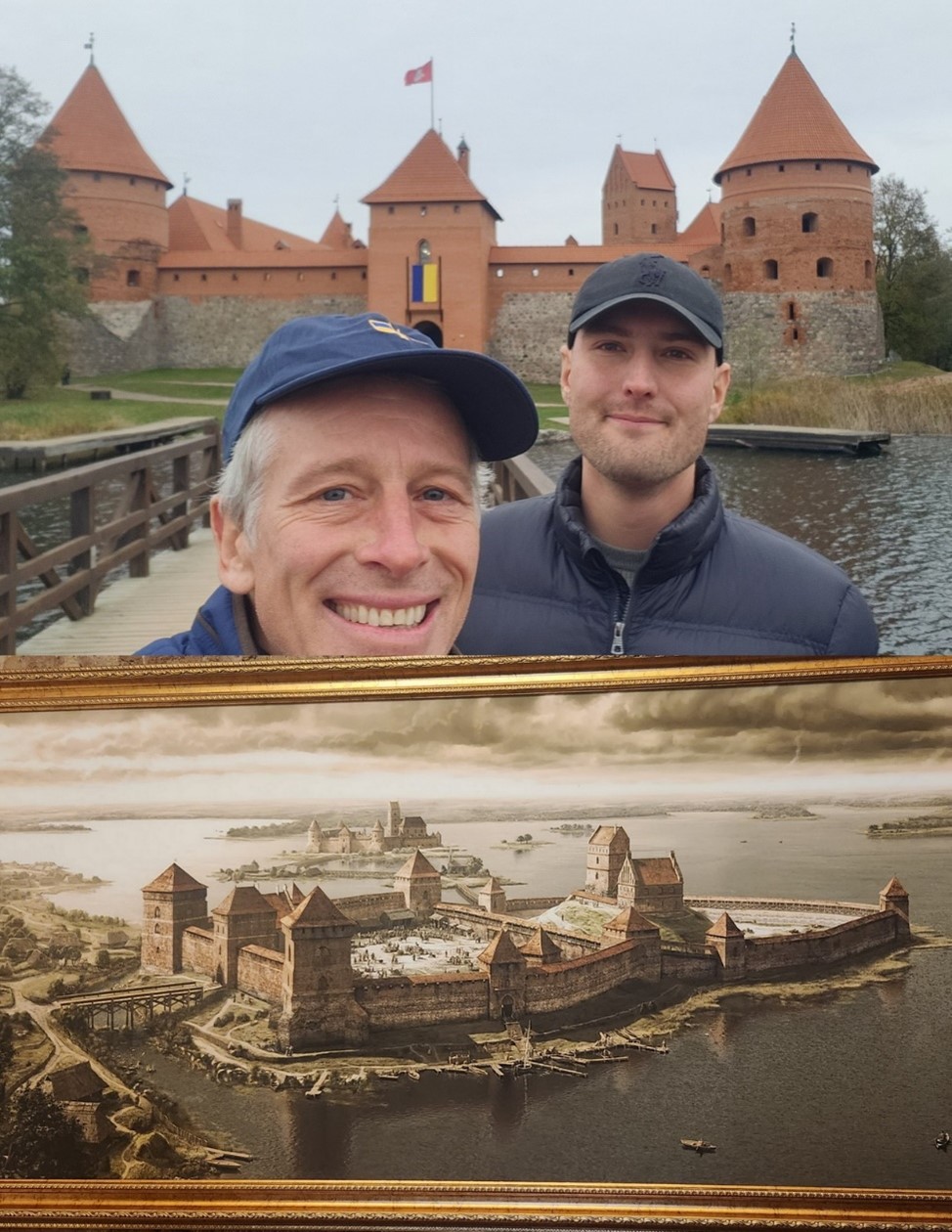
We drove four hours to the western part of the country where we visited an ambulance company yesterday, on the way stopping to see 1,000-year old Trakai Castle. It has been beautifully restored and has interesting historical exhibits:
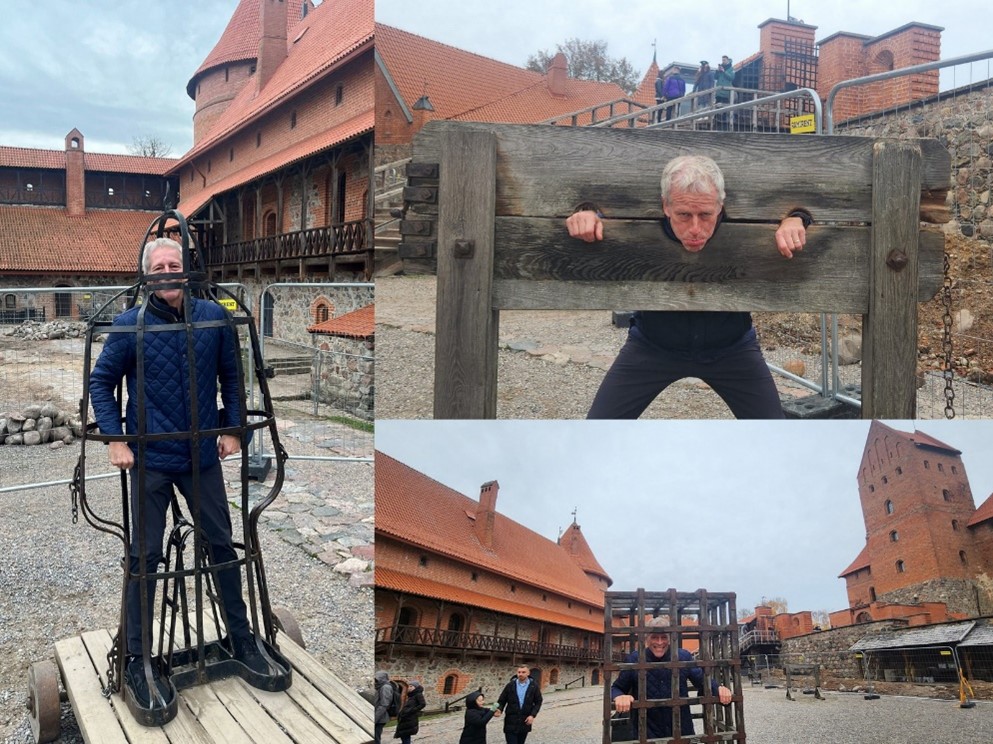
I of course had to try out the medieval torture equipment (I told Susan not to get any ideas!):
I posted more pictures on Facebook here.
Today, Jesse and I are exploring the beautiful old town of Vilnius before we both fly home tomorrow morning.
Best regards,
Whitney
P.S. I welcome your feedback at WTDfeedback@empirefinancialresearch.com.