

A 'big' breakout...
A 'big' breakout... The latest on oil... Porter was right again... This incredible one-time-only offer closes at midnight...
 Big banks are breaking out...
Regular Digest readers know we've been following the "quiet" rally in regional banks. Now, larger financial stocks appear to be joining them.
Yesterday, Citigroup (C), JPMorgan Chase (JPM), Morgan Stanley (MS), Wells Fargo (WFC), BB&T (BBT), and PNC Financial Services (PNC) all hit fresh 52-week highs.
There are several factors pushing bank and financial-services stocks higher today...
For one, data on the economy – including consumer confidence, manufacturing, and the jobs and housing markets – are improving. This is driving the demand for financial services. Businesses are taking out loans again (and paying themoff), and people are buying more "stuff"... so banks are making more money.
U.S. banks also have stronger balance sheets and are generally much healthier today than they were following the financial crisis of 2008-2009.
Despite hitting new highs, investors continue to hate these stocks. Steve Sjuggerud highlighted the negative sentiment surrounding financial stocks last month and explained why this could be great news for shares. From the May 27 Digest...
Years after the financial crisis, investors still want nothing to do with financial stocks. Today's reading of 20% is one of the most negative in history. Sentiment this bad could point out an opportunity. When investors flee a sector en masse, it tends to point toward a bottom, not a top. When investors are all doing the same thing, they're usually wrong.
Interestingly, financial stocks have begun a silent uptrend in recent months. They've underperformed the overall stock market since the beginning of 2015... but they've beaten U.S. stocks since bottoming at the end of January. Negative sentiment, combined with an uptrend, makes financial stocks a sector that interests us right now.
The news this week hasn't been as positive for oil prices...
On Tuesday, the Energy Information Administration ("EIA") reported U.S. crude-oil production in May reached its highest monthly level in 43 years. From an article on financial-news website MarketWatch...
May production averaged about 9.6 million barrels a day. In May 2014, production averaged almost 8.4 million barrels a day, which was the highest monthly average since March 1988.
"Despite the large decline in crude-oil prices since June 2014, this May's estimated oil output in the United States is the highest for any month since 1972," Adam Sieminski, EIA administrator, said in a statement.
The report confirms that even though U.S. shale-oil producers have essentially stopped drilling new wells this year, oil production isn't falling. In fact, it's still rising. This is exactly what Porter predicted in the March 13 Digest...
This chart shows you how many oil rigs are actively drilling for new supplies (the "rig count") and the most current oil-production figures. What you see is we're producing more and more oil even though drilling is shutting down. That's because most of the costs in oil production are upfront. There's almost no incentive for producers to shut in wells that are already flowing.
That's why it's going to take something around six months or maybe a year before we begin to see oil production falling. And in the meantime, prices could truly crash... because we're running out of storage.
But it's not just U.S. producers who are hitting new records...
This morning, the International Energy Agency ("IEA") said oil cartel OPEC's biggest members are producing record amounts of oil as well. From Bloomberg...
Saudi Arabia, Iraq, and the United Arab Emirates, accounting for at least 18 percent of global oil output, each produced at a record last month, the IEA said. The 12-nation Organization of the Petroleum Exporting Countries agreed on June 5 to leave its crude-output quota unchanged, choosing to defend its market share rather than prices...
Saudi Arabia, OPEC's biggest member and the world's largest crude exporter, raised production in May to 10.25 million barrels a day from 10.16 million in April. Iraq increased to 3.85 million a day from 3.75 million, and the UAE kept output at 2.87 million barrels a day.
Despite agreeing last week to keep its official production target at 30 million barrels per day, OPEC members have been pumping more than 31 million barrels per day for the past three months.
The IEA expects global oil production to grow quicker than demand over the remainder of the year, suggesting prices could be headed lower again.
We'll end today's Digest with an unusual new high of note...
Longtime readers know resource royalty companies are among our favorite stocks to own. As Stansberry Resource Report editor Matt Badiali noted in the April 24 issue of Growth Stock Wire...
These companies mine no metals of their own. Instead, they finance early stage mining projects or buy existing royalties. When the mine begins producing, the royalty company gets a cut of the cash flow.
Think of it this way... One company finds raw land, builds a new housing development, and then draws in people to rent. It manages the development and chases down delinquent payers.
This company takes enormous risks. It lays out huge investments and hopes that it will eventually get its money back. Royalty companies aren't like that.
Royalty companies essentially invest after the houses are full of renters... they just show up on rent day and get a check for their share.
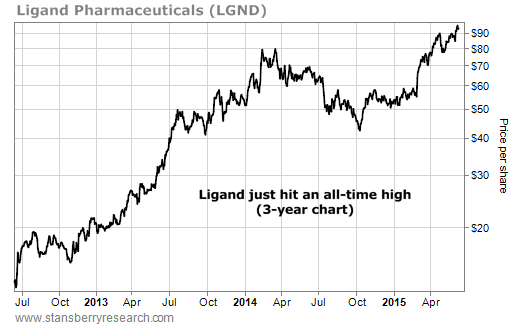
Ligand Pharmaceuticals (LGND) is an unusual company that applied the royalty model to the pharmaceuticals industry. And as you can see from the following chart, it has been successful. Ligand shares just hit a new all-time high this week...
Ligand was previously a recommendation in our exclusive small-cap Phase 1 Investor advisory (now named Stansberry Venture).
Longtime readers may recall Ligand appeared in the new 52-week highs at the bottom of the Digest nearly every day in 2013 and early 2014. In February 2014, subscribers locked in gains of 126% in just eight months.
But what most readers don't know is the driving force behind the recommendation ofthis little-known stock was Paul Mampilly, editor of our new Professional Speculator service.
Paul has been quietly working "behind the scenes" with our company for years... and Ligand is just one of a long list of 100%-plus recommendations we've seen him make. His track record is so impressive that we've been urging him to work for us full time for years. This year, we're thrilled to say he finally agreed.
As we've mentioned before, we're currently offering a special one-time-only charter deal on Paul's new Professional Speculator service...
Today, you can receive Professional Speculator for LIFE – all for just the cost of a normal one-year subscription. Plus, you can try it completely RISK-FREE for the next SIX months.
But please note, this charter offer closes permanently TONIGHT at midnight. Click here to learn more.
New 52-week highs (as of 6/10/15): Dollar General (DG), Euronav (EURN), iShares U.S. Insurance Fund (IAK), PNC Financial Warrants (PNC.WS), and Constellation Brands (STZ).
In the mailbag, a subscriber is concerned about a market top. Send your questions and comments for our analysts to answer to feedback@stansberryresearch.com.
"I read the latest issue of Retirement Millionaire last evening and was a bit taken back by how many Advice changes there were – 16 changes out of 33 listings – 11 downgrades alone. I've been reading Retirement Millionaire for several years now and have never noticed so many advice changes in a single issue. Is this his way of saying the market has topped out?" – Paid-up subscriber Charles Greene
Eifrig comment: We're not in the business of calling market tops. If you want to be a successful investor over the long term, we don't think you should try to call the top, either.
The global economy is strong enough to push stock markets a good deal higher from here. The question is what kind of shake-ups we'll see along the way.
Regardless of what happens, it always makes more sense to buy a stock at $40 than it does to buy it at $50. That's Finance 101. So after reviewing our model portfolio, we changed our ratings on many of our stocks to a "Hold." Don't consider that an act of fear... consider it an act of prudence.
Regards,
Justin Brill
Baltimore, Maryland
June 11, 2015
