

'A dangerous game of chicken'...
'A dangerous game of chicken'... Bond investors could face historic losses... These stocks could soar... The latest from Apple...
 Bond investors could be playing "a dangerous game of chicken" with the Federal Reserve...
The market expects that the Federal Reserve will begin raising short-term interest rates this year. But Bloomberg reports that Wall Street analysts have been quietly lowering their interest-rate forecasts for the rest of the year. From the article...
For all the hand-wringing over the recent selloff that wiped out about $1.2 trillion in value from the global bond market, the fixed-income market's best and brightest have actually taken down their year-end estimates for Treasuries in four of the past five months.
It amounts to a dangerous game of chicken, in which many analysts and investors are betting the Fed won't lift rates too fast because of the damage it may inflict on the economy – even after last week's stronger-than-expected jobs report.
And the stakes have never been higher for holders of debt globally, who are more exposed to the potential for big losses than at any time in history, based on a metric known as duration.
As we've noted, bonds across the world have been falling since April, and if the Fed does raise rates, the selloff is likely to continue. More from Bloomberg...
Since April, yields on U.S. 10-year notes have surged a half-percentage point. The selloff accelerated last week after a report showed wages in May rose by the most since August 2013 as hiring surged, strengthening the Fed's case for higher rates.
Fed Chair Janet Yellen, who said in May that she expects to raise borrowing costs this year if the economy meets her forecasts, also warned yields may soar once that happens.
The data "really confirms what Janet Yellen's been signaling," said Christopher Sullivan, who manages $2.4 billion as chief investment officer at United Nations Federal Credit Union. "Bonds could be in for a further tough go from here."
According to the report, if 10-year Treasury yields rise to just 3% by year-end – about 0.6 percentage points higher than today's 2.4% – investors today stand to lose nearly 4%. This would more than wipe out the "income" these investors receive... even before accounting for inflation.
For comparison, 10-year Treasury yields have risen nearly 0.8 percentage points this year since bottoming in February near 1.65%...
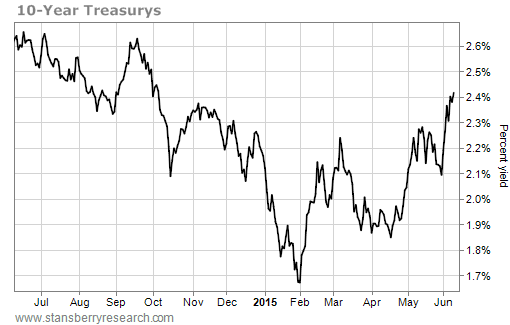
As we just noted, recent commentary from Yellen suggests the Federal Reserve is likely to raise short-term interest rates this year for the first time since 2006.
Regardless of the Fed's decision, we don't recommend owning bonds today... but contrary to popular belief, higher interest rates won't necessarily mean the bull market in stocks will end, too.
Longtime Digest readers know our colleague Steve Sjuggerud's research uncovered a surprising fact: The conventional wisdom on stocks and interest rates is incorrect. As Steve reminded readers in the June issue of True Wealth...
Rising interest rates won't kill the bull market... The Federal Reserve should raise interest rates sometime soon – for the first time in nine years. But keep this in mind: Over the past quarter-century, every time the Fed has been in a rate-raising cycle, stocks have gone up.
If you'd like to read more of Steve's surprising research on stocks and interest rates, be sure to check out this essay from our free DailyWealth e-letter right here.
So while we believe we're in the "final innings" of this bull market in stocks, higher interest rates alone aren't a reason to sell. And for some stocks, higher rates could actually be a reason to buy...
As we noted last week, financial stocks – particularly shares of regional banks – have been quietly leading the market since April. Shares of the SPDR S&P Regional Banking Fund (KRE) are up 7% compared with the S&P 500's flat return over the last two months.
According to financial blogger Josh Brown, shares could be rallying in anticipation of a Fed rate hike...
As of Friday, according to CME Group data, Fed Funds futures are now pricing in a greater than 50% chance of a 25-basis-point rate hike in September. It occurs to me that a long position in the regional banks is one of the primary ways in which investors might be "playing" this increased possibility.
As Brown pointed out, regional banks could be ideally suited to benefit from higher short-term rates...
The inverse correlation between the 10-year and the regional banks is fairly solid over the last year and there's a logical reason for it – something like two-thirds of regional-bank lending occurs at the short-end of the curve. Which means, theoretically, that a rising short-term rate move would lead to positive earnings revisions for these banks.
Brown also noted that unlike shares of major banks, regionals tend not to have significant exposure to the capital markets... meaning lower bond prices won't hurt them as much as they hurt larger banks.
Consumer-products giant Apple (AAPL) kicked off its annual Worldwide Developers Conference yesterday in San Francisco.
As you might have guessed, the conference's first day focused more on software than on launching new products (like the Apple Watch or the iPhone 6). So it didn't come with the same level of anticipation and hype as the announcement of a new Apple product. But there were some interesting items of note...
For one, the company is launching a new service called Apple Music. Apple Music will offer subscription-based plans starting at $10 per month to individuals who want to stream music and could make the company an instant competitor with Pandora and Spotify.
Apple also offered an update on its mobile-payment technology Apple Pay. Nearly 1 million locations are now accepting Apple Pay, and the company is launching the service in London soon.
Perhaps the biggest news of the day came when Senior Vice President of Software Engineering Craig Federighi announced the company is rolling out a new operating system called "El Capitan."
As Federighi previewed some of El Capitan's new features, the one that arguably stuck out the most was the improvement to Apple's "personal assistant," Siri. If you've picked up an Apple product in the last few years, you've probably seen some of Siri's bells and whistles. It can help you find movie times, restaurant reservations, call a taxi, look up the weather in your area, and much more.
In El Capitan, Siri is being renamed "Proactive Assistant" – and it's getting a serious upgrade. From the New York Times...
The new iOS, Mr. Federighi said, will learn your musical tastes and suggest songs to you. It will learn your calendar and tell you when to leave.
It will also look in your e-mail to figure out whether you know a random number calling you. The phone will also offer suggestions for people, places, and apps in its search bar. There is also a way for developers to plug into the search system, allowing the phone to search within apps.
That sounds a lot like what our colleague Paul Mampilly described in the May 26 Digest...
Imagine walking into a restaurant and the waiter already knows what you're going to order. Walking into a Starbucks and your pumpkin-spice latte is waiting for you already. Shopping for a new pair of pants online and the website shows you only the items in your size with the colors and styles you like.
The world I'm describing is custom-made for you. And it isn't science fiction. It's an emerging trend called "Big Data," which allows for the storage of incredible amounts of data on computers... like what songs you're listening to, what stores you shop in, and more.
Over time, this huge amount of data can accurately predict behavior in things like what consumers are interested in buying. And when you can predict these things, you can anticipate their needs before they even know them.
Here's how it works: Information scientists create programs and algorithms to crawl through data around the clock with the intention of figuring out your preferences. Over time – and with more data – these programs and algorithms learn more about you and what you like. One day soon, you'll be able to automate your decisions... including what to eat and drink, what clothes to wear, and what you'll do on the weekend.
Regular readers know several Stansberry Research analysts are bullish on Apple. Extreme Value subscribers are up 110% since editor Dan Ferris recommended shares in June 2013, and the company is currently rated a "buy" in the Stansberry's Investment Advisory portfolio and a "strong buy" in Dr. David "Doc" Eifrig's Retirement Millionaire portfolio.
While futuristic products like the Apple Watch and "Proactive Assistant" tend to grab the headlines, both Doc and Porter's team believe Apple Pay is the most important story for investors today.
Doc put together a special report explaining all the details of mobile-payments technology and the companies – in addition to Apple – that are leading its development. His presentation is free, and it's a must-watch... especially if you're an Apple shareholder. You can watch it by clicking here.
New 52-week highs (as of 6/8/15): Deutsche X-trackers Harvest China A-Shares Fund (ASHR) and Euronav (EURN).
It was a light day for the mailbag. Do you have a question you'd like to ask Dan Ferris, Doc Eifrig, Matt Badiali, or any of our other analysts at Stansberry Research? Send them to feedback@stansberryresearch.com. But please note that we cannot answer individual investment advice.
Regards,
Justin Brill
Baltimore, Maryland
June 9, 2015
