

A New Warning From the Bond Market
A new warning from the bond market... Is the 'Trump Trade' in danger again?... Highlights from Warren Buffett's 2017 shareholder letter... Three classic lessons from Uncle Warren... Buffett's thoughts on airlines and Apple... Why we don't recommend buying more Apple today...
 Stocks and bond yields are diverging again...
As regular Digest readers know, the post-election rally – or "Trump Trade" – was largely defined by a rally in U.S. stocks, rising long-term interest rates, and falling government bond prices. (Remember, interest rates and bond prices move inversely.)
This trade stalled for a short time in late December and January before resuming...
Since then, stocks have continued their rally. The Dow Jones Industrial Average has closed at a new all-time high for 11 straight trading days... a feat that has only been bested two times since 1900...

But interest rates haven't followed this time. Instead, after initially rallying in January, they've been slowly trending lower. In fact, the yield on the benchmark 10-year Treasury note just fell to a new post-election low of 2.317% on Friday...

What should we make of this divergence?
It could be a sign that the Trump Trade is weakening, and the risk of a correction is rising. As the Wall Street Journal reported this morning...
Stocks and bonds are again moving in tandem after diverging in recent months – a sign some investors may be losing faith in the reflation trade...
It is a shift from late last year when investors were selling bonds and buying stocks, anticipating that large fiscal stimulus from President Donald Trump would lead to accelerated growth and higher inflation, a bet known as the reflation trade...
Some money managers and traders believe that a rising Treasury bond market, often seen as a haven for investors, is a warning that valuations of riskier assets – such as stocks, corporate bonds and emerging-market assets – may be stretched.
President Trump is scheduled to speak to a joint session of Congress tomorrow, and he is expected to give an update on his "big three" proposals – tax reform, regulatory reform, and infrastructure spending – among others. What he says (or doesn't say) could carry even more weight than usual.
Warren Buffett released his latest annual letter for Berkshire Hathaway shareholders over the weekend...
As always, it contained several invaluable insights and lessons from the legendary investor, and we'll highlight a few of these below...
First, Buffett shared his thoughts on corporate share repurchases...
And they should sound familiar to longtime Digest readers...
Buffett explained that while discussions about share repurchases (or "buybacks") often become "heated," judging whether they're beneficial for shareholders in any particular situation is actually simple. Here's an excerpt from the letter (emphasis added)...
From the standpoint of exiting shareholders, repurchases are always a plus. Though the day-to-day impact of these purchases is usually minuscule, it's always better for a seller to have an additional buyer in the market.
For continuing shareholders, however, repurchases only make sense if the shares are bought at a price below intrinsic value. When that rule is followed, the remaining shares experience an immediate gain in intrinsic value. Consider a simple analogy: If there are three equal partners in a business worth $3,000 and one is bought out by the partnership for $900, each of the remaining partners realizes an immediate gain of $50. If the exiting partner is paid $1,100, however, the continuing partners each suffer a loss of $50. The same math applies with corporations and their shareholders. Ergo, the question of whether a repurchase action is value-enhancing or value-destroying for continuing shareholders is entirely purchase-price dependent.
It is puzzling, therefore, that corporate repurchase announcements almost never refer to a price above which repurchases will be eschewed. That certainly wouldn't be the case if a management was buying an outside business. There, price would always factor into a buy-or-pass decision.
When CEOs or boards are buying a small part of their own company, though, they all too often seem oblivious to price. Would they behave similarly if they were managing a private company with just a few owners and were evaluating the wisdom of buying out one of them? Of course not...
My suggestion: Before even discussing repurchases, a CEO and his or her Board should stand, join hands and in unison declare, "What is smart at one price is stupid at another."
Later, Buffett warned against the growing use of "adjusted earnings" to manipulate corporate performance...
Here, too, Buffett's warnings should sound familiar... We've discussed how 90% of companies in the S&P 500 now also report earnings that are not based on traditional "GAAP" accounting rules. This is up from 72% of companies in 2009. And Buffett believes this trend is bad for shareholders and management teams alike. More from his letter...
Too many managements – and the number seems to grow every year – are looking for any means to report, and indeed feature, "adjusted earnings" that are higher than their company's GAAP earnings. There are many ways for practitioners to perform this legerdemain. Two of their favorites are the omission of "restructuring costs" and "stock-based compensation" as expenses.
Charlie [Munger] and I want managements, in their commentary, to describe unusual items – good or bad – that affect the GAAP numbers. After all, the reason we look at these numbers of the past is to make estimates of the future. But a management that regularly attempts to wave away very real costs by highlighting "adjusted per-share earnings" makes us nervous. That's because bad behavior is contagious: CEOs who overtly look for ways to report high numbers tend to foster a culture in which subordinates strive to be "helpful" as well. Goals like that can lead, for example, to insurers underestimating their loss reserves, a practice that has destroyed many industry participants.
Charlie and I cringe when we hear analysts talk admiringly about managements who always "make the numbers." In truth, business is too unpredictable for the numbers always to be met. Inevitably, surprises occur. When they do, a CEO whose focus is centered on Wall Street will be tempted to make up the numbers.
He also railed against the excessive fees charged by Wall Street brokers, hedge funds, and the like...
Buffett went so far as to say that even the wealthiest investors would be better off investing in low-cost index funds rather than giving their money to high-cost advisors...
The bottom line: When trillions of dollars are managed by Wall Streeters charging high fees, it will usually be the managers who reap outsized profits, not the clients. Both large and small investors should stick with low-cost index funds.
Of course, we fully agree with Buffett's criticisms of high-cost managers. But we also know individual investors can do far better than the market with just a little effort... and without taking excessive risks or paying high fees to managers to do it.
How do we know? Because each of our $199/year "entry level" investment services – Porter's Stansberry's Investment Advisory, Steve Sjuggerud's True Wealth, and Dr. David "Doc" Eifrig's Retirement Millionaire – have earned market-beating, double-digit returns over the past 10 years. And we believe our new Stansberry Portfolio Solutions product will make even better returns available to virtually any investor.
We also note that Buffett himself doesn't follow this advice. He and Berkshire own – and continue to buy – large positions in individual equities. (More on that below.)
Finally, Buffett reminded investors of the importance of being a contrarian...
He reiterated the idea behind one of his best known and most important axioms: "Be greedy when others are fearful"...
The years ahead will occasionally deliver major market declines – even panics – that will affect virtually all stocks. No one can tell you when these traumas will occur – not me, not Charlie, not economists, not the media. Meg McConnell of the New York Fed aptly described the reality of panics: "We spend a lot of time looking for systemic risk; in truth, however, it tends to find us."
During such scary periods, you should never forget two things: First, widespread fear is your friend as an investor, because it serves up bargain purchases. Second, personal fear is your enemy. It will also be unwarranted. Investors who avoid high and unnecessary costs and simply sit for an extended period with a collection of large, conservatively-financed American businesses will almost certainly do well.
He also admitted that while he expects Berkshire Hathaway to be among those that do well, its large size means it's unlikely to do as well in the future as it has in the past...
As for Berkshire, our size precludes a brilliant result: Prospective returns fall as assets increase. Nonetheless, Berkshire's collection of good businesses, along with the company's impregnable financial strength and owner-oriented culture, should deliver decent results. We won't be satisfied with less.
This, too, should sound familiar to regular readers...
As Porter explained in the February 10 Digest, Buffett himself has said he could earn upwards of 50% annually if he managed less money and were able to buy high-quality, small-cap businesses.
And it's why we're thrilled about the launch of our new Stansberry Venture Value service, dedicated to finding small, capital-efficient stocks capable of growing revenues rapidly for years. We believe Venture Value subscribers could see total long-term returns of 1,000% or more in safe, "plain vanilla" stocks.
[Editor's note: As we noted on Friday, Stansberry Venture Value will be closing to new subscribers tomorrow, Tuesday, February 28 at midnight. If you're interested in learning more, we must hear from you soon. Click here for all the details on our special charter offer. You can also give us a call tomorrow at (800) 758-0689 between the hours of 10 a.m. and 4 p.m. Eastern time, and our Member Services team would be happy to answer any questions you may have.]
Buffett appeared on financial-news network CNBC this morning to talk about the markets...
He said U.S. stocks prices are still "on the cheap side" with interest rates at current levels, though he did admit that stocks could quickly become expensive if rates spiked higher. "If interest rates were 7% or 8%, then these [stock] prices would look exceptionally high," he said.
Clearly, Buffett isn't particularly worried about that right now... He said he has invested $20 billion in U.S. stocks since the November election.
When asked why he had reversed his long-held bearish stance on airlines, Buffett simply said that he was hopeful the industry's "bad century" was behind it...
As he told CNBC's "Squawk Box" this morning...
It's true that the airlines had a bad 20th century. They're like the Chicago Cubs. And they got that bad century out of the way, I hope... The hope is they will keep orders in reasonable relationship to potential demand.
Buffett also said his firm had doubled its stake in Apple (AAPL) again in January...
Regular readers know Berkshire already reported it had doubled its position in the consumer-electronics giant prior to December 31. Berkshire now owns $17 billion worth of Apple stock – 2.5% of shares outstanding – making it the company's second-largest holding behind beverage giant Coca-Cola (KO).
When asked why, he said, "Because I liked it!" As CNBC reported...
"Apple strikes me as having quite a sticky product, and an enormously useful product to people that use it," Buffett told CNBC.
The Berkshire Hathaway chairman and CEO said that late investor Philip Fisher's 1958 book "Common Stocks and Uncommon Profits" inspired him to research how consumers feel about Apple products.
"He talks about something called the 'scuttlebutt method,' which made a big impression on me at the time, and I used it a lot," Buffett said. "[It's] essentially going out and finding out as much as you can about how people feel about the products that they [use.]"
And, while the results were favorable enough for Buffett to greatly up his stake in Apple, "I don't have an iPhone," the investor said. "I have an iPad. Somebody gave it to me though."
Speaking of Apple, not everyone is as bullish as Buffett is today...
In this morning's edition of our free DailyWealth e-letter, our colleague Brett Eversole explained why the rally in Apple has likely gone "too far, too fast." He noted Apple shares recently hit their most overbought level in history... which means we could see double-digit losses over the next year...
We always like to buy ignored investments... things no one else is interested in owning. Instead of following the hot trends, we make contrarian bets. That's how we pocket our largest gains. Buying Apple is not a contrarian bet right now... It's the exact opposite.
Apple is currently at an extremely overbought level based on its relative strength index (RSI). The RSI is a measure of a stock's recent gains and losses. It tells us when a stock is overbought or oversold. Oversold stocks tend to rally... And overbought stocks tend to correct.
An RSI reading of 70 or higher means a correction is likely. And the recent rally in Apple has moved its RSI to crazy levels. Take a look...
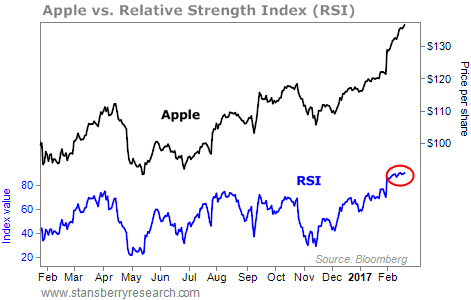
As Brett explained, the recent rally to new highs has pushed Apple's RSI to 90. This is the most extreme reading in Apple's history, and it's a big warning sign for investors...
You don't become the world's largest company without massive stock market gains. Over the past 10 years, Apple's shares have typically gained 6.1% over three months and 26.9% annually.
With numbers like these, it would have been hard to lose money investing in Apple over the last 10 years... But buying its shares at a high RSI level would have been a good way to do it...
Over the past decade, similar overbought RSI levels led to small, 1.2% gains in three months... and 10.2% losses over the next year. That's nearly a 37-percentage-point underperformance compared with Apple's typical annual return!
I'm not telling you to short Apple. And I'm not saying its business is in trouble. But Apple's RSI tells us the market has moved too far, too fast. And history says losses of 10% over the next year are a likely result. That makes Apple a company to avoid until that changes.
New 52-week highs (as of 2/24/17): AmerisourceBergen (ABC), Axis Capital (AXS), Boeing (BA), Becton Dickinson (BDX), Berkshire Hathaway (BRK-B), C.H. Robinson Worldwide (CHRW), Cisco Systems (CSCO), iShares Select Dividend Fund (DVY), Cedar Fair (FUN), Huntington Ingalls Industries (HII), PureFunds ISE Mobile Payments Fund (IPAY), Laboratory Corporation of America (LH), 3M (MMM), Monsanto (MON), AllianzGI Equity & Convertible Income Fund (NIE), and Stanley Black & Decker (SWK).
In today's mailbag, more kudos for the Stansberry Newswire... and another subscriber weighs in on the latest from P.J. O'Rourke. Send your questions and comments to feedback@stansberryresearch.com.
"I really like the summaries in the am and pm. This is short and to the point. A nice addition to the material you provide." – Paid-up Stansberry Alliance member Jim M.
"Bradley Stone is drinking the Kool Aid from left wing media. He obviously used their talking points rather than listening to the actual words coming from Trump's mouth. Never once did Trump use the word terrorism and Sweden. He has said, 'Look at what's happening is Sweden.' While I didn't vote for President, I get a kick chuckle at uninformed people are who regurgitate talking points from manipulative media (I won't call them fake news, biased for sure.) Always best to stick with facts and believe nothing unless you see it yourself." – Paid-up subscriber Dave D.
Regards,
Justin Brill
Baltimore, Maryland
February 27, 2017