
A potential global crisis... The U.S. consumer is showing signs of life... Buying boats, clothes, and car parts... The world is drinking more beer... Russia's dour outlook... Things are looking similar to the 1998 Russian crisis... Why your 401(k) could be at risk...
 There's a potential global crisis lurking right now. We could soon see a wave of debt defaults that would cripple everything from large European banks to anyone with a 401(k). And one of the world's foremost experts on the topic says we're nearing the boiling point.
But before we get to the doom and gloom, we'll share some positives in the U.S. economy today...
The U.S. consumer is alive and well. Lower oil prices have been a boon to the average consumer. As we pointed out yesterday, gas prices are near record lows in terms of wages and fuel economy. And folks are hopping in their SUVs and buying, well... everything.
Just look at stocks hitting 52-week highs for proof...
Retailers Target, Wal-Mart, Macy's, Bed Bath & Beyond, Lowe's, and Home Depot... restaurant chains Domino's Pizza and Cheesecake Factory... cruise lines Carnival and Royal Caribbean... plus, Kroger (groceries), Advanced Auto Parts (auto part store), and Brunswick (boats).
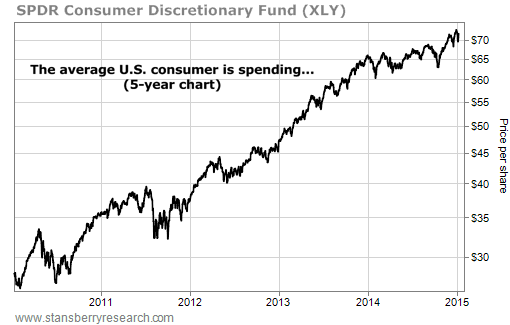
Take a look at this five-year chart of the SPDR Consumer Discretionary Fund (XLY), which holds a basket of companies like Home Depot, McDonald's, Nike, and Starbucks. As you can see, people are shopping...
 People are also drinking more beer...
As Stansberry Research Editor in Chief Brian Hunt has often written, it's unlikely that having a beer after work will become obsolete. People will drink during both good times and bad.
And we're seeing that thesis play out with Extreme Value recommendation Constellation Brands (STZ). The alcohol giant is the third-largest beer supplier in the U.S., with brands like Corona, Modelo, and Pacifico beers. It also owns Robert Mondavi wine and Svedka vodka.
Today, shares popped higher after the company reported impressive third-quarter results.
Net sales grew 7% compared with the third quarter of 2013. Constellation's beer segment grew 16% over the same period, more than making up for flat sales in wine and liquor. President and CEO Rob Sands noted that the impressive performance led the company to revise its outlook, from $4.10-$4.25 earnings per share to $4.25-$4.35.
The company recently closed on a deal to acquire 100% of Crown Imports, the nation's largest beer importer. As Extreme Value editor Dan Ferris explained in the July 2 Digest...
|
Shares rose as much as 6% on the news. As of midday trading, Dan's subscribers were up more than 400% since June 2011.
It has been a while since we've heard from Global Contrarian editor Kim Iskyan. Today, he shares the latest going on with Russia's economy...
|
Around one-quarter of Russia's economic output is connected to the energy sector. So the 56% decline in the price of Brent oil (the international benchmark) in recent months has hurt the economy.
Sanctions imposed by the U.S. and the European Union on Russia over the conflict in Ukraine have also squeezed Russia's economy. And the perception of higher political risk in Russia is discouraging investment. And the worsening situation is causing people to lose what little faith they had in Russia. More from Kim...
|
As Kim explained, it's normally a big deal to cut a country's sovereign credit rating... especially when it's going from investment grade to junk...
|
The big question on everyone's mind is whether Russia will default like it did in 1998.
Financial expert Jim Rickards thinks so. He has seen this situation before. In fact, he was responsible for negotiating the bailout of Long Term Capital Management (LTCM) – a hugely leveraged hedge fund that collapsed in the midst of the Russian crisis – as the firm's general counsel.
Because LTCM had so much exposure to derivatives, it was viewed as a systemic risk. So Jim sat down with 14 of the world's biggest banks (like JPMorgan, Merrill Lynch, and Goldman Sachs) to arrange a $3.6 billion bailout for the hedge fund. The Federal Reserve supervised the entire deal.
Jim recently sent us an e-mail expressing his concerns over the current situation in Russia... and the similarities between what's happening today versus the late '90s.
In short, he thinks we'll see contagion. He's not worried about a sovereign default, because Russia has enough money to cover its dollar-denominated sovereign debt. But he says Russian corporations only have enough money to pay their debt until the end of this year.
Meanwhile, the largest European banks and emerging-market funds all hold loads of Russian corporate debt. So if you're invested in mutual funds or have a 401(k), your assets could be at risk. But when the banks start writing down the value of that debt, the problem will magnify.
Jim also noted that the Russian crisis actually started in Thailand, then spread to Indonesia and Korea before striking in Russia. LTCM's collapse took more than a year to play out. He thinks we're facing a similar timeline today.
But Jim isn't the only one who thinks we could see a replay of 1998. David Tepper, one of the wealthiest hedge-fund managers in the world, recently told CNBC, "This year rhymes with 1998. Russia goes bad. Easing [is] coming from Europe. Sets up 1999... I mean 2015."
Tepper wasn't calling the top. He was just warning people that things look similar to the Russian crisis... and that we should be prepared.
Luckily, Jim wrote the most important book out there for this kind of economic calamity. It's called The Death of Money. It's a must-read for anyone concerned about what's happening in the economy today – or who wants a better understanding of government currency manipulation and the potential outcomes.
Plus, Jim agreed to write an exclusive bonus chapter for Stansberry Research subscribers. In it, he explains his favorite assets to own during a crisis. This is something you won't find anywhere else.
We think Jim's book is so important, we've arranged for Stansberry Research subscribers to get a free copy. We just ask you pay the $4.95 in shipping and handling. You can learn the full details right here.
New 52-week highs (as of 1/7/15): Deutsche X-trackers Harvest China A-Shares Fund (ASHR), Becton Dickinson (BDX), Cempra (CEMP), Esperion Therapeutics (ESPR), Invesco Value Municipal Income Fund (IIM), Nuveen AMT-Free Municipal Income Fund (NEA), Nuveen Municipal Opportunity Fund (NIO), Nuveen Municipal Value Fund (NUV), Constellation Brands (STZ), Target (TGT), and Wal-Mart (WMT).
In today's mailbag, one of the most frequent questions we receive: Porter's bearish argument versus Steve Sjuggerud's bullish argument. Send your thoughts on today's market action, 2014 in review, or anything else that's on your mind to feedback@stansberryresearch.com.
"Good afternoon, I've not been a subscriber for very long but have already gained a lot of respect for your whole talented group. The problem I'm having is the extreme disparity between Porter's 2015 kickoff piece on a market meltdown this year and Steve's rather more bullish view over the next year at least – although he does feel we are in the later innings. Help." – Paid-up subscriber Stan Dahle
Goldsmith comment: We get this question a lot. The abbreviated answer is that both Steve and Porter agree that the eventual outcome is inevitable. They just share a different time frame. We dedicated an entire Digest to the topic on it, which you can read right here.
Regards,
Sean Goldsmith
Baltimore, Maryland
January 8, 2015
