

A Trail of 'Wealth Gap' Inspired Destruction (and Hope)
Much more on the GameStop 'short squeeze'... This doesn't happen in a 'fearful' market... A trail of 'wealth gap' inspired destruction (and hope)... The 'how' is less important than the 'why'... 'Today will be the top'... Takeaways from all of this...
 We still have our eyes on the 'GameStop story' that we wrote about yesterday...
Because, in brief, "the rise of the short squeezes" against a few Wall Street hedge funds' most heavily shorted companies, and the world's most left-for-dead companies, is telling us that the market is as euphoric – or at least as "nutty" – today as it was a few days ago.
Maybe a little more...
This morning, again propelled higher by an army of risk-taking day traders, shares of video-game retailer GameStop (GME) jumped roughly 100% on the open... a line we never thought we'd write... throwing salt in the wounds of anyone still short the stock.
About two dozen nostalgia stocks experienced similar unexpected gains – like retailers Bed Bath & Beyond (BBBY), Express (EXPR), and Macy's (M), as well as rental-car company Hertz Global (HTZGQ) and other names that most folks haven't considered buying in ages.
At least hundreds of users on the popular "WallStreetBets" section of message-board website Reddit – many of them Millennials who have discovered stocks for the first time in recent months, or maybe even weeks – are behind the frenzy.
It's such a euphoric digital grassroots craze that some people are even buying the wrong stocks because they're so trigger-happy...
That happened today with some folks who were looking to bid up overleveraged movie-theater chain AMC Entertainment (AMC), which shot up roughly 300% today. However, some misguided would-be corporate raiders confused it with the similarly named and debt-ridden television entity AMC Networks (AMCX), inadvertently boosting those shares on the open, too... However, by the end of the day, AMCX had plunged down about 20%.
That detail reminds us of when current world-darling Zoom Video Communications (ZM) went public in April 2019... A lot of investors instead bought the wrong stock, Chinese-based Zoom Technologies (ZOOM), because of the similar name and ticker.
Ah, April 2019... back when the record-long bull market was still shooting higher. It was similar to the end of 2019, when the WallStreetBets board was last in the spotlight, as we mentioned yesterday via our colleague Jeff Havenstein's Digest from back then.
Then, of course, 2020 happened...
Today, this Reddit crowd has even latched on to remnants of the once-proud but bankrupt movie-rental chain Blockbuster... The penny stock of BB Liquidating has surged nearly 1,000% over the past two trading days, even though only one Blockbuster location remains (in Bend, Oregon).
The point is, this is not the sort of stuff that happens in a 'fearful' or boring, ho-hum market...
No, it happens when folks all over are frothing at the mouth and don't even take the time to make sure they're buying the right stock. They're all looking to make a little extra money – or a lot extra, in some cases.
People hear about what's happening – or in this case, they read about it on an online message board. They see winning screenshots of trades with huge returns, much like you might see a picture of a lottery winner holding an oversized check with all the zeros on TV or in the newspaper. Buying begets more buying... The stories get passed around.
Before you know it, it's a bubble... (And they all pop eventually.)
To be clear, the "greed" that I (Corey McLaughlin) mentioned in yesterday's Digest goes for everybody involved here, as a few readers correctly pointed out in response (which you'll see in our mailbag today).
The hedge funds that the folks on WallStreetBets targeted were also greedy, combining by the end of 2020 to short more shares (71 million) of GameStop than actually existed (50 million)... And then, they proverbially fell asleep at their monitors.
These bullish bets – call options at large scale that pushed prices higher and higher – were telegraphed in public by amateurs (some more sophisticated than others) on the Internet... And yet, the pros didn't budge until it was too late to not lose money.
And while we don't know their full backgrounds or any of them personally, the individual traders who have piled in – judging from their very visible online comments – sound almost like a digital mob, simply looking to gang up on Wall Street greed, real or perceived.
Many of these folks don't even know the details of the options instruments they're using, but they know what they want... They want to pay off student-loan debt, to get some kind of break, or to take advantage of a "system" they feel has taken advantage of them.
We see a "bubble," but it's even more than that. This brings up a big point we haven't seen discussed much around this "short squeeze" story...
The 'how' here is less important than the 'why'...
The Reddit user who apparently kicked off this whole plot to push up GameStop's share price with a post four months ago, quoted another user, "dlkdev," in the initial missive, as if he was a martyr...
The only way to beat a rigged game is to rig it even harder.
That is the sentiment that has led to this entire story. And we can see why...
We've said it before...
Whether anyone knows it or believes it, the Federal Reserve and other policymakers have set the table for all of this, with decades of cheap-dollar policies that have made the poor poorer, through a less valuable U.S. dollar amid largely stagnant wages.
Meanwhile, the rich have gotten relatively richer.
Monetary policy, while not sexy to most of Main Street and difficult to explain, has all kinds of implications and a track record of results... It goes way beyond the scope of one Digest, and frankly, many of our editors can explain all the finer details better than I can anyway.
But the biggest consequence might be the large "wealth gap" in this country – from the 1% to everyone else, and then, from the top 30% to the bottom 70%. And a step beyond that, the perception of these divides, which might be as influential as the reality...
It has all fueled angst and distrust among more and more people over more and more years. Today, we're again seeing the influence and the wealth divide's growth as we (hopefully) edge closer to the end of the COVID-19 pandemic.
Remember all those predictions about what shaped-letter recovery we would see from the pandemic?
We looked at the possibility of a U- or V-shaped recovery back in May 2020. Well, across the globe, the winner looks like a "K-shaped" recovery...
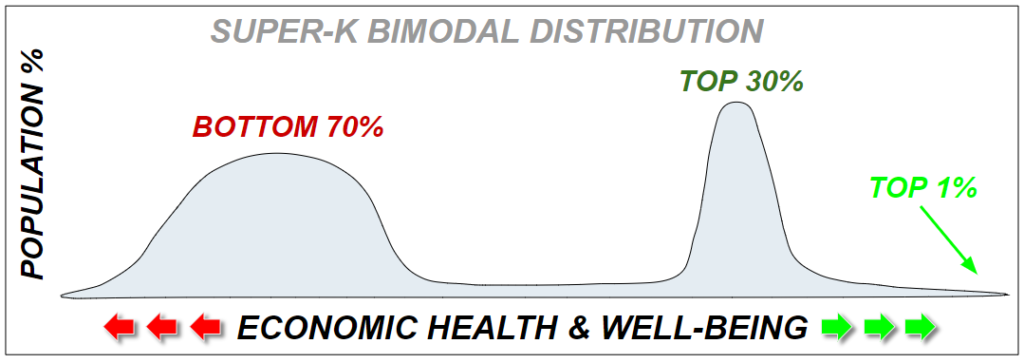
The credit for this label is being given to Peter Atwater, an adjunct professor at the College of William & Mary, who said well-off people's fortunes are going up... and everyone else's are going down. And Justice Clark Litle, the chief research officer at our corporate affiliate TradeSmith, shared this chart in his daily newsletter last Thursday. He called it a "Super-K recovery"...
... The basic idea, as the graphic above shows, is that the top 30% of the U.S. economy is having a very different pandemic experience than the bottom 70%. Their sense of economic health and well-being is high, and for the top 1%, it is off the charts.
For the bottom 70% of the U.S. economy, meanwhile, the experience has been horrible – and for tens of millions of Americans, the "New Great Depression" experience is all too real.
It sure looks that way...
Since the pandemic began, the number of people living in poverty worldwide has doubled to more than 500 million, according to a new report from the anti-poverty group Oxfam.
Meanwhile, according to the report, the collective wealth of all U.S. billionaires has increased more than $1.1 trillion since mid-March 2020, a nearly 40% leap during the past 10 months.
And in the middle, employment numbers are telling a similar story about the divide between the remote economy and the in-person economy, with those in the latter suffering more.
And we're seeing an environment of low interest rates and cheap dollars promised for years into the future by the Fed, which has pushed more people into the stock market – consciously or subconsciously – and prices higher and higher...
What's the solution, at least economically, as far as central banks and governments are concerned? More "free money"... which, in the long run, just keeps the cycle going whether anyone knows it or not in the short term.
In a way, the WallStreetBets traders are simply leaving behind a trail of 'wealth gap' inspired destruction...
Don't get me wrong, the folks who engineered these short squeezes have Internet connections and the ability to trade stocks to begin with... That's more than some people.
But hear me out...
Last year, Millennials became the generation with the most living U.S. adults, surpassing Baby Boomers. That means their desires and behaviors are going to start making their way more and more into daily life... They're starting to make more money and buy homes, for example.
In the bigger picture, this may be a moment that puts more people onto the idea that no-fee digital brokerages like Robinhood are where a new generation of largely Millennial investors are accessing stocks and getting their trading feet wet... And as the country's largest generation, they're there in large enough numbers to influence Wall Street.
And if we know Millennials, we know that...
- A lot of them who are at least poking around the stock market on the Internet and their smartphones probably went to college and have a lot of debt,
- They're largely disillusioned with capitalism and mostly everything else in the world, and
- They're addicted to their smartphones, where they can trade in an instant, send and receive information freely, and really "gang up" on a stock – push it up or down – in a few minutes before the mainstream investing crowd notices.
It's sort of like a group of community-based activist investors.
Now, done effectively, you could do a lot by being part of this relatively small, contrarian mob – powered by one or two stimulus checks, or maybe a growing income from a work-at-home job. That is, as long as your "enemy" is not paying attention at all, as was the case here.
One WallStreetBets user posted last weekend... "I love you guys," along with a screenshot of a final student-loan payment of more than $20,000, made with the profits from buying calls on GameStop. In the comments section of the post, the user said... "[I never] thought I would have this paid off so soon."

(Screenshot: Reddit via Yahoo Finance)
The end result of all this may be another goal of at least some of the Redditors... to perhaps save these companies from their childhoods from going bankrupt, or at least delay their inevitable demises. (That is sort of perverse in its own way, when you think about how these companies were managed into their overleveraged positions to begin with.)
Because GameStop's stock has surged so high – up roughly 1,900% year to date – and it now has a market cap of $24 billion, the company could sell just some of its own shares to help with its balance sheet at this point.
It would be dumping someone else's pump of its own stock and surviving another day.
Anyway, the point is, this stuff didn't just happen overnight, as much as it would appear that way...
A group of the 50 most-shorted companies on the Russell 3000 Index had risen 33% this year, as of yesterday's close.
Hertz was bid up last year by folks from this same message board... Tesla (TSLA), too, which is why its CEO Elon Musk has, in his own way on Twitter, voiced support for this whole episode.
The above user who paid off the student loans – a 28-year-old American with a bachelor's degree in graphic design – said they started paying attention to GameStop back in November. They bought call options weekly before making about $80,000 last week.
But only now have the two hedge funds we mentioned specifically yesterday – Melvin Capital and Citron Capital – completely closed out of their short positions on GameStop. Andrew Left of Citron, who we quoted yesterday, said in a YouTube video today that his firm covered the majority of its short bets at "a loss of 100%."
And our Director of Research Austin Root suspects many more hedge funds may be feeling the pain, too...
Today, Austin ran a screen that looked at U.S.-traded companies in the same ballpark as GameStop. His screen included companies with short interest as a percentage of float (available shares) greater than 15%... total debt as a percentage of total assets greater than 30%... and market caps between $50 million and $25 billion.
Here's what Austin found...
On a day when the S&P 500 Index was down 2.6%, this cohort of about 150 companies was UP 7.2%. And for the year, the S&P 500 is now flat, while this group is UP 49%.
There have to be loads of hedge funds getting killed here, well beyond Melvin Capital and Citron.
If you're not directly involved – though in some way, everyone invested in the market ultimately is – it has been entertaining to watch everything unfold. But entertainment like this is a hallmark of a market in "euphoria" mode... And it can be dangerous if you're not aware of it.
The fun might be close to ending...
That's especially true now that the targets are out and this whole thing has been more widely documented. We suspect hedge funds with short positions are holding their breath now, or at least asking junior analysts to take a look at WallStreetBets more frequently.
Whitney Tilson, the founder of our corporate affiliate Empire Financial Research, has been noted for several high-profile short sales during his career. He said in his free e-letter earlier today that he believes "today will be the top" of the "short squeeze bubble."
He has created an Excel spreadsheet with all of the stock names involved and says...
I think these 25 stocks (including GameStop) are highly likely to underperform going forward.
As has been a theme of late here, though – with stock valuations across the board, and with life in general, as our colleague Dan Ferris pointed out eloquently in last Friday's Digest – things can always get crazier than people can imagine.
Whatever happens, don't make it easy for yourself to get caught up in the madness...
Stansberry NewsWire editor C. Scott Garliss, who spent 20 years on Wall Street before joining Stansberry Research, wrote about this whole episode today. He provided insight from the view of the institutional investors who suffered massive losses...
What's going on with Melvin, and likely many other hedge funds, highlights an interesting situation within that group of investors...
Many of them use leverage to produce returns. Three to five times leverage on your book is a common practice. In other words, you may manage $100 million, but you invest more along the lines of $300 million to $500 million. I know clients who have dialed up to seven times leverage in the past.
But here's the thing... When you're that dialed up, your trigger finger to reduce exposure has to be a lot quicker. And if yours isn't, the trigger finger of the guy extending you that leverage, your prime broker, is.
For more details, we encourage you to check out Scott's essay. But for now, just know that being slow on the trigger to protect yourself can lead to a cascade of money-losing consequences for folks like these hedge funds. Today, Scott says...
It may also be in the best interest of any fund managers short stocks to preemptively unwind positions in case a similar scenario plays out in other names. Being proactive instead of reactive is always a good way to protect assets.
That's timeless advice that individual investors would be wise to heed today, too...
Have a plan, and if you're going to change it, make sure as best you can that you're doing it for a logical reason that aligns with your goals and what you want from your investments to begin with. As Scott wrote today...
It's a stark reminder of why we need to be disciplined as investors. Have conviction in the names you're investing in. Have a thesis behind that decision. And above all, use trailing stops to take emotion out of the situation and protect against big losses.
In my perfect world, all of these new investors making fast money today will come across our long-term advice and be investors over the long haul. And in the process, they'll realize that capitalism shouldn't be "canceled"...
They'll see that the very platforms, smartphones, and computers they're trading from – and the Internet connections they're using – are a result of it.
They'll see that the start of financial freedom really comes down to saving more than you spend and investing the rest in regular intervals. Of course, most people are never taught those basics in school... and need to figure it out for themselves.
I'm not naïve... I know that if these lessons ever hit the bulk of what is now America's largest generation, it will take time – and a lot of pain. By pain, I mean the type that WallStreetBets users are inflicting on short sellers today... as well as the type that a 20% stock market correction would inflict on those same folks who have "taken up" GameStop and other left-for-dead stocks.
In the end, this "short squeeze bubble" might be a relatively isolated story in the grander scheme of the market. But if history is any indicator, it might very well portend the popping of a bigger, more spectacular bubble when most investors – especially a flurry of new, inexperienced, greedy, and aggressive ones – least expect it.
Once again, we're in what True Wealth editor Dr. Steve Sjuggerud calls the "Melt Up." We're seeing things we haven't seen since the late 1990s and the dot-com bubble.
In other words, start preparing now for the "Melt Down."
New 52-week highs (as of 1/26/21): Apple (AAPL), First Majestic Silver (AG), Autohome (ATHM), Booz Allen Hamilton (BAH), Brunswick (BC), Baozun (BZUN), Cerner (CERN), CoreSite Realty (COR), CommVault Systems (CVLT), Futu Holdings (FUTU), Alphabet (GOOGL), Harrow Health (HROW), Innovative Industrial Properties (IIPR), Microsoft (MSFT), NVR (NVR), OptimizeRx (OPRX), ResMed (RMD), ProShares Ultra Technology Fund (ROM), Silvergate Capital (SI), First Trust Cloud Computing Fund (SKYY), TFI International (TFII), and Vir Biotechnology (VIR).
In today's mailbag, thoughts on yesterday's Digest about the GameStop saga as a sign of market euphoria... more feedback on Dan's Friday Digest... and kudos for our "2021 preview" event last night. What's on your mind? Tell us at feedback@stansberryresearch.com.
"I am writing to comment on [yesterday's] Digest. If we talk market euphoria, I think the only reason there is market euphoria with GME is because a hedge fund, Melvin Capital, got greedy. They rode GameStop down to $3.00 a share but yet they didn't cover their short position. Who is greedy here?
"Sounds like Melvin Capital was being a pig at the trough. I've heard that bulls make money, bears make money but pigs get slaughtered. Not sure why the unwashed Reddit Wall Street Bets investors get the bad rap here. If it weren't for a group of wealthy investors who pooled their money together via Melvin Capital and tried to short this stock to $0, there would be no story here. When you say, 'Wall Street Bets is a corner of the Internet populated by folks with reputations for looking to make quick, easy money...' you are really describing wealthy hedge funds.
"I loved this quote by Andrew Left, 'I've never been more bearish on the market than I am right now because of foolishness like this. The market today is a total get-rich-quick scheme. The lunatics are running the asylum.' Again, it seems the foolishness was Melvin Capital having such a large short position on GameStop. Instead of wealthy investors banding together in a hedge fund shorting a stock to $0 it is individual investors banding together against the hubris and foolishness of a hedge fund. Maybe the wealthy lunatics have been running the asylum but I think they are getting a five-alarm wake-up call. How is Melvin Capital going to cover this short? Waiting to see, but in the meantime, I am long GameStop." – Paid-up subscriber Dave D.
"It looks to me like the fund investors got a little too greedy shorting GME. When you short more shares than there are available to trade it creates a problem. Then when you take the bailout money you get from the government and short it again, as you drive it down from its highs and you then get short squeezed again. It's a little hard to be sympathetic to the poor fund managers." – Paid-up subscriber Brad B.
"This crowd is partying like it's 1928 all over again. Similar behavior to the stock pools big investors formed to drive up stock prices then dump 'em when retail investors got in. John J. Raskob, the baron of Wall Street, was a key player in this. After the crash of 1929 I read that he was later seen on the street selling apples. When the stock market becomes a substitute for the gaming tables at Las Vegas, look out! Will certainly take this article under advisement." – Paid-up subscriber Don G.
"Dan, [Friday's Digest] was a particularly interesting article for me. Prior to my retirement in 2007, I was the Chief Risk Officer of a largely diversified Fortune 200 enterprise. Not a banking enterprise, but a primarily U.S. based multinational manufacturer. A piece of my job was to anticipate the unimaginable. That's not a SWAG perspective as such, but a highly refined evaluation of possibilities and probabilities anchored within or without internal and external variables.
"Missing a boat of severe magnitude can both end careers and stakeholder's dreams. Looking at history is a starting point toward my end expectations but never an ending point. The world changes too much between significant events.
"Your point is well taken, especially now, as internal and external variables are not subject to reason and understanding. There almost seems to be another force at work in these times, something beyond economics and logic. That remains to be seen or acknowledged, but expecting the unexpected has to be a part of all investment thinking going forward. Thanks." – Paid-up subscriber John C.
"Too many investors suffer from hubris, compounded by normalcy bias and lack of imagination. They could profit (or at least limit their losses) by hearing messages like 'Cassandra' Dan's from time to time." – Paid-up subscriber Kurt H.
"As an Alliance member, I thoroughly enjoyed your very informative, honest presentation about the current 2021 economic situation. It was an excellent discussion and congratulate the Stansberry 'team' for the production. Your services and multiple newsletters are very detailed in analysis of not only specific situations but also of the overall 'feel' of the current investment environment. Thank you for your continued service to investors and I look forward to your assistance in 2021!" – Stansberry Alliance member Robert J.
Corey McLaughlin comment: Our pleasure, Robert... Thanks so much for your note and the kind words (and to everyone who contributed to today's entertaining mailbag).
If anyone missed our "2021 preview" event, you can watch the full replay right here.
All the best,
Corey McLaughlin
Naples, Florida
January 27, 2021