
Back in 'correction' territory?... What to do if you're losing sleep... These stocks rallied today... The next great royalty company... In the mailbag: One of the best e-mails we've received this month... More on Doc's retirement account warning...
 We're flirting with "correction" territory again...
As of midday trading today, all three major U.S. stock indexes – the Dow Jones Industrial Average, the Nasdaq Composite, and the S&P 500 – were back in a correction – defined as a decline of 10% or more from their highs.
However, the market rallied a bit by the end of the day... the benchmark S&P 500 closed down 0.3%.
But if you've been reading the Digest... you're prepared if the decline continues.
If you're feeling uneasy, we urge you to remember the advice from Stansberry Research Editor in Chief Brian Hunt that we shared in the September 2 Digest...
First and foremost, make sure you're using intelligent asset allocation. This means keeping a diversified mix of cash, bonds, real estate, gold, stocks, and speculations. Using intelligent asset allocation will prevent you from suffering a catastrophic loss if one asset experiences a big drop.
Second, realize that if you own high-quality businesses you purchased years ago for good prices, you don't need to do anything. You can sit tight, knowing these high-quality businesses will hold up well in any environment we'll see in the coming years (just as they've done in the past).
Third, if you're considering new stock purchases, please make sure they are in very high-quality businesses trading for good prices. This isn't the time to pay 50 times earnings for a tech company with a big dream and lots of competitors. Instead of buying riskier businesses, consider holding off on new purchases. If you have cash that has been building up in your account, sit on it.
As always, we also recommend keeping a close eye on your trailing stops. And if you aren't already using trailing stops (or another defined exit strategy), drop everything and correct that now...
Consider conducting a "position audit" to ensure you're holding only the best opportunities. And then be sure to have an exit strategy for every position you keep.
Assuming you have those "bases" covered, we urge you to take Porter's advice and try to short a stock or two. As he explained in the September 4 Digest...
I'll be writing about three basic strategies (again and again) in an effort to help you profit during this period.
The first of these is simply to short stocks. That allows you to make a profit as share prices decline. You want to look for companies that have borrowed way too much money or whose business model depends on access to low-cost financing. We're recommending two such short-sell trades in my newsletter this month.
If shorting a stock is unfamiliar to you and you're afraid to try, then start small: Just short a single share. You'll discover that it's no different from simply buying a stock. But whatever you do, don't ignore this advice. Learn to short. Make sure you have an arrangement with your broker so that you're allowed to do so. This might be the key to avoid taking big losses on your other investments.
If you're new to the idea of short selling, you can find a great introduction in the Stansberry Research Education Center here. You can also read a more "advanced" explanation in the August 22, 2014 Digest.
Finally, all Stansberry's Investment Advisory subscribers can find Porter's two favorite short-sell candidates in the September issue right here.
One sector defied the selloff and moved higher today. Regular Digest readers won't be surprised...
Gold and silver each rallied more than 2%. And gold stocks did even better...
The widely followed Gold BUGS Index (HUI) rallied nearly 7% today. So did the popular Market Vectors Gold Miners Fund (GDX). And many smaller gold stocks did even better.
The signs of a significant bottom in gold stocks have been falling into place for months. And as we discussed on Monday, we're seeing some positive "price action" that could confirm it's finally here.
Seeing gold move higher again today – while the rest of the market fell – is one more sign that the recent "test" of the lows was successful, and that a new rally could be starting...
But that's not the only reason for optimism. Brian Hunt and his co-editor Ben Morris explained the situation in their Tuesday issue of DailyWealth Trader...
Today, we'll show you another positive sign for gold stocks... And we'll show you how you could make at least 30% in the coming rally.
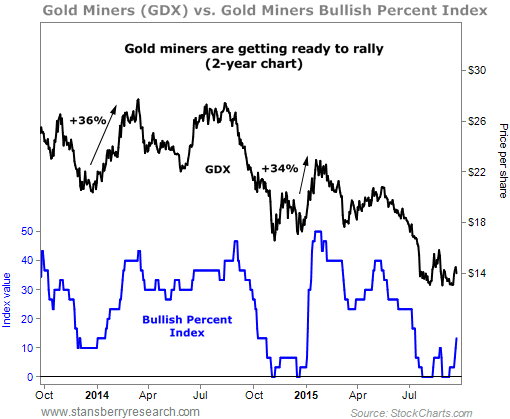
The positive sign comes in the form of the "bullish percent index" (or "BPI"). The BPI tracks the percentage of stocks in a sector that are trading in a bullish pattern. It ranges from zero to 100.
The BPI flashes a buy signal when it reaches 30 or lower (oversold territory) and then turns higher. And it flashes a sell signal when it reaches 80 or higher (overbought territory) and then turns lower.
In the chart below, you'll see GDX (the black line) and the BPI for gold stocks (the blue line) going back two years. In late 2013, the gold-stock BPI fell to 10. When it turned higher, GDX rallied 36% in less than three months. Then in late 2014, the gold-stock BPI fell to 0... the lowest possible reading. When it turned higher this time, GDX rallied 34% in just one month.
Today, we have a similar setup. The gold-stock BPI fell back down to 0 over the summer... And it just turned higher.
There are a number of ways to profit from a rally in gold stocks...
One of the easiest is simply to buy shares of GDX or another popular exchange-traded fund (ETF) that holds gold stocks.
If you're willing totake more risk, you could consider buying small positions in junior gold stocks – or "stock options that never expire," as we like to say around the office.
Of course, longtime readers know that one of our favorite ways to profit from gold – and other resource markets – is to own royalty stocks. As Porter reminded readers in the June 12 Digest...
There's another kind of business that's almost as capital-efficient as insurance... These firms are the absolute best way to invest in almost any industry or trend. I'm talking about royalty companies.
These firms raise capital and then invest in operating businesses. But rather than buy stock or lend on credit, these companies buy a small percentage of the company's future revenue. Royalty rates vary, but they're typically between 5% and 10% of all future revenue. That adds up.
Royalty companies are one of the safest and most reliable ways to profit from gold. While most gold stocks plummeted over the past few years, high-quality gold-royalty companies have not only survived the downturn... they've done well. Porter used top gold-royalty company Franco-Nevada as an example...
The most famous (and one of the best) is Franco-Nevada (FNV). Most investors know that owning gold over the last five years hasn't been a great bet. (It's down around 3%.)
But even if you bought gold at just about the worst possible time in the last 20 years, if you bought gold via exposure to Franco-Nevada's royalty streams – its stock – you've done well. You're up nearly 60%...
.png)
If you're interested in profiting from a rally in gold with relatively low risk, consider gold-royalty companies like Franco-Nevada (FNV) or Royal Gold (RGLD) instead. But remember, even these stocks are not without risk. Using proper position sizing and trailing stops is particularly important in the resource sector, even with high-quality companies like these.
Investors who are starting to build positions in these great royalty stocks today are likely to do very well over the next few years. But if there's one "downside" to these companies, it's that they're already very large. They're unlikely to return the huge gains investors in smaller gold stocks could see.
But our colleague Dan Ferris, editor of Extreme Value, has discovered a smaller, little-known royalty company that could combine the safety of stocks like Franco-Nevada and Royal Gold with the explosive upside of smaller stocks.
In fact, Dan believes investors buying today could see gains of 500% or more over the next few years. Even better, he believes investors could do well even if gold and other resources go nowhere. He has put together a presentation explaining it all. To watch Dan's presentation and learn more about subscribing to Extreme Value, click here. (Or if you prefer to read a transcript, click here.)
New 52-week highs (as of 9/23/15): Activision Blizzard (ATVI).
Another subscriber weighs in on Tuesday's controversial mailbag... and one reader has a question about Doc's IRA warning in yesterday's Digest. Send your questions, comments, and complaints to feedback@stansberryresearch.com. As always, we can't respond to every e-mail, but we read them all...
"Dear Porter, as you have repeatedly said, 'there is no teaching, only learning.' Case in point... (and this is all based on my 'learnings' from Stansberry Research, not a specific recommendation from one of your editors) on Aug. 24, I purchased 100 shares of AAPL for $101.16 each after the market had tanked. A week later on 8/31, I sold a Sept. 13 call option for $3.45. Last weekend, the shares were called away at $113. A tidy $1,529 profit on a $9,771 investment in 26 days. This represents an annual return of 211% (shout out to the folks at DailyWealth Trader for providing the handy-dandy option return calculator). And these types of trades can be made all the time if one just pays attention.
"The point I wish to make with this example is that this is something I was able to execute on my own using my own noggin, based on what I have learned as a subscriber.
"Also, even in the free daily emails, if you pay attention, there are actionable trades & investments to be made. If poor Francis would just pay attention, then he could be making lots of extra dough that he could give away to all the needy folks he's so concerned about. Thanks for all you provide. A happy camper and satisfied Alliance member." – Paid-up subscriber Wes Powell
"In yesterday's email, you indicated we should provide comment on the proposed legislation regarding options trading in IRAs. I read your analysis, and also read the proposed legislation; but I could not find any mention of options or contracts that made any sense.
"I realize legislation is often written generically and usually obscures intent, but in your call to actions, can you provide the legislative language (as a callout) itself that creates the issue?
"I have no issue commenting that I want to preserve options trading in IRAs, but my comments might be more effective if I can reference the specific language that is objectionable and should be stricken, given that a lot of the other proposals and language seem legit and worthy. Thanks." – Paid-up subscriber Sherwood L.
Brill comment: You are correct... It is convoluted, and there is a lot of confusion about what the regulation would actually do if approved. That alone is reason for concern. (Remember the "Affordable" Care Act?)
But the portion that really worries us falls under the provision titled the "Best Interest Contract Exemption," or "BICE." In particular, the provision's executive summary states the following (emphasis added):
The exemption proposed in this notice ("the Best Interest Contract Exemption") was developed to promote the provision of investment advice that is in the best interest of retail investors such as plan participants and beneficiaries, IRA owners, and small plans. [Employee Retirement Income Security Act of 1974 (ERISA)] and the Code generally prohibit fiduciaries from receiving payments from third parties and from acting on conflicts of interest, including using their authority to affect or increase their own compensation, in connection with transactions involving a plan or IRA. Certain types of fees and compensation common in the retail market, such as brokerage or insurance commissions, 12b-1 fees, and revenue-sharing payments, fall within these prohibitions when received by fiduciaries as a result of transactions involving advice to the plan participants and beneficiaries, IRA owners, and small-plan sponsors. To facilitate continued provision of advice to such retail investors and under conditions designed to safeguard the interests of these investors, the exemption would allow certain investment advice fiduciaries, including broker dealers and insurance agents, to receive these various forms of compensation that, in the absence of an exemption, would not be permitted under ERISA and the Code.
The provision later defines "fiduciaries" and "advice" quite broadly (again, emphasis added):
Under the statutory framework, the determination of who is a "fiduciary" is of central importance. Many of ERISA's and the Code's protections, duties, and liabilities hinge on fiduciary status. In relevant part, ERISA section 3(21)(A) and Code section 4975(e)(3) provide that a person is a fiduciary with respect to a plan or IRA to the extent he or she (i) exercises any discretionary authority or discretionary control with respect to management of such plan or IRA, or exercises any authority or control with respect to management or disposition of its assets; (ii) renders investment advice for a fee or other compensation, direct or indirect, with respect to any moneys or other property of such plan or IRA, or has any authority or responsibility to do so; or, (iii) has any discretionary authority or discretionary responsibility in the administration of such plan or IRA.
The statutory definition deliberately casts a wide net in assigning fiduciary responsibility with respect to plan and IRA assets. Thus, "any authority or control" over plan or IRA assets is sufficient to confer fiduciary status, and any persons who render "investment advice for a fee or other compensation, direct or indirect" are fiduciaries, regardless of whether they have direct control over the plan's or IRA's assets and regardless of their status as an investment adviser or broker under the federal securities laws.
Finally, the provision defines which assets would be "exempt" from the new rule (once again, emphasis added):
(c) An "Asset," for purposes of this exemption, includes only the following investment products: Bank deposits, certificates of deposit (CDs), shares or interests in registered investment companies, bank collective funds, insurance company separate accounts, exchange-traded REITs, exchange-traded funds, corporate bonds offered pursuant to a registration statement under the Securities Act of 1933, agency debt securities as defined in [Financial Industry Regulatory Authority (FINRA)] Rule 6710(l) or its successor, U.S. Treasury securities as defined in FINRA Rule 6710(p) or its successor, insurance and annuity contracts, guaranteed investment contracts, and equity securities within the meaning of 17 CFR 230.405 that are exchange-traded securities within the meaning of 17 CFR 242.600. Excluded from this definition is any equity security that is a security future or a put, call, straddle, or other option or privilege of buying an equity security from or selling an equity security to another without being bound to do so.
Under the proposal, brokerages (including discount online brokerages) that administer IRA or other retirement plans could be considered "fiduciaries" with regard to any asset NOT on the list above... even if they provide no actual investment "advice" and simply collect a commission or transaction fee for trades like most online brokerages do. And options are clearly excluded from this list.
So unless you believe your online brokerage is likely to allow you to trade for free, your ability to buy or sell options in your IRA could disappear under this proposal.
Again, the comment period ends tonight, September 24 at 11:59 p.m. Eastern time. As Doc Eifrig explained yesterday, if you haven't submitted your comments, you can do so by clicking this link, and then clicking "Comment Now" in the top right and entering your opinion. You can also send an e-mail directly to e-ORI@dol.gov. Be sure to include "RIN 1210 – AB32" in the subject line.
Regards,
Justin Brill
Baltimore, Maryland
September 24, 2015

|