
Do you own gold yet?... India and Poland cut interest rates... 21 central banks have eased this year... A new high for Blackstone... A 15% dividend... Why we're bullish on Europe today... Druckenmiller likes Europe and Japan... A must-read book...
 Today, another warning why you should own some gold...
The global currency war isn't a foreign topic to regular Digest readers. Central banks around the world are cutting interest rates in a race to debase their currencies.
As we showed you in the January 26 Digest, almost every major currency is plummeting versus the dollar.
If you're curious what a debased currency looks like, see the chart below, which shows the euro-to-dollar ratio...
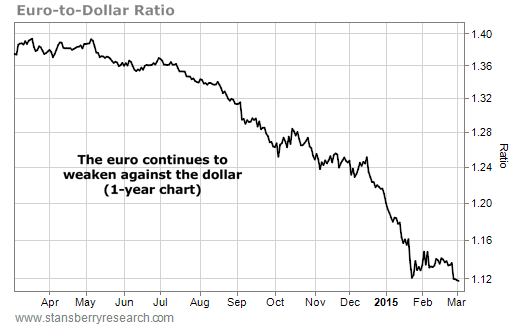
The euro hit its lowest level since 2003 today, falling to nearly 1.10 against the dollar.
We won't go into the finer details of the currency wars. For that, you can re-read the January 26 Digest or the February 10 Digest.
But understand this: Things are just getting started...
India surprised the market yesterday with its second interest-rate cut in two months. The Reserve Bank of India ("RBI") cut the benchmark interest rate from 7.75% to 7.5%.
RBI Governor Raghuram Rajan explained his reasoning for the cut before the bank's April meeting...
|
In other words, everybody else is doing it... so why don't we?
Following India's move, Poland's central bank cut its benchmark interest rate from 2% to a record-low 1.5%. (The market was expecting 1.75%.)
To date this year, 21 central banks have cut interest rates. Some have cut rates multiple times... Denmark cut interest rates an astounding four times this year (trying to maintain its euro peg after the European Central Bank announced quantitative easing).
|
Albania
|
European Central Bank
|
Romania#
|
|
Australia
|
India#
|
Russia
|
|
Botswana
|
Indonesia
|
Singapore
|
|
Canada
|
Israel
|
Sweden
|
|
China#
|
Pakistan
|
Switzerland
|
|
Denmark^
|
Peru
|
Turkey
|
|
Egypt
|
Poland
|
Uzbekistan
|
|
# Two rate cuts
|
||
|
^ Four rate cuts
|
||
This rate-cutting frenzy is bad news for anyone living on a fixed income.
About one-third of European sovereign debt now has a negative yield. There is now $3 trillion in government bonds with negative nominal interest rates worldwide.
Today, the demand for "safe" government bonds is greater than the supply (hence the negative yields).
But how safe is locking your capital into a guaranteed loss (the so-called "return-free risk")?
There's always the possibility – or rather, the likelihood – that new money will push bond yields further negative. In that case, investors buying bonds at today's negative rates would profit as bond prices continue their relentless march upward.
We'd rather own gold – a much safer currency of which central banks can't simply print more. As we've written many times... non-believers in gold point to its zero yield. It's true that gold yields 0%. But 0% is better than negative rates.
For more reasons why we're bullish on gold, read the February 10 Digest.
As True Wealth editor Steve Sjuggerud predicted, the S&P 500 soared thanks to the "Bernanke Asset Bubble" – the resulting price inflation from former Fed Chairman Ben Bernanke's money printing.
The Bernanke Asset Bubble led True Wealth subscribers to some massive gains... They're sitting on gains of 416% in health care stocks, 169% in technology stocks, and 109% in homebuilder stocks, to name a few.
One stock Steve recommended to take advantage of a recovering U.S. was private-equity behemoth Blackstone Group (BX). In particular, Steve liked Blackstone as a way to profit from a rebound in U.S. housing. The company was spending billions of dollars buying single-family homes for rental purposes. It's now the country's largest owner of single-family homes.
Plus, private-equity firms are a great way to profit from the current monetary environment in general. These companies can borrow huge amounts of money for acquisitions at record-low interest rates. Meanwhile, their assets under management grow as more freshly minted capital is looking for a home... And these companies write up the value of their assets as a result of price inflation.
The result of these fiscal policies is clear when you look at the following chart...
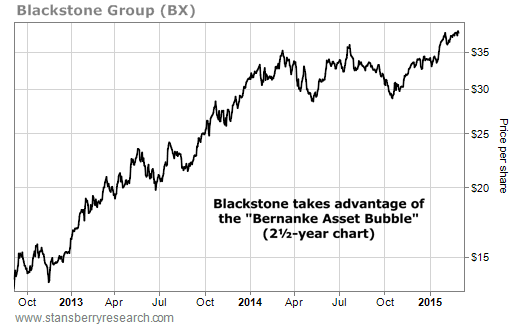
True Wealth subscribers are up nearly 210% on Blackstone since November 2012. Based on the company's trailing 12-month dividend payments, Steve's subscribers are earning 15%-plus a year on their original investment in dividends alone.
Following the Bernanke Asset Bubble, Steve turned his sights to Europe, when Bernanke's counterpart – Mario Draghi – had declared war on deflation.
In December 2013, Draghi told the world he would follow Bernanke's lead and keep interest rates low for "an extended period of time." In other words, Draghi would cut rates to the bone and print money if needed to boost the sagging European economy.
True to his word, Draghi initiated quantitative easing (QE) this year. But the European stock market hasn't kept pace with the S&P 500...
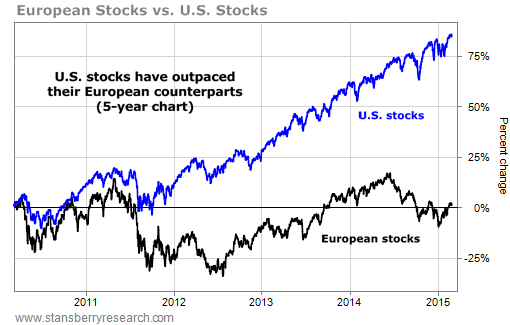
But Steve is still super-bullish on Europe today. As he often says, "money flows to where it's treated best." And right now, money in Europe is treated better in stocks than it is in bonds (just like in the U.S.). Steve says it's more extreme than ever and investors could double their money in European stocks. As he explained in the latest issue of True Wealth...
|
Billionaire hedge-fund manager and trading legend Stanley Druckenmiller appeared on CNBC this week. He's also bullish on Europe. From his interview...
|
Look again at the earlier list of central banks that have eased so far this year. The Fed and European Central Bank are only two of the 21. We could also see the Rajan Asset Bubble (India), the Xiaochuan Asset Bubble (China), and more.
Like investing legend Warren Buffett, we think buying bonds today is a bad idea. We would rather have our money in excellent businesses that are able to survive difficult economic times.
Unlike Buffett, we also want some of our money in gold.
Of course, we're here to help you navigate today's financial landscape. Our job is to help you protect and grow your savings (which is becoming more and more difficult thanks to the U.S. government).
But we urge everyone to understand the amazing financial forces at work today... and what the end result of this unprecedented monetary experiment will be.
That's why we've arranged for you to receive a free copy of a book written by Jim Rickards, who is one of the smartest financial minds out there.
Jim literally wrote the book on currency wars. He saw early on what was happening to the world's money... and noticed that central banks were hell-bent on destroying paper money.
And we liked his second book – The Death of Money – so much that we purchased thousands of copies from his publisher for Stansberry Research readers. We'll send you a copy free of charge. (We just ask that you cover the $4.95 for shipping and handling.)
We also commissioned Jim to write the "missing chapter" for his new book. This "missing chapter" is not available anywhere else on the Internet or in any bookstore.
In it, Jim details the exact investments to make right now to prepare for what he believes are huge changes coming to America and our financial system. These happen to be VERY similar to the ones Steve covers in True Wealth. This missing chapter is worth as much or more than the book (which retails for about $20 everywhere else online).
Between The Death of Money and True Wealth, Steve's subscribers have a complete playbook on how to handle the current environment of central-bank manipulation.
They outline what government intervention will mean for stocks, bonds, commodities, real estate, precious metals, and even collectibles... And they tell you what to own (and what to avoid).
What central bankers are doing to our money today is likely the largest financial story of our lifetimes. The consequences of their actions will be serious and long-lasting. It's incredibly important for you to understand what's happening and how you can protect yourself.
Jim's book is a great place to start. Learn how to receive your free copy right here.
New 52-week highs (as of 3/3/15): American Financial Group (AFG).
In the mailbag, one subscriber writes in about his thoughts on currency wars. Send your diatribes to feedback@stansberryresearch.com.
"Your recent article, re 'China joins the currency war,' is so accurate as I can attest to based on our colleagues, dealings, and insight having done business since 1980 – soon after Nixon made it legal to do so – in the PRC. There is so much going on clandestinely that the West does not know about that is going to seriously harm the US financially, militarily, etc. when the time comes – which our consortium is carefully preparing for. Interestingly, Porter's excellent book, America 2020 The Survival Blueprint, fails to mention that most serious threat to US citizens when advising re 'how to protect yourself.' Yet that is really equally important re timely preparation. Notwithstanding, his book needs to be read and heeded by every American and I repeatedly recommend it to everyone here and abroad. My compliments to him and his colleagues; keep up the fine work and Godspeed – and pray for our Nation which is in far more danger than its citizens comprehend – or they would do as my forefather did, as a Sons of Liberty at Lexington, and rise up to rid our Nation of The United Snakes of America." – Paid-up subscriber Paull Anderson
Regards,
Sean Goldsmith
March 4, 2015
