

'Get used to volatility'...
'Get used to volatility'... New lows for the yen... Japan is still soaring... The surprising Obamacare boom... Is oil headed lower again?... An important question from a new subscriber...
 The global bond "rout" is back...
As we mentioned in the May 7 Digest, bonds plunged (and bond yields subsequently soared) beginning in late April. The move was led by German bonds ("bunds"), whose yields jumped from 0.05% to more than 0.70%.
After a few weeks of relative calm, bond yields across the world are now soaring again.
The German 10-year bund yield jumped as high as 0.99% this morning, the highest level that German interest rates have been since September. The 10-year U.S. Treasury yield hit a new 2015 high of 2.42% as well.
.png) According to the Wall Street Journal, the moves are being blamed on the latest comments from European Central Bank (ECB) head Mario Draghi. From the article...
According to the Wall Street Journal, the moves are being blamed on the latest comments from European Central Bank (ECB) head Mario Draghi. From the article...
|
Draghi reaffirmed that the ECB's quantitative easing (QE) will continue as planned, regardless of bond volatility. More from the Journal...
|
Our view remains the same... We're staying far away from bonds... and European equities are likely headed higher from here.
Last month, we also noted that both of Steve Sjuggerud's True Wealth recommendations in Japanese stocks had hit new 52-week highs. As we wrote in the May 21 Digest...
|
Today, we have more big news on Japan...
Japan's currency – the yen – just hit a 12-year low versus the U.S. dollar. From a report in the Financial Times this week...
|
.png) As we've seen in the U.S., a weakening currency can provide a big tailwind for stock prices. That appears to be the case in Japan, too.
As we've seen in the U.S., a weakening currency can provide a big tailwind for stock prices. That appears to be the case in Japan, too.
Since our write-up, Japan's benchmark stock index – the Nikkei 225 – has continued to march higher. Tuesday marked the Nikkei's first losing day in 12 trading sessions. Over the last seven months, the Nikkei is up 25%, while U.S. stocks (as measured by the S&P 500) are up just 5%.
With Japanese stocks hitting new highs practically every day, we checked in with Steve to get his latest thoughts on the situation. Here's what he told us in an e-mail today...
|
Steve's True Wealth subscribers are currently sitting on 58% gains in the WisdomTree Japan SmallCap Dividend Fund (DFJ) and 85% in the WisdomTree Japan Hedged Equity Fund (DXJ). But as you just read, Steve thinks there's more upside ahead.
The ongoing boom in health care continues...
As regular Digest readers know, our colleague Dr. David "Doc" Eifrig has written at length about how Obamacare and the aging "Baby Boomer" generation have created a huge opportunity in health care for investors.
Doc has led his Retirement Millionaire subscribers to triple-digit gains in the Fidelity Select Medical Equipment and Systems Fund (FSMEX), medical-device firm Medtronic (MDT), and drugstore chain CVS Health (CVS).
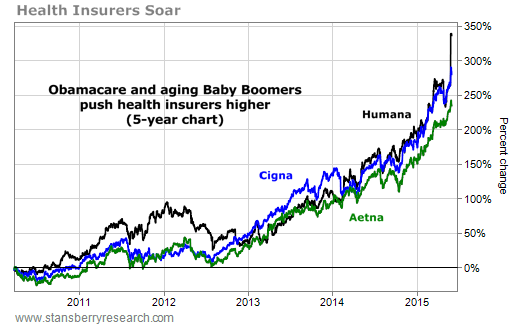
Surprisingly, another beneficiary of the boom has been health-insurance companies. As Editor in Chief Brian Hunt wrote in a recent DailyWealth Market Note...
|
Earlier this week, health-insurance firms Aetna (AET), Cigna (CI), and Humana (HUM) hit fresh all-time highs. As you can see from the chart below, these three companies have skyrocketed since Obamacare was signed into law in March 2010...
 Oil prices have also been rallying...
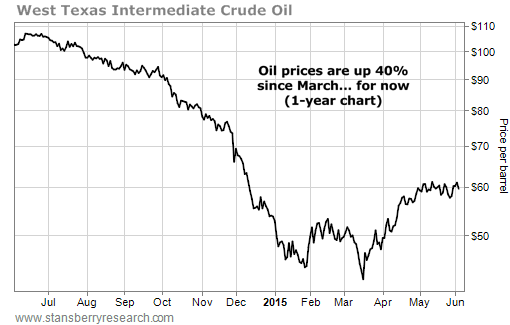
As we've mentioned previously, the price of oil is up nearly 40% from its lows earlier this year. West Texas Intermediate (WTI) crude oil – the domestic benchmark – currently trades for more than $61 per barrel, while Brent crude – the international benchmark that typically trades at a premium to U.S. crude – is trading for more than $63.
But according to the former head of research for oil cartel OPEC, you shouldn't expect these prices to last...
In an interview with Bloomberg, Hasan Qabazard – OPEC's research head from 2006 to 2013 – said Brent crude oil will trade back between $40 and $50 by the end of the year. WTI will likely trade even lower.
Qabazard expects oil supplies to rise – as Iraq and Iran increase production in coming months and shale oil production in the U.S. stabilizes – at the same time that demand from the U.S. is slowing. From Bloomberg...
|
This wouldn't surprise us... Regular Digest readers know we think oil prices are likely to fall further from here. As Porter said in the March 13 Digest...
|
New 52-week highs (as of 6/3/15): Activision Blizzard (ATVI) and Prestige Brands Holdings (PBH).
A subscriber who's new to investing asks us for book recommendations in today's mailbag. We'd love to know what topics and strategies you'd like to learn more about. Send your requests to feedback@stansberryresearch.com.
"I got a subscription to you in the winter and love learning about investing. I am 32 years old and just getting to a point where I have a little money to invest. I have been reading your site and learning as much as I can before I jump in with both feet. Could you please send me a few suggestions on books to point me in the right direction? Thank you so much for the tips. I am also very excited about the upcoming Friday series on how to value companies and make the right stock selections. I think this will be incredibly valuable for me. Thanks again for all your hard work." – Paid-up subscriber Dustin
Brill comment: Thanks for writing in, Dustin. We get this question often. Over the last year or so, we've published a handful of books (across several investment topics) in the Stansberry Research Bookstore. For new investors, there are two in particular we recommend.
The first is the Stansberry Research Guide to Investment Basics. This easy-to-read book will teach you everything you need to know to get started with investing in the stock, bond, and mutual fund markets. It's a great reference guide to keep on your bookshelf and read through every so often.
The second is the Stansberry Research Starter's Guide for New Investors. This book separates the dozens of lousy investment strategies from the most important ideas you need to know to be a successful investor. The Starter's Guide features educational essays and interviews from some of our most trusted contacts in the business.
We encourage all new investors to check them out. And please let us know what you think at feedback@stansberryresearch.com.
Regards,
Justin Brill
Baltimore, Maryland
June 4, 2015
