
Making 'gobs of cash' from poor people... A rental business with 80% gross margins... Upgrading rent-to-own... Following a private-equity firm into retail... Making almost 50% in two weeks... A major breakthrough in cancer treatment...
 "Businesses that cater to the bad habits of poor people are destined to make gobs of cash," Porter said on a recent episode of his Stansberry Radio podcast.
He has been loading the Stansberry's Investment Advisory portfolio with companies that follow this strategy, like discount retailer Dollar General, for example.
Today, we'll discuss another type of business that caters to the poor: Rent-to-own (or "RTO").
Americans want things they can't afford. But most people aren't willing to save money to make purchases. Instead, they borrow money to buy cars or televisions.
RTO businesses provide folks who can't borrow money with the goods they want... at huge margins.
In the April issue of Stansberry's Investment Advisory, Porter quoted a customer of national RTO chain Aaron's from an article that appeared in the Atlanta Journal-Constitution. "Without Aaron's, there are a lot of things I wouldn't be able to get," he said. "I don't have [good] credit. So to get what I want, I would just have to save."
This mindset is why the RTO business model is so profitable.
There are more than 10,000 RTO stores operating in North America... They serve 5 million consumers and generate revenues of $9 billion a year. And 83% of these consumers have incomes between $15,000 and $50,000 per year.
But RTO gross margins are typically more than 80%. Operating margins are between 10% and 13%.
To rent something from one of these stores, the customer usually only needs the upfront money required to rent the item for one week, a valid driver's license, and a delivery address. And because it's technically renting these items (rather than financing them), these RTO stores can charge much higher prices to willing buyers.
The RTO business model has been struggling lately... Credit is too loose. Everyone can get a loan today. But Porter and his team of research analysts believe credit will eventually tighten... So they added RTO firm Rent-A-Center (RCII) to the model portfolio in April. From that issue of Stansberry's Investment Advisory...
|
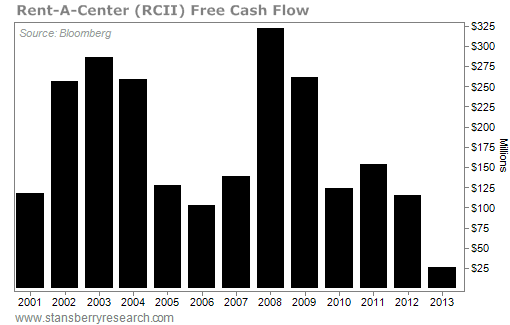 Rent-A-Center is one of our favorite ways to play the "disappearing middle class." It appears investment bank Canaccord Genuity has also noticed this trend. Today, it upgraded Rent-A-Center from a "hold" to a "buy." Shares had risen more than 5% as of midday trading on the news.
In the August 12 issue of the S&A Short Report, Jeff Clark followed private-equity firm Sycamore Partners into a losing trade...
Rent-A-Center is one of our favorite ways to play the "disappearing middle class." It appears investment bank Canaccord Genuity has also noticed this trend. Today, it upgraded Rent-A-Center from a "hold" to a "buy." Shares had risen more than 5% as of midday trading on the news.
In the August 12 issue of the S&A Short Report, Jeff Clark followed private-equity firm Sycamore Partners into a losing trade...
Sycamore specializes in retail and consumer investments. It invests in struggling retailers and tries to turn them around.
Last November, Sycamore bought an 8% stake in clothing retailer Aeropostale for $50 million (at about $8 a share).
Shares had fallen about 80% as profits fell and margins contracted. However, Aeropostale had 1,000 store locations and $2 billion in annual revenue... Sycamore was betting it could improve margins and boost profit.
Sycamore lost 60% of its investment ($29 million) in just nine months. But instead of selling, Sycamore loaned Aeropostale another $150 million with the option to buy another 5% of the company at $7.25 per share. As Jeff wrote in the S&A Short Report...
|
Jeff's subscribers were able to make a long-side bet on Aeropostale with shares trading at around $3.37 per share – a 60% discount to Sycamore's original investment.
Today, shares of Aeropostale rose more than 8% to around $4.15 per share on no news... And subscribers who followed Jeff's advice and bought the call options he recommended are up nearly 50% in two weeks.
But he thinks bigger gains are on the way. In an e-mail to me today, Jeff said the technicals for Aeropostale look great... "We now have a set of higher highs and higher lows on the chart."
Short interest in the stock is 30%. And Jeff said, looking at the chart today, he'd be "rushing to cover my trade."
Doctors are on the cusp of revolutionizing the way we treat cancer... and Small Stock Specialist editor Frank Curzio has spent the last month researching the cutting-edge companies that are fighting the disease. Early-stage testing shows huge increases in survival rates in a widening range of cancer types.
The biggest new trend is in an area of medicine called "immunotherapy." Hailed as Science Magazine's "breakthrough of 2013," this new treatment trains a patient's immune system to attack cancer cells. It may sound like common sense, but one of the downsides of cancer is that the human body doesn't recognize the disease as something it should fight.
Immunotherapy "fixes" this problem. As Frank wrote in the August issue of Small Stock Specialist...
|
And the results are already positive...
At this summer's annual American Society of Clinical Oncology (ASCO) meeting, researchers released test results showing immunotherapy's great potential.
For example, clinical trials for one of Bristol-Myers Squibb's immunotherapy treatments showed 79% of melanoma patients were still alive after two years. A doctor involved in the study noted that the survival rate would have been less than 10% a couple years ago.
Another drug called Pembrolizumab nearly tripled the one-year survival rate of melanoma patients who participated in the trial. The FDA was so impressed by the results that it gave the drug its "Breakthrough Therapy" designation, meaning the FDA will work to speed up the drug's approval process.
Even better, doctors believe many immunotherapy drugs can treat a range of different types of cancer. When researchers tried using Pembrolizumab to treat lung cancer, 80% of patients showed signs of tumor shrinkage. These results came from a small, 35-patient Phase I clinical trial... But you can see why doctors are so excited about the long-term potential of these immunotherapy drugs.
Cancer treatment is already a fast-growing market. Spending on cancer drugs has tripled over the past decade, hitting $91 billion last year. And analysts at Citi Equities Research estimate that number will hit $130 billion within a few short years. Frank expects immunotherapy to carve out a big piece of this market as new drugs gain FDA approval over the next few years.
Big drug companies are already jumping on this developing trend.
Reporting from the recent ASCO meeting, the New York Times said...
|
In Small Stock Specialist, Frank is covering the big, early-stage trends that will shape the world going forward... Like the railroad build-out in the late 1800s or the Internet boom in the 1990s. Frank thinks immunotherapy will be on par with these achievements.
And he believes these new developments in cancer therapy could lead to massive gains for people who invest today. Over the next few years, we'll likely see immunotherapy drugs replacing traditional cancer treatments like chemotherapy and radiation. And the companies innovating in this arena could soar as immunotherapy gains in popularity.
Of course, investing in early-stage medical companies is a tough business... Truth be told, most of these companies fail. But if you pick one winner, you can more than make up for the losses.
That's why Frank is recommending a basket of four small-cap biotech stocks. We can almost guarantee you have never heard of these companies before.
These firms all have promising immunotherapy drugs that are already in clinical trials. And Frank believes each one could return triple digits as this huge trend continues to gains momentum in the coming years.
Right now, you can get immediate access to all four of Frank's recommendation with a no-risk, four-month trial subscription to Small Stock Specialist. You can learn more (without watching a long video) by clicking here.
 New 52-week highs (as of 8/26/14): SPDR S&P BRIC 40 Fund (BIK), Dolby Laboratories (DLB), ProShares Ultra MSCI Emerging Markets Fund (EET), Enterprise Products (EPD), KLA-Tencor (KLAC), ProShares S&P 500 BuyWrite Fund (PBP), PowerShares Buyback Achievers Fund (PKW), PowerShares QQQ Fund (QQQ), ProShares Ultra Technology Fund (ROM), RPM International (RPM), ProShares Ultra Health Care Fund (RXL), ProShares Ultra S&P 500 Fund (SSO), Steel Dynamics (STLD), Cambria Shareholder Yield Fund (SYLD), Whiting Petroleum (WLL), and W.R. Berkley.
In today's mailbag, subscribers share their opinions on whether Warren Buffett is a hypocrite. What do you think? Let us know at feedback@stansberryresearch.com.
"Mr. Buffett keeps getting accolades as the world's greatest investor. A tip of the hat also has to go to Brookfield Asset Management (BAM), a long time Stansberry idea. BAM goes toe to toe when it comes to performance." – Paid-up subscriber J Till
"Yes, he is a hypocrite. He eschews his salary as CEO. Instead he receives stock options, dividends and capital gains. The IRS should make CEOs pay taxes on the fair market salary for a CEO, as the workers making much less money must." – Paid-up subscriber Bill Smith
Regards,
Sean Goldsmith
August 27, 2014

The only indicator with 100% accuracy...
Yesterday, master trader Jeff Clark explained some of the different indicators he uses to take the market's temperature at any given moment. No indicator has a flawless track record... except one.
In today's Digest Premium, Jeff gives some detail behind the only indicator that has never been wrong yet...
To subscribe to Digest Premium and receive a free hardback copy of Jim Rogers' latest book, click here.
The only indicator with 100% accuracy...
Editor's note: Yesterday, master trader Jeff Clark explained some of the different indicators he uses to take the market's temperature at any given moment. No indicator has a flawless track record... except one. In today's Digest Premium, Jeff gives some detail behind the only indicator that has never been wrong yet...
 Longtime readers may be familiar with the "Mother Indicator."
I (Jeff Clark) used to use my mother as a contrarian indicator. Back in 1987, Mom had never bought stocks before. I had been a broker for five years. And for five years, I had been trying to get her interested in the market. Dad was interested, too. But when it comes to arguing with Mom about money, Mom always wins. So he stayed out of the equation.
In July 1987, Mom called me and wanted to put basically her entire nest egg into the stock market, because the stock market had done nothing but go up. I took a mental note that this was probably a cautionary time. Sure enough, in October 1987, stocks crashed.
That November, I called my folks up and said, "Hey, now would probably be a good time to get involved." And of course, she wanted nothing to do with stocks at that time, because the market had crashed and everybody she knew had lost a bunch of money.
It turns that she was just a perfect contrarian indicator. I didn't think much of it for several years until the very first weekend in 1994. Mom gave me a call and said, "Hey, I'm interested in buying stocks now." I told her, "Listen, you know we'll talk about it next week. I'll come on over and we'll sit down and talk about it."
I was in my office at the time. I hung up the phone and I immediately started calling clients saying, "Hey, I got the biggest sale indicator possible. Sell everything in your portfolio first thing Monday morning." That happened to be the day the stock market topped, because later that week, the Fed surprised everybody by hiking its target for the Federal Funds Rate, which made the market go into a tailspin that year.
She was the perfect indicator. I've used her multiple times over the years for everything from trading gold and silver to stocks and bonds. Whenever Mom called and was interested in something, I would immediately know it was time to get out of that asset – or perhaps even short that asset.
That hasn't worked so well lately, because now Mom reads a lot of S&A's research. She subscribes to the S&A Short Report. So she has gotten a little bit better about things. I think I have to find a different mom to keep the Mother Indicator going.
– Jeff Clark
The only indicator with 100% accuracy...
Yesterday, master trader Jeff Clark explained some of the different indicators he uses to take the market's temperature at any given moment. No indicator has a flawless track record... except one.
In today's Digest Premium, Jeff gives some detail behind the only indicator that has never been wrong yet...
To continue reading, scroll down or click here.
Stansberry & Associates Top 10 Open Recommendations
(Top 10 highest-returning open positions across all S&A portfolios)
As of 07/21/2014
| Stock | Symbol | Buy Date | Return | Publication | Editor |
| Prestige Brands | PBH | 05/13/09 | 411.6% | Extreme Value | Ferris |
| Enterprise | EPD | 10/15/08 | 316.2% | The 12% Letter | Dyson |
| Constellation Brands | STZ | 06/02/11 | 310.5% | Extreme Value | Ferris |
| Ultra Health Care | RXL | 03/17/11 | 268.2% | True Wealth | Sjuggerud |
| Ultra Health Care | RXL | 01/04/12 | 222.2% | True Wealth Sys | Sjuggerud |
| Altria | MO | 11/19/08 | 210.2% | The 12% Letter | Dyson |
| Targa Resources | TRGP | 12/13/12 | 187.6% | SIA | Stansberry |
| Blackstone Group | BX | 11/15/12 | 179.1% | True Wealth | Sjuggerud |
| McDonald's | MCD | 11/28/06 | 178.1% | The 12% Letter | Dyson |
| Automatic Data Proc | ADP | 10/09/08 | 158.2% | Extreme Value | Ferris |
Please note: Securities appearing in the Top 10 are not necessarily recommended buys at current prices. The list reflects the best-performing positions currently in the model portfolio of any S&A publication. The buy date reflects when the editor recommended the investment in the listed publication, and the return shows its performance since that date. To learn if a security is still a recommended buy today, you must be a subscriber to that publication and refer to the most recent portfolio.
| Top 10 Totals |
| 3 | Extreme Value | Ferris |
| 3 | The 12% Letter | Dyson |
| 2 | True Wealth | Sjuggerud |
| 1 | True Wealth Sys | Sjuggerud |
| 1 | SIA | Stansberry |