
Editor's note: We're entering an unprecedented time of technological revolution.
And early investors could make life-changing gains.
To explain this megatrend in further detail, we turn to our friend Jeff Brown, editor of the excellent Exponential Tech Investor advisory. In today's Masters Series essay, Jeff explains why companies like Uber are becoming the norm... and how investors can take advantage...

Make Bigger, Faster Investment Returns Than at Any Time in History
Imagine it's 1990...
But instead of having a vague idea of what these new ideas mean... you have specific knowledge of how they will create vast new trillion-dollar industries... while demolishing old ones.
If you knew all that, what money moves would you make before these things transformed how we work and live?
You could buy $1,000 worth of Cisco (CSCO) stock after its IPO. Less than 10 years later, that small stake would be worth around $1,264,000 (a 1,264-fold return).
Or you might buy Microsoft (MSFT), which gained 9,556% during the 1990s.
Just think of it... an investment of just $1,000 or $5,000 turning into millions.
That's what's possible when you invest in technology that completely changes the world.
The bigger the change, the bigger the gains.
Knowing all this is extremely important right now.
We're on the verge of a transformation similar to what we saw in the 1990s.
In the next few years, you'll be able to buy a small subset of investments that are a virtual lock to soar more than 10,000% over the coming years.
So instead of looking back at this time with regret and knowing you "missed out," you'll look back with satisfaction and fond memories, knowing it was when you laid the first stone of your family's financial dynasty.
What's coming is that big... and that important.
It all starts with the law of accelerating returns.
Why Everything Is About to Change... And Make Some People Obscenely Wealthy
Over the next 10 years, we'll see more change to the economy than we've seen in the past 40 years.
The way we work, shop, sleep, travel, bank, and receive health care will look completely different from how they look now.
Amazing new industries will spring up at a pace we've never seen. Those new industries will demolish old ones at the same breakneck pace.
Although we've seen radical changes in technology over the past 40 years, these improvements are relatively small. They are incremental.
We're on the cusp of an exponential change.
The term "exponential" might sound complicated. But it's actually easy to understand.
You've heard the saying "breeding like rabbits."
You have two rabbits. Those two rabbits breed and now you have four rabbits. Those four rabbits breed and you have eight rabbits. Those eight rabbits breed and you have 16 rabbits.
The rate of increase gets larger with each stage. So in just 10 breeding stages, you get an astounding 2,048 rabbits. And the final stage represents a 512-fold gain over the original number.
This is what we call "exponential growth."
When a low number grows at an exponential rate, the initial progress isn't striking. The growth plotted on a chart doesn't soar upward during the early stages.
The truly awesome growth happens at a specific "tipping point" in time... where the exponential growth makes things change at an incredible rate. This tipping point is the "elbow" you see on the chart below...
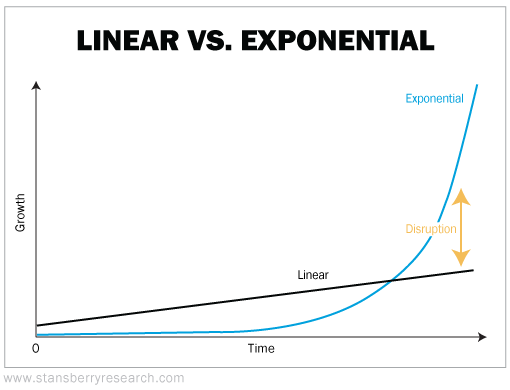
Over the last 40 years, advancements in computing power, computer memory, storage capacity, telecommunication bandwidth capacity, and other aspects of digital gear have followed a path like you see on the left side of the chart. After all, these technologies were brand new. They started from extremely low levels.
But after years of advancing at exponential rates, everything I just described is entering the "elbow"... the rocket ship phase.
At the same time, the size and cost of computing power is plummeting.
For example, in 1996, the $55 million ASCI Red Supercomputer was the first computer to reach the speed of one teraflop. It occupied a footprint nearly the size of a tennis court.
In 2014, Sony released its PlayStation 4 video game console. It has almost twice the computational power as ASCI Red... and it costs 100,000 times less. It can fit in a small backpack.
This has radical implications for our economy. It will...
| • | Make medical implants smaller and better, |
| • | Make it possible for you to take high-quality pictures with your phone, |
| • | Allow amazing "apps" like Uber to transform the way we travel, |
| • | Slash the cost of solar and wind power, |
| • | Allow you to check e-mail on your smartphone while waiting in line, |
| • | Make it so you can use Wi-Fi on your computer almost anywhere, |
| • | Make it possible for Tesla to build high-quality electric cars, and |
| • | Enable self-driving cars. |
This is a very, very important point, so let's cover it again...
Advancements in computing power are the wellspring from which other technological progress flows.
Over the last few decades, it took on average about 20 years for the typical Fortune 500 company to reach a market capitalization of $1 billion.
In 1998, Google was able to reach $1 billion in market cap in only eight years, which was considered fast at the time.
By 2004, Facebook (FB) had done it in five years.
By 2009, Uber had done it in less than three years.
In 2012, virtual-reality firm Oculus Innovative Sciences (OCLS) did it in a little more than a year.
And as recently as 2014, a workplace-productivity company called Slack pulled it off in eight months.
The chart below displays the amount of time it took for companies to hit a billion-dollar market cap.
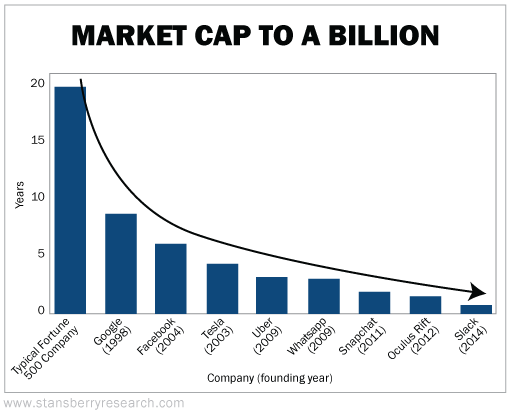
As you can see, it's taking less time to generate incredible wealth. Investors are reaping the benefits. Facebook shareholders who bought at the IPO enjoyed a 200% return on their investment in just four years.
And they're the laggards. Google shareholders are up around 1,500%.
With this simple example, you can see how the time it takes for major economic change is getting "compressed." Industries are being transformed in a short time.
But just as fast as these companies create positive change, "old" industries are demolished in the process.
As Uber soared to a billion-dollar valuation, the old taxi industry was devastated. It lost hundreds of millions in annual revenue.
As Apple's (AAPL) iPhone dominated the phone market, the loser in the game, BlackBerry (BBRY), saw its share price plummet more than 90%.
These massive industry shifts used to take 20-plus years to happen. Now, they are happening in less than five years. The rate of change is speeding up.
For another perspective on how quickly things are changing, have a look at the chart below. It shows how the average company lifespan in the S&P 500 is plummeting...
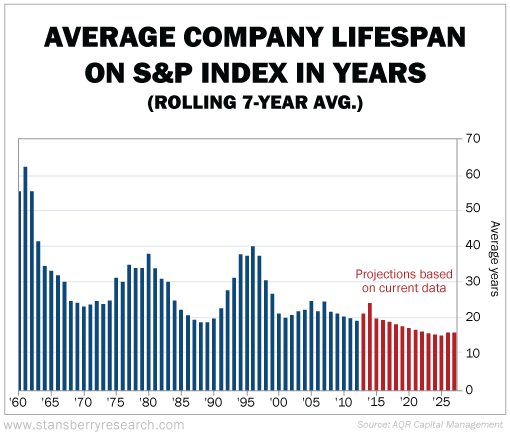
The S&P 500 is a who's who of corporate America. It tracks 500 of America's largest, most successful companies.
The average "tenure" in the S&P has declined from 61 years in 1958 to just 18 years in 2015. The time it takes to create and demolish industries is being compressed. Technology is playing a major role.
So what should you do as an investor?
Well, obviously, you don't want to be in the taxi business. You don't want a job doing menial office work that a robot could easily replace. But there's a lot more for us to figure out.
In tomorrow's essay, I'll detail why a large group of America's most innovative companies are about to go public... and offer us the investment opportunity of a lifetime.
Regards,
Jeff Brown
Editor's note: Jeff has spent 25 years as a tech executive, doing everything from building startups to running billion-dollar businesses... and has had incredible success as an angel investor. And as the technological revolution he described gets underway, you could turn $5,000 into $100,000 by investing in the right companies. Learn more about this coming megatrend – and how to sign up for Exponential Tech Investor for a $500 discount – right here.