
Editor's note: Vladimir Putin is angling to control the uranium market.
As Marin Katusa – a veteran investor and fund manager in the energy and resource-exploration sector – showed yesterday, the president of Russia has launched the Colder War. Marin says Putin plans for Russia to replace the U.S. as the dominant force in the global energy markets.
In today's edition of our weekend Masters Series – excerpted from his new book The Colder War – Marin discusses the future of the beleaguered uranium market… and how a long-term shortage of the stuff will lead Putin to turn uranium into a cash register…

The Putinization of Uranium
By Marin Katusa, author, The Colder War
On Friday, March 11, 2011, nature struck.
A monster, magnitude 9.0 earthquake grabbed the seabed 40 miles northeast of Honshu, in Japan. It tossed the entire island eight feet eastward and shifted the earth's axis by more than four inches.
The shock generated tsunami waves that reached elevations of 130 feet and inundated areas six miles inland. Hundreds of thousands of people fled. Nearly 16,000 bodies were recovered and another 2,500 still are missing.
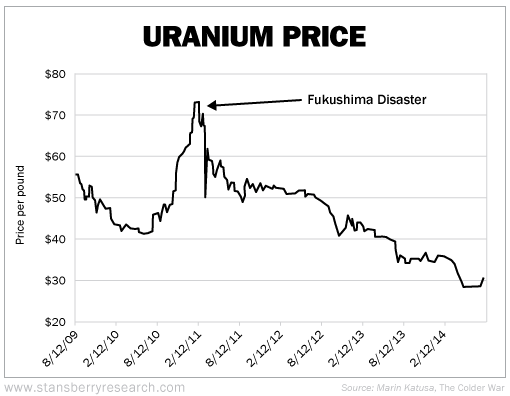
Lying in the tsunami's path were generators that fed the Fukushima Daiichi nuclear power plant's cooling system. They were disabled, and the cooling system stopped. Reactor core meltdowns followed. On the International Nuclear and Radiological Event Scale, it was a Level 7 disaster, matched only by Chernobyl.
In the aftermath of Fukushima – the cleanup of which will take decades – the spot price of uranium yellowcake has dropped more than 60%, to $28 per pound, and the stock prices of uranium miners have plunged between 60% and 85%.
Japan shut down all 52 of its other reactors for safety evaluations. South Korea followed suit for its 23 reactors – although most have now been returned to service.
Fukushima rousted antinuclear protestors out of bed around the world. For them, the earthquake revealed nuclear power to the world for the terrible idea it had been all along.
Germany announced it would shut down all 17 of its reactors, permanently, by 2022. It seemed that many other countries – perhaps all of them – would be closing their nuclear power plants as well.
Well, not so fast.
No one followed Germany's lead. Today, 71 new plants are under construction in more than a dozen countries, with another 163 planned and 329 proposed.
Many countries without nuclear power soon will build their first reactor, including Turkey, Kazakhstan, Indonesia, Vietnam, Egypt, Saudi Arabia, and several of the Gulf emirates.
Many countries with nuclear power plants declared a time-out to reassess safety practices. But almost all are staying with what they have. Uranium is still the only fuel that can produce base-load electricity economically and without exhaling greenhouse gases and other unwelcome hydrocarbons.
In the United States, which hasn't opened a nuclear power plant since 1977, six new units are scheduled to come online by 2020, four from license applications made since mid-2007.
The U.S. is the world's biggest producer of nuclear energy, accounting for more than 30% of the worldwide total. Its 65 nuclear plants (housing 100 reactors) generate 20% of U.S. electricity.
France is the country most dependent on uranium… 75% of its electricity comes from nuclear power. China, whose urban residents are choking on pollution from coal-fired plants, is now on a nuclear-construction fast track.
It already has 17 reactors in operation, and 29 more are being built. The country wants a fourfold capacity increase by 2020. India has 20 plants and is adding seven more. Several countries in Africa, where more than 90% of the population goes without electricity, have begun to explore the possibility.
New facilities are going to be safer, too, especially after Fukushima exposed the vulnerabilities of older designs. Though the containment systems at Fukushima were far more robust than the buckets that held the Chernobyl reactors, they were 40 years old, several generations behind today's containment engineering and materials. Fukushima would soon have been a candidate for decommissioning.
Long-Term Shortage
Germany may be able to get by without nuclear power plants (although its carbon footprint is spreading, and it's already fudging by importing nuclear-generated electricity from France). But none of the other countries using or readying for nuclear power can. There's just no alternative.
That means the demand for uranium will rise as both the world's economy and its discomfort over fossil fuels grow. And that means profits and political leverage for any country that might dominate the uranium industry – like Russia.
The World Nuclear Association predicts demand growth of 33% from 2010 to 2020 and similar growth in the 10 years that follow. In 2011, the world consumed 160 million pounds of yellowcake uranium.
By 2024, just 10 years from now, it will be chewing through 200 million pounds annually – if it's available.
At the same time, a supply crunch is building. In 2012, the world consumed 25% more uranium than came out of its mines, a shortfall of 40 million pounds (at current long-term prices, about $1.8 billion worth). The deficit is likely to rise to 55 million pounds by 2020.
Uranium mines are few and far between. Only 20 countries have even one, and half of global production comes from just 10 mines in six countries.
In the United States, 100 reactors are burning fuel from 43 million pounds of uranium per year to produce electricity. Supply from U.S. mines is about 4 million pounds, or only 9% of what's needed to keep those plants running.
Here's another way of looking at it: The estimated needs of U.S. nuclear power plants between now and 2021 come in at around 275 million pounds of yellowcake. The country's entire inventory amounts to only 120 million pounds.
In the long run, more mining is the only answer. But a new uranium mine is more difficult to bring into production than any other kind of resource. Given the engineering challenges, environmental and safety requirements, and strict permitting, it takes 10 years, minimum, to get from decision to production.
New mines are not coming online quickly enough to meet expected growth in consumption. And the world already is using more than it digs out of the ground. In fact, it has been doing so for the past 20 years.
If every uranium mine proposed in the past decade were approved, built, and commissioned on schedule, supplies might be able to keep up. But current uranium prices are too low to entice any company to build those potential mines, and any risk taker that might decide to gamble on rising prices would face the separate risk of regulatory delay.
Getting the permits to build a uranium mine is not like standing in line for an hour at the Department of Motor Vehicles. You have to stand in many lines for many years while you wait for decision makers to find the courage to confront the radiation bogeyman.
A shortage is coming. Putin is preparing to turn it into a cash register and make controlling in-the-ground resources a tool of geopolitics.
Editor's note: Marin Katusa claims controlling in-the-ground resources is just part of Putin's plan to make Russia the dominant player in the global energy market. To get the full story on Putin's plan – as well as learn more about the Colder War and how Marin says it will directly change your life – click here.