
More QE is on the horizon... U.S. deflation hits a six-year high... Kim Iskyan explains exactly what's happening in Russia... Howard Marks on Russia and oil...
 Deflation is still dominating the global economy...
Consumer prices across the European currency union rose at the slowest annual pace since 2009, according to Eurostat, the official statistics agency of the European Union.
Annual rates of inflation slowed to 0.3% in November for the area. Inflation in the European Union as a whole was 0.4%. Both figures are down from 0.4% and 0.5%, respectively, in October.
These inflation rates are well below the European Central Bank's (ECB) target of 2% inflation... But still, the ECB sits idle.
Rumors abound that ECB head Mario Draghi may quit. He wants to ease the economy. But the more austere European nations – namely Germany – are pushing back. Those in the know say Draghi is tired of arguing.
Today, the Wall Street Journal reported ECB executive board member Benoît Coeuré gave a clear signal that more easing is on the way...
|
We're seeing low inflation outside of the European currency union, too...
Inflation in Great Britain is at 1%. Bank of England Governor Mark Carney says that number its likely to fall further.
Sweden and Poland said they are likely to cut rates next year. Sweden said it may go to negative interest rates and initiate asset purchases.
And U.S. consumer prices (as measured by the Consumer Price Index) dropped in November, leading to the highest rate of deflation since December 2008.
The CPI is still up 1.7% through November, but still remains below the Fed's target of 2% inflation.
While things are slowing down in the U.S. and Europe, Russia is entering full crisis mode.
Low oil prices – which sat at a five-and-a-half-year low before today's spike higher –have crushed the Russian economy. The ruble hit an all-time low versus the dollar this week. And Russia is doing everything in its power to save itself. Still, the situation is bleak.
We asked Global Contrarian editor Kim Iskyan for an update on one of the biggest stories in the world today...
|
To put Russia's extreme hike into context, at the peak of the economic recession in the late 1970s, interest rates in the U.S. hit 19%. It took the Fed around two years to hike rates from 10.5% to 19%. Russia roughly made the same move in a single day...
|
Initially, Russia's efforts didn't work. On Tuesday, 64 rubles was worth one U.S. dollar. The ruble continued to weaken all the way to 72 rubles to the U.S. dollar. (For perspective, it took 34 rubles to buy one U.S. dollar as recently as July.)
But today, the ruble and Russia's stock market changed course...
The ruble strengthened more than 11% – another spectacular move – to nearly 60 rubles to the U.S. dollar. As the ruble continues to weaken, it costs more and more to buy one U.S. dollar, as you can see in the chart below…
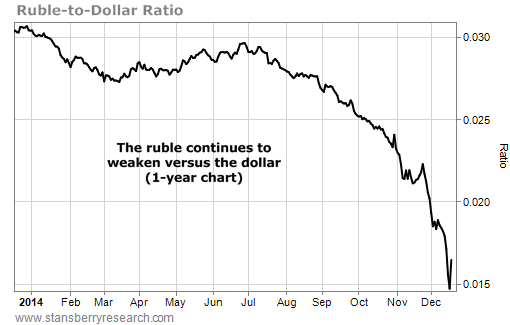
Russian stocks also jumped significantly... Gas giant Gazprom was up nearly 15% on U.S. exchanges.
As you know, this kind of volatility isn't normal. Markets always overcorrect (in both directions), and Russia's extreme selloff was likely overdone... But so is today's jump. Kim says there are still plenty of things to worry about with Russia...
|
Global Contrarian subscribers will receive Kim's full thoughts on Russia – and whether he's buying – in this month's issue, due out on Monday.
If you don't already subscribe to Global Contrarian, I recommend trying it out.
International advisories are never big sellers. Still, we spend an incredible amount of resources producing them because we want to put out one of the most valuable international letters on Earth. We firmly believe that's exactly what Kim is doing.
Over the past year, he has traveled to Iran, Russia, Argentina, Kazakhstan, Mongolia, Macau, Venezuela, and Myanmar. Every place Kim visits, he shares his "boots on the ground" research... and stories from his vast network of global contacts.
Plus, he's digging up little-known companies in these markets that most investors have never heard of before.
In essence, we asked Kim to produce the letter that we as Stansberry employees would want to read. So far, he's doing a fantastic job.
To learn more about Global Contrarian – and how to read about his latest adventures – click here.
Speaking of Russia... Oaktree Capital co-chairman Howard Marks is one of the best investors in the world today – especially when it comes to high-yield investments. Marks appeared on Bloomberg yesterday to share his thoughts on what's happening in Russia. Like us, Marks is skeptical of Russia's 17% interest rates...
|
Remember, high interest typically equals high risk. Russia is trying to attract capital with egregious yields on government debt... It's a sign of desperation.
But as Marks said, even more important than the recent action in Russia and oil are the market lessons you can learn from the decline. From his Bloomberg interview...
|
As we've written in the past, Marks is obsessed with risk. His quote above explains why. When things go bad in the markets, they can go bad faster than anyone expects.
Still, Marks said it's time to start getting excited about oil (joining fellow investment gurus Carl Icahn and Steve Schwarzman in the sentiment).
New 52-week highs (as of 12/16/14): CVS Health (CVS) and ProShares Ultra 20+ Year Treasury Fund (UBT).
In today's mailbag, one of the longest – and best – pieces of reader feedback we've received in a while from paid-up subscriber Kenneth. Due to spacing constraints, we're excerpting some of our favorite parts from it. Let us know what's on your mind as the end of 2014 approaches at feedback@stansberryresearch.com.
"Porter and Staff, just want to take a little time to drop a line to wish you all happy holidays and for making 2014 the most valuable year of education I have experienced in my life. I became a paid subscriber about a year ago (December 2013 or January 2014) when I had a very small brokerage account and I was able to take advantage of some special offers on Doc's 'Retirement Millionaire' and the recently shuttered 'Small Stock Specialist' newsletters.
"Early in 2014 I subscribed to the streaming Stansberry Live events and sat in online for the Miami, Dallas, and Los Angeles conferences; then I was able to travel in October to Nashville in person for that show. Any one of them alone would have been worth the price I paid for all four, and I began to appreciate the diverse investment philosophies and backgrounds of the editors, as well as the range of opinions Porter encourages... After Miami I added a couple of more 'entry level' subscriptions, including the Stansberry Investment Advisory and one of Dan Ferris's publications (sorry, I don't remember which since I have added more during the year).
"Through 2014 the great equalizer, time, caught up to my family and I lost two elderly relatives. Between them, they left me enough money that I could add over a full year's salary to my brokerage account after storing a sensible amount away in other fixed income assets and bank accounts. This led me to add gradually more subscriptions, until I recently stepped up to become a Flex Alliance member.
"It used to be that if I reached the end of a year and saw I'd lost money I'd feel horrible without knowing why or what to do next year to make better investment decisions. But this year, I'm looking back on the winners and losers I have from 2014 with a lot more clarity. I'm starting to see why certain investments were a good idea and why certain ones caused me to get stopped out. So that gives me a lot more optimism going into 2015 that I will make better investment decisions next year. I'm not going to predict wild gains or stellar returns, but I am going to predict that I won't make as many mistakes each year going forward as I did the year before.
"So thank you to everyone at Stansberry Research for a very educational 2014. For less than the cost of a full-year's undergraduate tuition at my college alma mater, I've learned more that's practical about investing and the markets than I have in any year previously – ever. I hope you and your families have a safe and happy holiday season and a joyous and prosperous 2015." – Paid-up subscriber Kenneth Nuckols
Regards,
Sean Goldsmith
December 17, 2014
