

New Evidence the 'Melt Up' Has Begun
More details on next week's 'Metropolitan Man' event... Amazon steps up its war on brick-and-mortar retailers... A 'make or break' point for the U.S. dollar... Another reason for short-term caution on stocks... New evidence the 'melt up' has begun... The latest chapter from P.J. O'Rourke's brand-new book...
 We're less than one week away...
Next Wednesday, April 5 at 8 p.m. Eastern time, the "Metropolitan Man" – who has held just about every high-ranking economic position in the U.S. government – will be joining us live at our Baltimore headquarters.
As regular Digest readers know, this could be the most important and valuable event in our company's 18-year history...
At this meeting, the Metropolitan Man will not only reveal himself for the first time... He'll share details on a specific development that could have huge consequences for the markets and the U.S. economy over the next few years.
As a Stansberry Research subscriber, you can be there... We're offering exclusive online access to this event for just $19.95. Click here to reserve your spot now.
And don't miss tomorrow's Friday Digest, where Porter will share new details about next week's can't-miss event.
Online-retail behemoth Amazon (AMZN) is taking its fight against brick-and-mortar retailers to a new level...
According to reports, Amazon has invited some of the world's biggest food and packaged-goods brands to a private meeting at its Seattle headquarters.
On the agenda? Convincing these companies to sell products directly to consumers – using Amazon's online marketplace, of course – and bypassing large retailers like Wal-Mart (WMT), Target (TGT), and Costco Wholesale (COST) altogether. As Bloomberg reported this morning...
Executives from General Mills, Mondelez and other packaged goods makers will attend the three-day gathering in May... Amazon is looking to upend relationships between brands and brick-and-mortar stores that for decades have determined how popular products are designed, packaged and shipped.
If Amazon succeeds, big brands will think less about creating products that stand out in a Wal-Mart Stores Inc. aisle. Instead, they'll focus on designing products that can be shipped quickly to customers' doorsteps. Brands have been experimenting with such changes, so the Seattle event may well resonate.
"Times are changing," Amazon says in an invitation obtained by Bloomberg. "Amazon strongly believes that supply chains designed to serve the direct-to-consumer business have the power to bring improved customer experiences and global efficiency. To achieve this requires a major shift in thinking."
The reason is clear: Food and packaged goods are an $800 billion market, according to Bloomberg data. And it is one of the few remaining markets Amazon hasn't been able to steal away from brick-and-mortar stores.
But if Amazon can get these major brands to agree, that may not be the case much longer.
Speaking of Amazon, the company's meteoric rise hasn't just changed the way we shop...
It has also made founder Jeff Bezos among the wealthiest men on the planet.
Yesterday's 2.1% rise in Amazon shares added another $1.5 billion to Bezos' holdings... officially making him the second-richest person in the world.
Bezos now has a net worth of more than $75 billion... $700 million more than legendary investor Warren Buffett. Only Microsoft founder Bill Gates is worth more.
Yesterday, we noted the recent decline in the U.S. dollar...
It has now given up nearly all of its gains since November's presidential election, suggesting the "Trump Trade" rally could be faltering.
But our colleague Ben Morris believes further downside remains ahead. As he explained to his DailyWealth Trader subscribers on Friday, the dollar has reached a critical juncture...
The dollar is on the verge of breaking down. And if it does, a chart pattern that has been developing for months suggests that a sharp drop will follow... It's called a "head and shoulders." It shows that a move has run its course... And it often marks a turning point.
The pattern is made up of four pieces: the head, the left and right shoulders, and the neckline... But this is the most important point... When the chart of an asset's price forms a right shoulder and then breaks the neckline, a big drop often follows. In the chart below, you can see that the U.S. Dollar Index is sitting right at this "make or break" point...
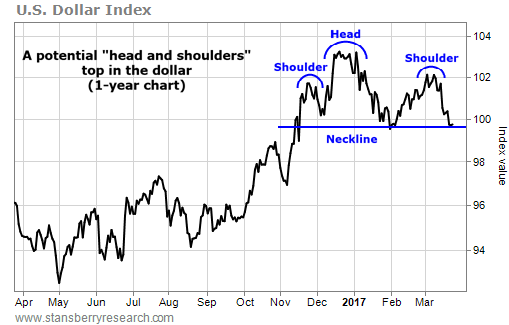
As Ben explained, it's not certain the dollar will break below this level...
Data suggest the U.S. economy has been improving, and rising interest rates make the dollar more attractive. So it's possible the dollar "holds" here and continues its move higher.
But if the dollar does break down, it could soon be headed much lower. More from the issue...
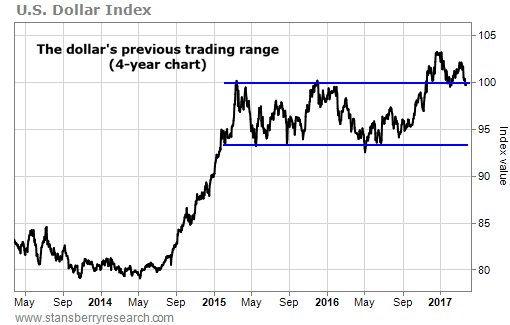
To get an idea of how far it could fall, let's look at a long-term chart. You can see that from early 2015 through the end of last year, the dollar traded in a big sideways range. If it breaks below the neckline in the chart above, we could expect it to fall back toward the lower end of this range...
A falling dollar isn't the only reason to believe the Trump Trade rally in stocks is due for a correction...
The Dow Jones Industrial Average has fallen nine of the past 10 trading days, through yesterday's close. The index has only declined 1.3% over that period, but according to our friend Jason Goepfert, history suggests further declines are likely. The Wall Street Journal highlighted his research this morning...
Only once in the last 100 years has the Dow fallen nine out of 10 trading sessions and suffered a loss smaller than the current stretch, according to data from Jason Goepfert, publisher of the SentimenTrader newsletter. It was in 1941, just months before the U.S. was dragged into the Second World War...
Still, even the least damaging losing streaks tend not to bode well for the market in the short term, at least historically. Mr. Goepfert finds that this is the 17th stretch where the Dow has suffered less than a 5% decline while also sinking nine days out of 10. The Dow has averaged a 0.7% decline in the week after such instances and 0.4% a month later. Six months later, on average, the Dow had fallen 2.8%.
But our colleague Steve Sjuggerud says history is sending a very different message about the longer term...
In the latest edition of his True Wealth Systems Review of Market Extremes, published yesterday, Steve noted that investor sentiment has finally started to "flip" from fear to optimism for the first time since before the financial crisis.
Steve says this is a strong sign the "melt up" he has long predicted has begun... And stocks could absolutely soar in the months ahead. From the update...
It's the simple idea that before the bull market has a major Melt Down... there will be a Melt Up, where prices soar as investors flood back into stocks. That's happening right now. And the current extreme in investor optimism proves it. Take a look...
Investor optimism just hit a level we haven't seen in 17 years. But more important, stocks will likely move much higher before an eventual crash. History proves it... The last time we saw a similar bullish extreme was at the beginning of 2004. The S&P 500 soared by over 50% in the three years after that extreme...
Again, we are in the late innings of this bull market. But the largest gains come as investors pile back into to the markets. That's happening right now.

Steve recently prepared a report for his True Wealth subscribers explaining why he's convinced the "melt up" has started... and exactly what investors need to do now to profit. If you're not already a True Wealth subscriber, you can learn more right here.
Subscribers continue to weigh in on next week's Metropolitan Man event. Send your questions and comments to feedback@stansberryresearch.com. And be sure to read past the mailbag for the latest from Digest contributing editor P.J. O'Rourke.
"Porter, I didn't get a chance to read Friday's Digest until this morning. EXCELLENT!!!! The subject essay is 100% spot on. These days it is a rarity to find such facts and context. And this is why I became a lifetime subscriber. Our media sucks. All of it. Newspapers, magazines and broadcast / cable television. That said, I would like your permission to forward your essay to someone analytical. This person will appreciate the essay. Of that I am certain. Any conditions you set I will pass along before I forward. Thank you." – Paid-up subscriber Chuck F.
Porter comment: Of course, Chuck... And thank you for the kind words.
"I hope this is not a scare tactic to generate income because the subject is very very scary. Please have it available to read as west coast time makes it hit right at our dinner hour. Please advise me if it will only be broadcast live at [8 p.m. Eastern]." – Paid-up subscriber E.P.
Porter comment: You're right, it is scary. This is a dangerous time for our country. But I continue to be believe what ultimately unfolds will be great for most Americans. And don't worry... We don't want anyone to miss this information because of a scheduling conflict, so we're also including access to a full replay of the event. Reserve your spot here.
Regards,
Justin Brill
Baltimore, Maryland
March 30, 2017
Editor's note: Stansberry Digest contributor P.J. O'Rourke has just published his latest book: How the Hell Did This Happen? The Election of 2016.
He covers the entire election cycle from its 2015 start (when voters were perplexed, confused, and split into angry partisan factions) until its 2017 finish (which left voters perplexed, confused, and split into angry partisan factions).
Along the way, P.J. uses his dark sense of humor and biting satire to offend everybody who ran for president and anybody who voted for them. He even tries to offend himself, as one of the "media elite" political pundits who so miserably failed the American public.
He may make you mad, but he will make you laugh.
In past weeks, we shared P.J.'s "Road Trip" and "First Ladies" tests for selecting a president. This week, in the third of three chapters adapted from How the Hell Did This Happen?, P.J. delves into the details of the bizarre system that disgorged the two least popular general-election candidates in history. (The full book is available here.)
How Did We Choose Our President? – a Look at America's Weird Primary and Caucus System
While some voters in the 2016 presidential election were satisfied with one or the other of the major party candidates who were picked to run, few of us were satisfied with the way they were picked.
America's political primary and caucus system, at its best, seems strange and confusing. At its worst, it seems opaque, conflicted, exclusionary, and unfair.
It's interesting to look at how we acquired this peculiar method of selecting the only two people who will have a real chance to be president.
The Democratic and Republican parties may think they are integral parts of the U.S. government. But in fact, they're private organizations with no more Constitutional standing than motorcycle gangs.
Maybe some day in the future, we'll select our two major presidential candidates with fists, chains, and knives in the parking lots of biker bars. In which case, expect either Leadhead Eddie of the Bandidos or Gypsy Joker member Bob the Beef to occupy the Oval Office.
For the time being, however, we've got a dumber way of picking who'll run for president. This involves "primaries" and "caucuses." Both Democrats and Republicans have them in all 50 states and the District of Columbia.
(Although until 1961, people who lived in D.C. were considered to be overexposed to the debilitating effects of political radiation and therefore not competent to vote.)
Democrats and Republicans also have primaries and caucuses in American Samoa, Puerto Rico, Guam, the U.S. Virgin Islands, and the Northern Marianas to make sure that residents of U.S. territories who don't get to vote in presidential elections have a say in who they don't get to vote for.
The primaries and caucuses have different rules depending on your location. It's like a baseball game where if you're on first base, you're supposed to dunk the ball through the net… if you're on second base, you're supposed to knock the puck past the goalie… and if you're on third base, you're supposed to kick a field goal.
Primaries are make-believe voting. You have an election, but instead of electing a candidate, you elect a candidate for election.
Caucuses are coffee klatches for people who need to find a bingo game.
State and territorial primaries and caucuses take place at different times. Each is scheduled to be either so early that who you vote for doesn't matter or so late that it doesn't matter who you vote for.
Who's in charge of this process? Nobody. Because that's who's in charge of the Democratic and Republican parties.
The Democratic and Republican national organizations aren't in charge because they're run by the Democratic and Republican Party state organizations who aren't in charge because they're run by the Democratic and Republican Party county organizations.
There are 3,143 counties in the United States. The Republican Party County Chairman is a retired Dairy Queen franchisee in doubleknit slacks with a white vinyl belt and matching shoes, and the Democratic Party County Chairman is a woman who owns 19 cats.
The reason American political parties have no constitutional standing is that the framers of the Constitution hoped America would have no political parties.
In Federalist Paper No. 9, Alexander Hamilton declares "domestic faction" to be "the cause of incurable disorder and imbecility in the government."
In Federalist Paper No. 10, James Madison inveighs against "the violence of faction," calls it a "dangerous vice," and warns that "the public good is disregarded in the conflicts of rival parties."
However, even in 1788, most Americans weren't listening to Hamilton and Madison, and neither were Hamilton and Madison.
Alexander Hamilton would go on to form the Federalist Party. And James Madison would co-found the Democratic-Republican Party with Thomas Jefferson, who had also claimed to oppose political parties.
In a 1789 letter to his friend and fellow Declaration of Independence signer Francis Hopkinson, Jefferson wrote: "If I could not go to heaven but with a party, I would not go there at all."
George Washington detested political parties and didn't belong to one. But by the end of his second term, a recognizably modern "two-party system" had taken hold.
This caused George – by solemn Father-of-His-Country standards – to burst a seam. In his 1796 Farewell Address, the first president said:
Let me now... warn you in the most solemn manner against the baneful effects of the spirit of party generally.... The alternate domination of one faction over another, sharpened by the spirit of revenge, natural to party dissension... is itself a frightful despotism. But this leads at length to a more formal and permanent despotism. The disorders and miseries which result gradually incline the minds of men to seek security and repose in the absolute power of an individual...
So, if we were guided by the thoughts of wise men – or of men while they were temporarily being wise – America shouldn't have any political parties. And we'd be spared discussion of primaries, caucuses, and other ridiculous methods by which Democrats and Republicans choose their electoral candidates such as rummaging through the partisan trash to pick superdelegates and delegates-at-large.
America shouldn't have any political parties, and funnily enough, America doesn't. At least, we don't have any "political parties" in a way that most people in most of the world would understand.
Thirty-five years ago, I was in the Soviet Union where I became friendly with a reporter from Pravda. Friendly enough that I admitted my admiration for Ronald Reagan.
One night the Pravda reporter and I were in a Moscow bar talking about Reagan and Brezhnev. The reporter said, "You are Republican?" I said yes. The reporter leaned in close, lowered his voice, and asked, "Are you Party Member?"
In America, you don't join a political party. It tries to join you.
You don't pay "dues" unless you want to. I suppose you could be a card-carrying Republican or Democrat, if you got the card printed yourself. There's no such thing as "party discipline," as Bernie Sanders showed. And as Donald Trump proved, you can't get kicked out of an American political party no matter what you say.
No major American political party has ever had a real ideology. The parties usually don't even have more than one or two ideas.
In America, we've got two vague political tendencies. One tendency is to favor a larger, more powerful government to make things better. The other tendency is to favor a smaller, more limited government to make things less worse.
Recently, we've seen a lot of partisan political rancor. But at other times, it can be hard to tell American political parties apart.
I once had a Marxist British journalist friend. Back in the '70s, he remarked, "You Americans have a one-party system, and just like Americans, you have two of them."
The fact that usually a major American political party claims to be conservative, while usually its opposite number claims to be otherwise, does not necessarily make distinction easier.
For example, in the early days of the republic, the supposedly conservative Federalists were for a great big federal government and an international alliance with Britain. The supposedly liberal Democratic-Republicans had a platform that sounded like George Wallace's – States Rights and Fortress America.
Our political parties were despised to begin with and were given, by law, the role in government that they deserve, which is none.
The parties themselves are a mulligan stew of political leftovers. No wonder the process by which they select their presidential candidates is a disgusting muddle.
Things didn't used to be better. Until the 1830s, a presidential candidate was customarily selected by a political party's congressional delegation.
We can imagine the insider deals hatched in the era's smoke- (or rather, snuff-) filled rooms. The Senate was not directly elected, and the general franchise was severely limited. Voters had about as much say in choosing the presidential nominee as you have in choosing your airline seat when using frequent flyer miles to travel on a holiday weekend.
Nominating conventions were thought to be a more democratic alternative. The first presidential nominating convention was held in 1831 by the Anti-Masonic Party. They were adamantly opposed to Shriners in miniature cars driving around in circus parades. Or something.
And that pretty much set the tone for wisdom and intelligence at national political party conventions for the next 70 years.
State and local party bosses quickly took control of the conventions. To wield political influence, you no longer had to be a crooked elected official, just being crooked would do.
Of course, there's nothing that can't be made worse by reform. Reformers of the Progressive Era took aim at the conventions, seeking to replace them with some type of referendum – a preliminary vote (a "primary") or a public committee meeting (a "caucus") – where ordinary citizens would select convention delegates.
In 1901, the first state law to create a presidential primary was enacted in, of all places, Florida, which was, then as now... how else to put it?... Florida.
The practice of holding primaries or caucuses spread to everyplace like a flutter of hanging chads shaken loose from a Palm Beach County tampered ballot.
In 2016, congressional delegations were as ineffectual in the nomination process as they were in Congress. The conventions were simply bad TV commercials, the kind that don't send you to the phone to buy the product, they send you to the phone to call the Better Business Bureau.
And the electorate, as a whole, might as well have been monkeys throwing darts at front pages of the National Enquirer and FBI "Wanted" posters.
Only a little more than a quarter of eligible voters cast ballots in Democratic or Republican primaries and caucuses. More than half of the Republicans and nearly half of the Democrats supported candidates other than the two we got.
According to figures from the New York Times, just 14% of the people who are entitled to vote gave us Hillary Clinton and Donald Trump.
Regards,
P.J. O'Rourke