
The big dividend we didn't tell you about last week... How Blackstone solved the mortgage REIT problem... Porter is bullish on gold today... Buying resource hoarders... How Rick Rule made 42 times his money... Meeting the world's top resource executives in Vancouver...
 Last week, Editor in Chief Brian Hunt told you about a nearly 16% annual dividend True Wealth subscribers are collecting today...
In late 2012, Steve Sjuggerud urged readers to purchase shares of private-equity giant Blackstone Group (BX) as "a great way to play housing through the stock market." At the time, Blackstone was buying swaths of single-family homes... on its way to becoming the largest single-family homeowner in the U.S.
Shares of Blackstone are currently trading at an all-time high. If you bought Blackstone on Steve's recommendation, you're up an astounding 238%.
But as Brian pointed out last Thursday, that's not the best part. As he explained...
|
So in addition to more than tripling your initial investment, you're also earning nearly 16% a year in dividends on your invested capital while holding shares of a world-class company. It doesn't get better than that... especially given today's interest-rate environment. Steve still thinks Blackstone will perform well. It still trades at a forward price-to-earnings ratio of 11 and yields 5% based on trailing dividends. And he's still bullish on U.S. housing.
He says the decision to buy a home usually comes down to one question: Can you afford the monthly payment on the home? The answer to that question, for most Americans today, is "yes." From the latest issue of True Wealth...
|
 Steve says the fair median value for a house today is around $261,500. And despite a rise in prices, U.S. home prices are still $53,500 below fair value. He says "it's still one of the best times in American history to buy a home." Today, we'll discuss another Blackstone investment vehicle – Blackstone Mortgage Trust (BXMT). BXMT is a mortgage real estate investment trust (a "REIT"), or what we call a "virtual bank." Virtual banks borrow short-term money and buy longer-term assets (in BXMT's case, commercial mortgages). They use leverage to provide huge yields for investors. This can be a lucrative strategy if interest rates are working in your favor...
The market expects the Federal Reserve to raise short-term interest rates this year. But given the deflationary forces at work in the market today, they also expect long-term rates to hold or even fall. That's a disastrous market for virtual banks, whose borrowing costs rise, yields on investments fall, and share prices subsequently tank.
But Blackstone has solved most of the problems associated with a typical mortgage REIT.
Last May, we saw Jonathan Gray, Blackstone's global head of real estate, speak at the Grant's Interest Rate Observer conference. In addition to explaining the larger Blackstone's global real estate strategy, he also told us about BXMT for the first time. The company created BXMT as a vehicle to provide capital to the starved commercial real estate market and to provide investors with safe income.
Porter and I were wowed by Gray's intellect. Porter called Gray "the single greatest financier of my generation."
He wrote the entire May 9, 2014 Digest about Gray and BXMT. From that Digest...
|
Gray found a way to alleviate the concern of prepayment by focusing on commercial real estate. And he also found a way to match the duration of its assets. More from Porter...
|
Given the financial engineering used by BXMT and its conservative financing, Porter wrote, "I almost can't imagine a scenario where this deal goes bad."
He told readers that BXMT was one of the safest places to park cash in the market at the time. He called it "the best income secret I've ever heard."
And at the time, BXMT was yielding 7% – compared with just 2.6% for 10-year Treasurys.
If you bought BXMT last May, you've earned around 7% in dividends. But you've also made solid capital gains...
Last week, BXMT announced a deal to purchase a $4.6 billion commercial mortgage loan portfolio from GE Capital Real Estate. It was part of the larger deal for Blackstone Group and Wells Fargo to buy GE Capital's real estate business for $23 billion.
Nearly 70% of the acquired loans are in the U.S. The rest are in Canada, the U.K., and Germany. The deal approximately doubles the size of BXMT's assets.
Shares of BXMT popped more than 7% on the news. They're up more than 10% since the deal was announced... Porter says BXMT is still the best mortgage REIT out there. It's so safe, Porter says you can hold it as the cash portion of your portfolio.
And it's still yielding 6.5% today (based on the previous 12 months of dividends).
On a recent episode of Stansberry Radio, Porter had a conversation with one of the greatest resource investors we know – Sprott U.S. Holdings CEO Rick Rule.
Porter said he was bullish on gold at less than $1,200 an ounce. And he instructed his research analysts to scour the globe for the highest-quality, largest unmined resources.
Porter is looking for assets that are most likely to become mines during the next resource bull market. But he wants to buy it today for pennies on the dollar.
Rick, who has been investing in resources for decades, was no stranger to Porter's strategy. In fact, some of his greatest profits were made following the strategy Porter outlined above.
On the radio program, Rick shared the story of some of the profits he has made using this "hoarding strategy" – buying the companies sitting on huge, untapped assets...
|
The opportunity to turn $1 invested into $42 is rare... But as we've said many times, these gains aren't unheard of in the junior resource market.
The key is to buy the best assets near the bottom of a cycle. And we think we're approaching the bottom of that cycle today. Mind you, nobody can consistently call the absolute bottom... but the TSX Venture Index (the benchmark for junior resources) is down around 80% from its peak in nominal terms.
However, the reality is worse because the index doesn't include the many "smallest of the small companies," as Rick said on the radio. He says the index is down probably 90% in real terms...
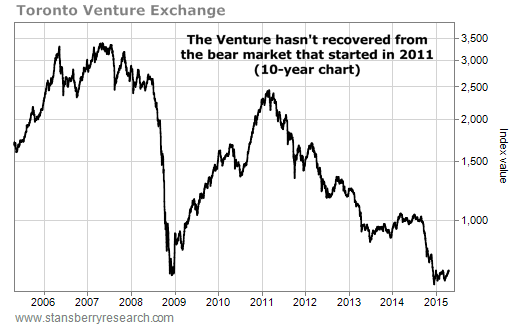 Of course, buying at the bottom is always easier said than done. Nobody wants to buy an asset when it has been crushed. People have lost a fortune and they're mentally scarred from the experience. But the point of maximum pessimism is almost always the best time to buy. So while you may not love the idea of buying resources today, if you have a long enough time horizon (say, three to five years), we believe carefully selected junior resource stocks will eventually trade for multiples higher than their current price.
We're so bullish about the opportunity in resources that we're co-hosting a world-class resource conference with Sprott Resources in Vancouver this July. It's called the Natural Resource Symposium. We'll hold the meeting at the Fairmont Hotel in Vancouver beginning on Tuesday, July 28.
You'll hear from Rick Rule and Porter, of course. But Rick has also arranged for some of the top mining executives in the world to attend this conference... guys you rarely see speak publicly.
For example, mining billionaire Robert Friedland of Ivanhoe Mines will speak. I saw Friedland speak at a conference in Hong Kong. It was one of the best presentations I've ever seen.
You'll also hear from Sprott Resources founder Eric Sprott, Franco-Nevada CEO David Harquail, Silver Wheaton CEO Randy Smallwood, Eldorado Gold CEO Paul Wright, and many others.
In short, you'll hear from the CEOs of many of the companies we've written about for years... companies we think are the best in their industries. If you're thinking about investing in resources, we can't think of better people to speak with.
In addition, you'll also hear from Stansberry Research editors Steve Sjuggerud and Matt Badiali, and Casey Research founder Doug Casey.
It's going to be a great show.
Again, the dates of the Natural Resource Symposium in Vancouver are July 28-31.
You can purchase a discounted ticket if you act before May 1. After that, prices rise by $300 a ticket. You can get the full details here. We hope to see you in Vancouver.
New 52-week highs (as of 4/17/15): Blackstone Group (BX) and Kinder Morgan (KMI). A subscriber writes in with an energy-related question, and our in-house resource expert responds. Send your questions and comments to feedback@stansberryresearch.com. "Do the U.S. crude oil storage capacity numbers reflect just total land based tank storage capacity? What about storage in anchored crude oil tankers? Is this practical? Could it be profitable? Are any tankers even available? Are the number of available empty tankers simply insignificant compared to global production capacity?" – Paid-up subscriber David Griffin
Matt Badiali comment: The typical numbers we see are for the oil stored in Cushing, Oklahoma, where the benchmark West Texas Intermediate (WTI) crude oil price is set. That's a critical location in terms of oil production, but it really only represents about 19% of our country's crude oil storage capacity.
What's interesting is that most of the media report "record volumes" in storage. What they fail to say is that in terms of capacity, we aren't at an all-time high. The storage expansion in Cushing has outpaced the volume increase. Today, we're at 77% capacity. (Back in March 2011, capacity hit a record 91%.)
Tankers will be employed if the contango (when today's price is less than a commodity's futures price) gets large enough. Analysts at consultant firm JBC Energy expect 30 million to 60 million barrels to be stored in tankers in the first half of 2015. That's about half of the 100 million barrels we saw stored due to the contango in 2009.
However, I don't think this situation is as dire as the media make it out to be. Contango is typically short-lived... because it's profitable. Once we have a huge volume of oil sitting in storage, the futures price will come down because there is a potential tsunami of oil waiting to hit the market.
Regards,
Sean Goldsmith
April 20, 2015
