

The Big Risk in 'Perfect' Stocks
Market 'darling' Under Armour reports another stellar quarter... Shares crash anyway... The big risk in 'perfect' stocks... Get ready for some serious volatility in natural gas... Badiali: It's time to get bullish on coal... The best risk-versus-reward trade in the market right now...
 Under Armour (UA) reported another stellar quarter this morning...
The super-popular athletic-apparel maker reported revenue of $1.5 billion in the third quarter – a 22% increase from a year ago, beating analyst estimates. Earnings were even better... They grew 28% to $128 million, or $0.29 per share, again beating estimates of just $0.25 per share. The company also noted revenue from its new footwear division grew 42%, e-commerce revenue grew 29%, and international sales grew a huge 74%.
In short, it was yet another strong quarter for the company. As CEO Kevin Plank highlighted in the statement, "This marks our 26th consecutive quarter of 20%-plus revenue growth, demonstrating the strength of the Under Armour brand."
Why do we bring this up? Because shares plunged as much as 15% this morning, to a new two-year low...

It seems Wall Street wasn't happy with the company's growth forecast. As Bloomberg reported...
The company said on Tuesday that it expects revenue to increase in the low 20% range during 2017 and 2018. That would be the slowest pace since 2009, the year the last U.S. recession ended. Under Armour also said that apparel sales are rising more slowly in North America than it previously expected...
It also gave a fourth-quarter sales forecast of 20% growth, missing the 22% estimate of analysts.
In other words, the stock is crashing because the company "only" expects to grow at a low 20% rate over the next few years.
As we've discussed many times, this is the problem with owning growth stocks that are "priced for perfection." (Even after today's plunge, UA shares are trading at an expensive 55 times forward earnings.)
When a company is trading at a lofty valuation like this, anything less than perfect results – or even perfect forecasts, in this case – can send shares plunging.
Think of it as the opposite of the "bad to less bad" scenario our colleague Steve Sjuggerud often mentions... Things don't have to get "bad" for the share price to drop. Things only have to get a little "less great" for the bottom to fall out.
Get ready for some serious volatility in natural gas...
Bloomberg reports the natural gas market has gone into "backwardation."
If you're not familiar, futures markets – where natural gas and other commodities trade – are typically in one of two conditions: "contango" and "backwardation."
In simple terms, contango occurs when future (or "forward") prices are higher than the spot price for a particular commodity, while backwardation occurs when forward prices are below the spot price.
According to Bloomberg data, most futures markets are in contango most of the time... ranging from nearly 100% of the time in gold and silver to about 55% of the time in crude oil.
This makes sense... Futures prices are roughly equivalent to the spot price plus some "cost of carry" – how much it would cost to hold that commodity in storage for the future. So you would naturally expect prices to be higher further out into the future.
It's usually only during significant supply or demand changes – such as when bad weather wipes out an entire year's wheat crop, or like in recent years when oil production was expected to increase significantly in the future – that the situation reverses.
This is particularly true in natural gas. In fact, we haven't seen a similar scenario in at least 10 years. As you can see in the chart below, gas for delivery this year and next is trading significantly higher than prices through at least 2022...

The current extreme follows a recent U.S. government report that natural gas supplies are likely to fall in 2016 for the first time in 11 years.
We should note that supplies remain near an all-time high currently, but this move suggests the market is concerned that could change as the winter heating season begins. As Bloomberg reported over the weekend...
The curve signals unusual volatility in the gas market for the next year as rising exports and diminishing output from shale basins stoke concern that output won't be enough to prevent price shocks in the winter, the peak season for heating demand...
"When we have in gas a backwardation, it's a unique development," said Francisco Blanch, head of global commodities and derivatives research at Bank of America Corp. in New York. "The market is asking for producers to increase supply. You might get some spikey price behavior."
The upcoming winter will be "more susceptible" to those price spikes, potentially sending gas to $4 to $5 per million British thermal units depending on how cold it gets, he said. Blanch sees gas averaging $3.50 in 2017 to encourage more production.
Making matters worse, early forecasts suggest this winter could be significantly colder than the last. More from Bloomberg...
This December through February may be 20% colder than the same period a year earlier, Jason Setree, a meteorologist with Commodity Weather Group LLC in Bethesda, Maryland, said in e-mail Friday.
Meanwhile, natural gas has never been more important to U.S. electricity generation. Thanks to the Obama administration's "war on coal" – along with the shale boom that pushed natural gas prices to multiyear lows – hundreds of coal-fired plants have been retired or converted to natural gas over the past few years.
According to the U.S. Energy Information Administration ("EIA"), natural gas generation surpassed coal generation on a monthly basis for the first time in April 2015. By the end of last year, natural gas and coal each accounted for about one-third of U.S. electricity production. And according to the latest data from the EIA, natural gas will account for 35% of U.S. electricity generation in 2016, while coal will account for just 30%.
In other words, any weather-related price spikes could be further amplified by record demand from natural gas-fired power plants. As Stephen Schork, president of energy consultant Schork Group, summed it up to Bloomberg, "There is a lot of fear being priced into the futures curve... Any sort of return to a normal winter means demand is going to be extraordinarily strong."
Badiali: It's time to get bullish on coal...
As we alluded to earlier, the ongoing "war on coal," along with cheap natural gas prices, has crushed coal demand.
Prices have plunged nearly 50% since 2011... and coal companies have been decimated. Matt notes nearly 50 have gone bankrupt in that time, and coal stocks – as tracked by the VanEck Vectors Coal Fund (KOL) – crashed 90%.
Given this backdrop, you may be surprised to hear our colleague Matt Badiali, editor of the Stansberry Research Resource Report, recently turned bullish on the sector.
Why, you ask? Precisely because he also believes natural gas prices are likely to go higher. As he explained in the October issue...
Thanks to low oil prices and fewer oil wells in production, natural gas production is falling (and as regular readers know, lower supply generally leads to higher prices). U.S. gas production is down 1% from June 2015 to June 2016 (the latest data available). And it's down 7% from its peak in January 2016.
At the same time, natural gas consumption is up and climbing... In 2015, we consumed 75.2 billion cubic feet per day (Bcf/d). The EIA forecasts a rise to 76.4 Bcf/d in 2016. (We've averaged 77.6 Bcf/d through July this year.) The EIA analysts think that will climb to 77.1 Bcf/d in 2017.
That means we have a situation where supply is falling and demand is rising. That should be enough change to push natural gas prices to the $4-per-Mcf range.
The recent backwardation in natural gas is simply one more reason to believe higher prices are likely. And Matt says this could be great news for coal. In short, while the coal industry is unlikely to return to "boom times," it's also not going away any time soon. And this presents an opportunity...
When we talk about investing in coal today, we also have to talk about what's happening in natural gas... You see, big power companies usually own both coal and natural gas power plants.
Take American Electric Power (AEP), for example. This giant Columbus, Ohio-based power company owns five natural gas power plants and another five coal plants. When natural gas is cheap, it can increase power production from its gas-fired plants and dial back utilization of its coal plants. When coal is cheap, it ramps up the coal power and eases back on natural gas.
That means if natural gas prices rise, coal demand should rise alongside them as power companies shift their emphasis from one fuel to the other.
As Matt noted, rising coal demand is just half of the story. The recent bust has wiped out a lot of supply as well...
Remember all those bankrupt coal companies? Well, they closed a lot of their mines. In the first half of 2016, coal production went down 32% from 2014 and 25% from last year. So it won't take much increase in demand to lift prices...
With coal, we have a hated commodity that fell 90% from its peak. It has begun a rally, and it has a tailwind thanks to rising natural gas prices. These factors will go a long way toward making us money.
In the October issue of the Stansberry Research Resource Report, Matt recommended two great ways to profit from a rebound in coal...
One is a "best of breed" coal producer that yields around 8% today... The other is a junior coal mining "survivor" that could quickly soar triple digits as Matt's thesis plays out.
If you're not already a Stansberry Research Resource Report subscriber, you can get instant access to the October issue with a 100% risk-free subscription. Click here to learn more.
The best risk-versus-reward trade in the market right now...
Elsewhere in the commodities market, our colleague Jeff Clark – editor of the Stansberry Research Pro Trader – believes copper is offering a fantastic trading opportunity.
In fact, Jeff says buying copper today around $2.09 per pound offers one of the best risk-versus-reward trades in the market right now. As he explained in our free Growth Stock Wire e-letter this morning...
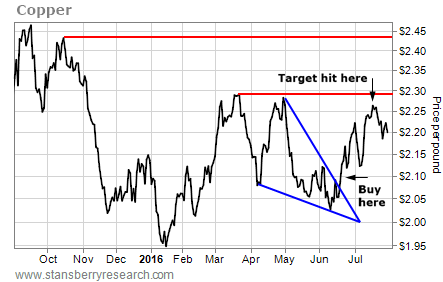
Back in June, copper traded for $2.10 per pound and the chart had just turned bullish. At the time, copper had broken out to the upside of a bullish falling-wedge pattern. And we were looking for a move up to the next resistance level at about $2.28 per pound.
That's exactly what happened. Take a look...
It took only one month for copper to reach our price target. Traders could have made 7% on that trade in just one month.
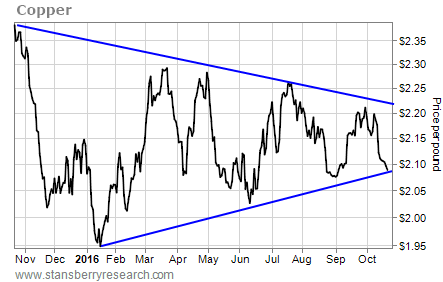
Jeff says copper is offering a similar opportunity today...
As you can see, copper has made a series of lower highs and higher lows – forming a large triangle on the chart. This is a consolidating pattern, which helps to build energy for the next big move... But with the price of copper sitting right on its support line, this is a low-risk area for traders to step up and buy the metal.
Traders who buy copper right here at $2.09 per pound can set a tight stop on the trade at $2.07. If the support line doesn't hold and copper breaks down from here, traders can exit the position for a small loss. On the other hand, if the support line holds and copper bounces from here, it will likely move back up toward the resistance line at $2.22. That would be a gain of more than 6% from Friday's closing price.
By buying copper right here, traders are risking $0.02 in order to make $0.13. In other words, this trade has six-and-a-half times more reward than risk. That's a good setup for a trade.
While Jeff has had success trading copper this year... his track record with gold has been absolutely incredible. In fact, in just four months this year, he closed out gold trades for nine years' worth of profits.
It sounds unbelievable, but it's true. And until tomorrow, you can learn Jeff's gold-trading strategy for yourself. Click here for all the details.
New 52-week highs (as of 10/24/16): CONE Midstream Partners (CNNX), Nuveen Floating Rate Income Opportunity Fund (JRO), Microsoft (MSFT), Paycom Software (PAYC), iShares MSCI Global Metals & Mining Producers Fund (PICK), TTM Technologies (TTMI), and ProShares Ultra MSCI Brazil Capped Fund (UBR).
Have you followed Jeff Clark's gold trades this year? Tell us about your biggest winners. Drop us a line at feedback@stansberryresearch.com.
Regards,
Justin Brill
Baltimore, Maryland
October 25, 2016