

The Investment Story of Steve's Career
The investment story of Steve's career... Expect 500% to 1,000% gains after this major announcement... The calm before the storm?... 'Rates are driving everything'… Two companies just got paid to borrow money... Negative-yielding 'high yield' debt is coming… The ECB stands pat… Apple announces a new iPhone...
 Before we begin today's Digest, a major announcement...
Steve Sjuggerud – one of our best-known and most respected analysts – has discovered an exciting new opportunity.
We spent $100,000 sending Steve and his team to research this opportunity... And while we can't give away the details just yet, we can say it is going to be BIG. In fact, Steve is already calling it "the investment story of my career." (And if you know anything about Steve, you know he doesn't say things like that often.)
The last two times we were this excited about an investment idea, we launched a brand-new research letter to take advantage...
| 1. | The first was Stansberry's Credit Opportunities, our distressed-bond research letter. Since launching in November, every single recommendation in the portfolio has gone up in value – with an average gain of 19%. |
| 2. | The second was Stansberry Gold & Silver Investor, focused on precious metals and precious metals stocks. The 17 stock positions recommended in this service are up an average of 50% in just five months. |
These are extraordinary gains. But Steve's announcement next week has the potential to blow them both out of the water...
This opportunity is like a second chance to profit from leading tech giants Google and Amazon... before they dominated the Internet.
This corner of the market is extraordinarily cheap right now... and could skyrocket hundreds of percent. Steve expects gains of 500% to 1,000%.
He's pulling back the curtain on this opportunity in an exclusive live presentation next week on Wednesday, September 14. Again, we can't spill the details just yet... To receive an invitation for Wednesday's event, sign up with one click right here.
And be sure to read to the end of today's Digest for the newest essay from contributing editor P.J. O'Rourke, who just returned from a month-long trip to Australia with an interesting perspective...
It has officially been a record-breaking summer...
Over the last 40 days, the Dow Jones Industrial Average ("DJIA") has moved in a range of just 2.27%. According to Dana Lyons, partner at J. Lyons Fund Management, this is the least volatile period in at least 100 years.
And it isn't even close... Lyons notes the next tightest range – 2.53% – was from December 1922 to February 1923.
August's calm has continued through the first full trading week this month. But don't get complacent...
The Stock Trader's Almanac notes in past election years, both the DJIA and the S&P 500 Index have peaked in early September and then declined through most of October. The Nasdaq has historically rallied until mid-September before turning lower.
In short, it's still too early to assume September will buck its historical trend this year.
That makes Marko Kolanovic – JPMorgan's global head of derivative and quantitative strategies – concerned...
He notes the recent period of low volatility has led so-called "systematic investment" funds – funds that make asset allocations based on volatility levels and/or momentum – to load up on near-record amounts of stocks. According to Kolanovic, this means even a small increase in volatility could trigger a significant decline. As he explained in a note on Wednesday...
Record leverage in these strategies... could push the market lower and volatility higher, if there is an initial catalyst to increase volatility. In fact, we may not even need a specific catalyst, apart from the seasonal increase in market volatility that is typical for September and October...
When it comes to deleveraging of systematic strategies, even this seasonal increase in realized volatility would produce outflows of ~$100 billion, which could push the market lower.
We've discussed several other reasons for caution today, including dismal earnings and worsening credit conditions. Now you can add "cross-market contagion" to the list...
Credit Suisse's cross-market contagion indicator tracks relationships between stocks, bonds, currencies, and commodities. And it shows prices are more connected than at any time since the indicator was created in 2008.
Yes, you read that correctly... By this measure, market movements are even more correlated now than during the heart of financial crisis, when virtually every asset was falling in tandem.
What accounts for this rare situation? According to Credit Suisse, it's simple. As Bloomberg reported this morning...
An increase in correlations is fodder for skeptics who look at declining U.S. earnings and rising valuations and argue that the only explanation for record highs in U.S. stocks this summer is Federal Reserve policy.
"Rates are driving everything," Mark Connors, Credit Suisse's global head of risk advisory in New York, said by phone. "At a minimum you have to be aware of the influence of central banks. What's moving the market is people's demand for yield and return. Fundamental analysis doesn't explain the movement higher from here."
Speaking of central banks, regular readers know the European Central Bank's ("ECB") quantitative easing ("QE") program has distorted markets and pushed yields on a huge amount of sovereign debt into negative territory.
But the bizarre consequences of the program – which was expanded to include European corporate bonds this summer – continue to ripple through the market...
Today, roughly 700 billion euros' worth of investment-grade corporate bonds – more than 30% of the entire sector – are trading at negative yields, according to the Wall Street Journal. That's up from roughly 5% of the market in January.
But this corporate debt is merely trading at negative yields. No European companies had actually issued negative-yielding debt. Until now...
On Tuesday, German household-products giant Henkel and French pharmaceutical company Sanofi (SNY) issued a total of 1.5 billion euros' worth of new bonds at yields of minus 0.05%.
That's right... Two European companies are now being paid to borrow money. Investors who purchase these bonds and hold until maturity are guaranteed to lose money.
Why would anyone willingly buy this debt? It depends on whom you ask...
Some analysts say it's a cheaper alternative to European government bonds, which are trading with even lower yields. As one bond trader – who just so happened to have worked on both of yesterday's offerings – told the Financial Times...
"Investors can park their cash in a higher-yielding instrument than is usually available," said Rupert Lewis, head of European bond syndicate at BNP Paribas, who worked on both deals.
Two-year German bunds yield minus 0.67%, so the Henkel bond offers investors a premium of 52 basis points over the so-called risk-free rate on sovereign bonds.
Of course, not all traders are so optimistic. The Wall Street Journal cited Edward Farley, head of European corporate bonds at PGIM Fixed Income...
We're trying to get our heads around it... It seems pretty bizarre to ask a corporate to look after your money and give you back less in two to three years' time.
Bizarre is one word for it. Insane is another.
But the madness doesn't end there...
Bloomberg notes the short-term debt of several junk-rated companies – including automaker Peugeot and HeidelbergCement – is currently yielding a little more than 0% and falling. According to Bank of America analysts, it's only a matter of time before negative-yielding "high yield" bonds become a reality.
Buying negative-yielding investment-grade corporates is one thing... You're guaranteed to lose money, but at least you can be fairly certain the company will return most of your principal.
Who on Earth would pay to own risky junk bonds? We may soon find out...
In the meantime, the ECB held its latest monthly policy meeting this morning.
The bank left interest rates unchanged. It also stopped short of extending its QE asset-buying program, which currently runs through March 2017.
ECB President Mario Draghi noted the bank had lowered its forecasts for growth and inflation. He said the changes were "not substantial enough to warrant a change in policy" at this time, but added, "there is no question about the will to act, or the ability to do so."
The market sold off following Draghi's remarks. Apparently, "investors" were disappointed he didn't announce more stimulus. But don't let today's news fool you... We don't expect the ECB to change course anytime soon...
The most recent data show eurozone inflation was still just 0.2% in August. This remains well below the ECB's long-held target of 2%. Yet, by all accounts, the ECB still believes it's on the right track. As the Wall Street Journal reported this morning...
Despite that failure, Mr. Draghi issued a defense of the central bank's stimulus measures, saying they had boosted lending to households and companies, and ended a situation in which borrowers in southern Europe paid higher interest rates than their northern European counterparts.
"While in the previous time we had observed fragmentation and very subdued credit developments, now we can say fragmentation is over and credit is growing constantly," he said. "I conclude that our policy has been very effective."
Finally, consumer-electronics giant Apple (AAPL) debuted its new iPhone 7 on Wednesday...
As expected, the company announced several incremental improvements – including a faster processor, a better camera, and a water-resistant design – but failed to deliver any significant new features.
Most pundits were unimpressed. But the market simply yawned. The stock essentially went nowhere... as it has for most of August.
This is the latest phone revamp for the company after iPhone sales have declined for the past two quarters... the first-ever declines in history for its most popular product.
However, our colleague Dr. David "Doc" Eifrig believes Apple is worth billions more... even if the latest iPhone isn't a hit. As Doc mentioned in the May 17 Digest following the company's earnings report...
There's no reasonable explanation for why Apple isn't worth more than its current valuation.
People are obsessed with growth these days and are hypersensitive to the news. The headlines trumpeted Apple's earnings miss as if it were the death of the company. Short-sighted investors sold. But Apple remains one of the most profitable and healthiest companies in the history of the world. No headline or tweet should cause you to forget that.
Since then, shares have rallied nearly 20%. But our colleague Ben Morris agrees the opportunity in Apple isn't over yet.
As he pointed out to his DailyWealth Trader subscribers last week, Apple has been in a cooling-off period since the beginning of the year, and looks to be forming a bottom...
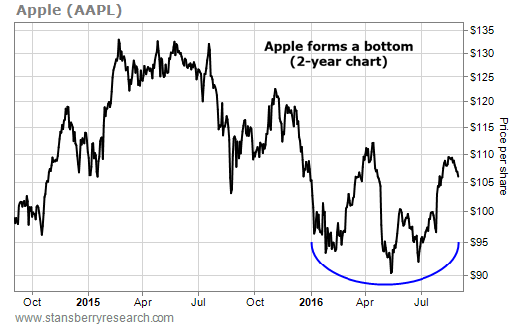
But Ben doesn't suggest waiting for a pullback to make a trade on Apple. As he explained in the issue...
In its most recent quarterly earnings announcement, Apple reported a 15% drop in sales and a 23% drop in earnings per share, from the same quarter a year earlier. It sounds terrible... But shares jumped 6.5% in one day on the news.
Then, news came out that Apple will likely have to pay a $15 billion fine for its accounting practices in Europe. That's 2.6% of the company's market value... But shares barely budged. Both of these reactions show that investors are starting to see Apple as a good value today... and that shares may be getting ready to climb higher.
As we mentioned at the outset of this Digest, Steve will detail an opportunity next Wednesday, September 14, that he's calling "the investment story of my career."
Imagine getting another chance to invest in Apple... before the iPhone was released. What if you could go back and invest in the technologies behind Microsoft... Google... or Amazon... before they soared? Steve says this opportunity is just as big and potentially lucrative... a rare "second chance" to invest in the fastest-growing technology companies in the world.
Best of all, he says this opportunity is within reach of every Stansberry Research subscriber, regardless of account size. Make sure you're on the RSVP list with one click right here.
New 52-week highs (as of 9/7/16): Bancroft Fund (BCV), Black Stone Minerals (BSM), Cisco (CSCO), WisdomTree SmallCap Dividend Fund (DES), ProShares Ultra MSCI Emerging Markets Fund (EET), Western Asset Emerging Markets Debt Fund (ESD), First Trust Developed Markets Small Cap AlphaDex Fund (FEMS), iShares Core S&P Small-Cap Fund (IJR), Paycom Software (PAYC), VanEck Vectors Russia Fund (RSX), Spectra Energy (SE), Guggenheim China Real Estate Fund (TAO), and Invesco High Income Trust (VLT).
Another light day in the mailbag... Surely, we've done something to please (or upset) you. Let us know at feedback@stansberryreserach.com.
Regards,
Justin Brill and Steven Longenecker
Baltimore, Maryland
September 8, 2016

Editor's note: Would it be a blunder to go Down Under? Renowned humorist and Stansberry Research contributing editor P.J. O'Rourke has just returned from a trip to Australia. So when people threaten to move there if certain candidates win office, P.J. can offer the pros and cons...
And today, he shares the first of a two-part column about what's ideal – and what's real – about living in "Oz."
P.J. will also be in Las Vegas for our upcoming conference later this month. Learn how to stream the event live from the comfort of your own home right here.
'If So-and-So Wins... I'm Moving to Australia,' Part I
"If [reviled candidate] wins, I'm moving to Australia" is a phrase we've all heard a lot during this presidential campaign.
With the two most-hated presidential candidates in history facing off against each other... is it a crazy response to the 2016 U.S. election? Well, my family and I just came back from nearly a month in Australia. And we've decided we're crazy, too!
This was my fourth extended visit and my second with my wife and three kids. I polled the household. We all love Australia. (The polling included two teenagers, at least one of whom, at any given moment, hates everything.)
"G'day, mate!" is Australia's unofficial motto. Everybody who passes by salutes you that way. I swear the Aussies say it to inanimate objects. (I was an inanimate object for a couple of days after the 15-hour plane flight from Los Angeles.)
Australians are so friendly that cab drivers will get out of the taxi and open your door for you. They accept a tip of any size (or none at all) with heartfelt gratitude. Bartenders go through their list of beers like jewelers helping you select the absolutely perfect engagement ring. Waiters are more concerned about how you liked your meal than your mom is. (But they're never bossy if you don't finish all your vegetables.)
A jet-lagged American, speeding through Australia's polite and affable customs inspection, worries about the nation's mental health. Is the whole of Australia on a manic jag? And is there an epidemic of obsessive compulsive disorder? The entire country seems neat and clean.
Then, when an American – who is finally relaxed and cheerful – leaves one of Australia's sparkling, uncrowded airports to arrive back in the "bus stations of the sky" we have here in the States, the American feels like Oscar the Grouch crawling back into his garbage can.
Australia is wonderfully spacious, only 23 million people in a country that's 95% the size of the continental U.S. That's like America with 296 million fewer people stepping on your toes. And it has 16,000 miles of coastline. If every one of Australia's 8.4 million families went to the beach at the same time, they would each have a 22-foot-wide space for a picnic. Your kid would have to be an Olympics-quality beach volleyball player to be able to kick sand on anybody else's kid.
It's even a pleasure to hear the residents of Sydney complain (with a smile, of course) about their rush-hour traffic. During morning drive time, Sydney looks like Los Angeles at 2 a.m.
Australia has a great climate and plenty of it. There's every kind of weather that nature can cook up. You can roast in the sun on Queensland's Sunshine Coast, bake in Western Australia's 500-mile-wide Great Victoria Desert, chill (and ski) in the snowy mountains of New South Wales, or stew in the Daintree tropical rainforest on Australia's northern tip. But mostly you'll be enjoying a refreshing cocktail of mild winters and breezy summers as if you're in San Francisco without the fog (or the political correctness).
Australia's scenery is so spectacular that it makes liars out of the people who write the country's tourism brochures. You want to take those brochure writers and give them a shake and shout, "Put in more superlatives! Add more exclamation points!!!!!"
And the best part of the scenery is the part that can barely be seen. Only little bits of the Great Barrier Reef are visible at low tide. But grab a snorkel and you'll feel like you're jumping off your couch and swimming right into your flat-screen TV playing Finding Nemo on Netflix.
... Except without the scary parts. Well, without most of the scary parts. Watching your kids make their first scuba dive is scary... although the kids thought it was wonderful. And their scuba instructor was a true Aussie, much calmer and more pulled together than Nemo's dad.
Australia's famously odd animals do not disappoint in their famous oddities. The web-footed, duck-billed, egg-laying platypus is all that and more. The males also have poisonous spurs on their hind legs. (Maybe to keep normal mammals from making fun of them.)
An echidna looks like a porcupine using a soda straw after getting a haircut from the barber at Parris Island. There really is something called a wombat – a sort of yard-long gerbil with a bad attitude. If a cat married a rat and their offspring mated with a pit bull, you'd have a Tasmanian devil. Now release it into the wild. It's endangered. And you will be, too, if you try holding on to it.
My guess is that God created the animals of Australia on the last day of His workweek – during cocktail hour.
The birds of Australia are just as fabulous. They're flamboyantly varied in size and shape and utterly uninhibited in the colors of their plumage. Walking through Sydney, there seems to be something wrong with the flock of pigeons. That's because what you're looking at is a flock of cockatoos.
The birds are also utterly uninhibited – to put it politely – in the noise they make. It sounds more like garbage men emptying trashcans in the morning than larks at dawn.
In bird school, when the subject of "birdsong" was being taught, Australia's birds were at the back of the classroom, giving each other noogies and throwing spitballs.
But no country is perfect. Australians also insist on driving on the wrong side of the road. Do not try to teach them the error of their ways by setting an example like I did. Good-natured as Australians are, I got honked at a good bit for being in the same lane as oncoming traffic.
Here's a secret for driving in places like Australia, New Zealand, England, and Ireland: Pretend you're a fashion model who supports Bernie Sanders. Think to yourself, "Look right! Keep left! Look right! Keep left!"
Speaking of such, you won't be able to completely escape nutty politics by moving to Australia. Nutty politics are everywhere these days. Australia has a parliamentary system. Who's in charge can change quickly. And does it ever. Australia has had five prime ministers in the past six years.
But it won't bother you as much. Australian political parties are hard to tell apart. To begin with, the conservative party is called the Liberal Party. It's in a coalition with the National Party, which represents rural and small-town voters and should be called the Local Party. The liberals who are opposed to the Liberals vote for the Labor Party, even though most people who do actual physical labor are pretty conservative and vote Liberal.
Meanwhile, instead of Canada geese, Australian golf courses have kangaroos. A large male can be more than six feet tall and weigh 200 pounds. I'm told they can be aggressive. You'll want your driver, not your sand wedge.
Furthermore, although Australians love to watch sports, they love to watch go-on-get-outta-here-you're-kidding-me sports. Aussie-rules football is like American football if nobody who played football had ever heard of helmets, shoulder pads, or the forward pass. The rules are hard to figure out because, as far as I can tell, there aren't any.
I don't mind. I'm a diehard New England Patriots fan. We're famous for our "no rules" attitude. Plus, with Tom Brady benched for the first four games and key defensive end Rob Ninkovich suspended, I've not only given up on American politics, I'm about to give up on the NFL, too.
So if whichever candidate you revile the most wins the election in November, I'll be right there in the stands wildly cheering for the Sydney Swans and loudly yelling at the guy who's playing the "half-forward flank" position (whatever that is) to do... whatever the guy who plays the half-forward flank position is supposed to do.
Or that's what I say.
We love Australia, but should we move there? And could we move there?
I've done my due diligence. I've studied the pros and cons. And next week, in the second installment of my column, I'll fill you in about what a move to Australia would really mean.
Regards,
P.J. O'Rourke
P.S. I hope to see you in Las Vegas for Stansberry Research's upcoming conference. But if you're not able to attend in person, consider signing up to stream the event from home. Learn more here.
|