

The Next Country to Experiment With Negative Interest Rates?
The next country to experiment with negative interest rates?... Japan could be planning to slash rates again... A brewing 'war on business'... History says this is bad news for stocks...
 Could negative interest rates be coming to yet another major economy?
In an interview with UK newspaper the Evening Standard on Friday, Bank of England ("BOE") rate-setter Gertjan Vlieghe was asked if the BOE could follow others by pushing rates below zero. His response may surprise you...
"I think interest rates could go a little bit negative," he said. But unlike his counterparts in Europe and Japan, he clearly admitted there are some serious potential downsides to negative interest rate policy ("NIRP") as well...
Even if you are willing theoretically to consider negative interest rates, there is only so far that they can go negative before you start worrying about the thing that central bankers have been worrying about all these years – which is, "Not only am I not getting any interest paid on my money in the bank, it is now potentially going to charge me, in which case I won't keep my money in the bank, I'll just take it out and keep it at home."
Once that happens, that is almost certainly negative for the economy because then you undermine the whole bank funding model... so we want to stay well away from that scenario.
Vlieghe said this "switching point" is probably somewhere between -0.75% and -1%, and noted that he wouldn't "even want to get close to" that range because he wasn't exactly sure. For comparison, rates for the eurozone and Japan are currently no lower than -0.4%.
We commend Vlieghe for his honesty. It's rare to hear central bankers admit there are downsides to their policies.
But even he suffers from the most common and dangerous central banker conceit... The belief that he knows better than the market what interest rates – the price of money – should be. And while we appreciate his caution, we can't help but think he's wrong...
Despite negative rates well above this range, European banks have been crushed... Japanese citizens have been buying home safes like there's no tomorrow (suggesting they're already hoarding cash)... and gold demand has been soaring around the world.
We'd hate to see what Vlieghe's worst-case scenario looks like.
Meanwhile, it appears the Bank of Japan ("BOJ") is planning to push rates even further into negative territory, only with a twist...
According to a report from Bloomberg Business, the BOJ is considering a new two-pronged initiative that would add a positive incentive for banks – a "carrot" – to go along with the "stick" of negative rates.
The plan would push short-term rates even lower... meaning banks would be charged even more for keeping reserves with the BOJ. But it would also push rates on the BOJ's "Stimulating Bank Lending Facility" into negative territory as well. This means the BOJ would pay banks to borrow money and lend it to customers.
In other words, the BOJ would be taking with one hand and giving with the other.
Why would they do this? In theory, the plan would encourage banks to lend more...
In simple terms, negative rates – as they've been implemented so far – act like a "tax" on the banks. They're punished for keeping reserves at the central bank. This was supposed to lower other interest rates across the economy and encourage banks to lend more to help make up the difference.
But while interest rates have fallen, bank lending hasn't improved. And because banks have generally been unable or unwilling to pass this "tax" onto customers, their profit margins have gotten crushed.
With this new plan, banks would still have to pay to keep reserves at the BOJ, but the BOJ would also pay them to lend.
Again, in theory, banks would be "taxed" less and would lend more. But that may not be the case.
It appears the BOJ believes banks are choosing not to lend. But data suggest it may be loan demand that's the problem... Their customers don't want (or can't afford) to take on more debt. From Bloomberg...
In Japan, where the sub-zero rate became effective in February, a survey of senior loan officers showed this week that banks' profit margins from lending to highly rated companies dropped to the lowest level in almost a decade. The BOJ's quarterly survey also showed that demand for credit from large, medium, and small-sized firms all dropped.
"This wouldn't address the underlying structural problem for the banks, which is not a loan supply issue but a demand issue," Jefferies Group LLC analysts including Mac Salman wrote in a report.
In short, despite the rhetoric, this plan is likely just more of the same.
Unfortunately, it could be just a matter of time before NIRP makes its way to the U.S. If all of the world's major reserve currencies begin paying negative interest rates, the Federal Reserve will have to follow.
But that isn't the only threat we're watching...
Regular readers know there's been a boom in mergers and acquisition (M&A) activity over the past few years.
There were more than $5 trillion of deals announced in 2015... eclipsing the previous record set at the top of the last business cycle in 2007.
Businesses have become so desperate for growth in this environment that they've resorted to more and more "creative" tactics... such as once-obscure "tax inversion" deals.
You may have heard about tax inversions in the news. They allow large U.S. companies to merge with a smaller, foreign business in a country with a lower corporate tax rate than the U.S. These tax savings allow companies to boost profit margins – essentially "manufacturing" growth.
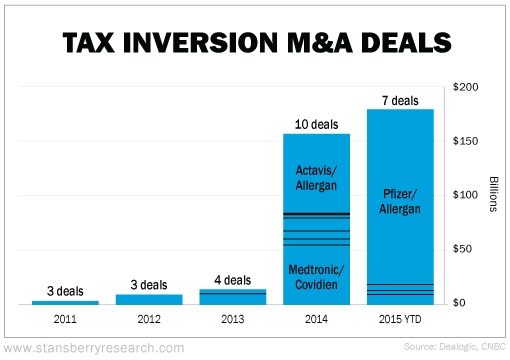
As you can see in the chart below, adapted from a graphic published on financial-news network CNBC's website late last year, the money involved in these deals exploded over the past few years...
But less tax revenue means less money for politicians to spend. And politicians LOVE to spend money...
They run for office on campaign promises like free health care, free college tuition, a standard living wage, and tax cuts for the masses. They know ordinary folks are likely to vote for candidates who give them the most "freebies." And the more tax revenue that comes in, the more promises they can make.
These big inversion deals, as our friend Doug Casey likes to say, starve "the beast" that is the U.S. government.
But now "the beast" is fighting back...
In the graphic above, the big blue bar on the right represents just one massive M&A deal – the proposed Pfizer/Allergan $160 billion tax inversion deal.
And earlier this month, the Treasury department introduced new rules to block it. Treasury Secretary Jack Lew said the move wasn't made "retroactively" to thwart any specific deal. But not everyone agrees...
Allergan CEO Brent Saunders told CNBC that he believes the government targeted his company's deal with Pfizer specifically. He said he was "blindsided" by the announcement, noting the companies had already come to an agreement and had followed all laws and regulations as required. As he explained after the new rules were announced...
For the rules to be changed after the game has started to be played is a bit un-American, but that's the situation we're in. We built this deal around the law, the regulations, all the notices that were put out by the Treasury and it was a highly legal construct. We followed the rules that Congress had set for companies looking to move to foreign domicile.
But that isn't the only big deal to come under heavy U.S. government scrutiny of late...
Earlier this month, we also learned that the U.S. Department of Justice is suing to block the massive proposed merger between oil services giants Halliburton (HAL) and Baker Hughes (BHI), citing "competition concerns." As USA Today reported at the time...
U.S. antitrust division chief Bill Baer delivered a blistering rebuke of the deal, saying it was so anti-competitive that it should never have made it out of the boardroom. He argued that a merger of two of the three largest U.S. oilfield services companies posed a "serious" threat to competition and "wasn't fixable."
"I have never seen one that poses so many antitrust problems in so many markets," Baer, an assistant attorney general, said in a conference call. "Our lawsuit should surprise no one."
The two companies originally announced plans to divest as much as $7 billion in assets in an attempt to ease the government's concerns. But as of this morning, financial magazine Barron's reports the deal is now likely off.
In just the past few weeks, we've seen a handful of other skirmishes as well...
United Airlines (UAL) gave up on plans to buy competitor Delta's (DAL) takeoff and landing times at Newark Liberty International Airport, which the feds had also sued to block.
Canadian Pacific Railway (CP) ended its bid for Norfolk Southern (NSC), the second-largest railroad in the eastern U.S., due to pressure from U.S. lawmakers.
Meanwhile, the Federal Trade Commission has challenged the proposed merger of Staples (SPLS) and Office Depot (ODP). It's also closely scrutinizing other deals, such as the merger between health insurance giants Aetna (AET) and Humana (HUM), insurers Cigna (CI) and Anthem (ANTM), and even beer giant Anheuser-Busch InBev's (BUD) proposed acquisition of SABMiller (SAB.L).
We fear these fights could signal the beginning of a much bigger trend... a brewing "war" between the U.S government and big business.
And it appears we aren't alone...
By now, you've probably heard of the FBI's fight with consumer-electronics giant Apple (AAPL) over iPhone privacy.
The FBI asked Apple to help unlock the iPhones of the San Bernardino shooters. Apple refused, instantly becoming a martyr to privacy advocates everywhere...
More recently, we learned that Microsoft is now suing the U.S. government for other privacy concerns... The company says that the feds have been secretly spying on its customers for years and not allowing the company to notify these customers that their data is being accessed by government agencies.
Regardless of your feelings about the U.S. government or big business in general, there's no denying this could be trouble...
A "war on business" would represent another big headwind for U.S. stocks and the economy... and there's no telling just how far it could go.
Speaking of headwinds, our colleague Steve Sjuggerud just shared some surprising data about U.S. stocks and unemployment...
In last Friday's edition of our free DailyWealth e-letter, Steve noted that "initial jobless claims" – the number of people applying for unemployment – hit a 42-year low last week.
While this sounds like great news, history says it's often been terrible news for the market. Here's Steve...
It may surprise you to hear it, but the stock market typically performs its best after BAD news on the employment front... When the initial-jobless-claims number is high (which means a lot of people are out of work), stocks actually perform incredibly well going forward...
Going back to 1973, whenever initial jobless claims were 500,000 or more, stocks soared an incredible 24% over the next year. (We looked at a four-week average of jobless claims to smooth out the weekly jobless numbers.)
Today, Steve says we have the opposite extreme. At just 247,000, fewer folks are applying for unemployment than any time since 1973. And history says this is actually bad news for stocks. More from Steve...
When the jobless-claims number is below 280,000, stocks lose money at a rate of 13% a year. (Again, we looked at when the four-week average was below 280,000, not just the weekly number.)
Don't get hung up on the specific return figures. Pay attention to the overall point... The U.S. economy, it appears, is healthier than previously thought, based on the latest jobless numbers. And history says that's not a great thing for stocks.
This is one piece of evidence that could mean the end of the great boom in stock prices might be closer than many people think.
Longtime readers know Steve has been one of the biggest bulls on the U.S. stock market over the past several years.
He predicted the Federal Reserve's unprecedented "easy money" policies could cause the bull market to go on longer than almost anyone expected... and so far, he has been exactly right.
Now, Steve is getting cautious, and it's just one more reason to be careful today.
New 52-week highs (as of 4/22/16): Becton Dickinson (BDX), Lundin Gold (LUG.TO), Medtronic (MDT), Nuveen Municipal Value Fund (NUV), and Regions Financial – Series B (RF-PB).
In the mailbag, several subscribers respond to Porter's Friday Digest. Let us know what you think at feedback@stansberryresearch.com.
"I saved today's Digest so I can periodically read it to remind myself how insolvent the world really is today. I just purchased a lot more gold and silver coins and bars last week. I'm also raising cash in this rally and will buy more metals upon any dip in prices. I have no idea what the catalysts will be to spark the bear, but I believe the 2008 downtown will pale in comparison to the next one. Thanks for your insight as always." – Paid-up subscriber Charlie T.
"Porter, this April 22, 2016 Digest states it better than I have ever seen it stated. We (our citizens) are in for an unbelievable crash. I could not have said it better. It is so hard to watch our youth feeling everything is OK and things will just work out. I fear for my kids and grand kids. Their futures may be in for serious trouble. I grew up in the forties and fifties. Those were the best times in history. Things were slow, sure, and wonderful.
"Today we live in a world of speed, deception, you owe me, instead of a life of help, save and what can I do for you today. The world's population will riot and they won't know what to do. Thank you for clarifying, in very good English, what we can expect. Please never stop your banter; I love that fact that some Americans can still talk about and understand what made us great." – Paid-up subscriber Charles Wentling
"Great essay Porter. You have incredible talent with words. I envy you. You've put everything I've ever wanted to communicate to my wife and children into a short essay. Thank you. You asked for feedback about what we've observed. So here goes.
"I own a handful of rental properties in Metro Detroit. The one disturbing thing I notice is the amount of taxes, fees, and licensing mandated by the local municipalities. In order to get a roof installed (legally) I have to pay $235 in fees for a $5200 roof job. Water heater? $130. JUST TO GET A PERMIT. My water heater installer charges about $800. 16% over and above the job cost goes to the city government. Outrageous.
"Then, there is the approximately $100 annual fee (depends on the city) for a landlord license. What does a landlord get in exchange? Nothing. But if you don't have the license you cannot evict a tenant until you get the license.
"I have no idea what city inspectors earn. Whatever it is, it's too much. But it must be far less than what property owners are charged for inspections and permits. All the extra fees go to fill a budget shortfall to pay for big new buildings, SUV's for the employees, and pensions. Taxpayers are milked to pay for the retirement of city employees who are long gone. It is maddening that my taxes today pay for a government employee who hasn't provided a benefit to anybody living in the city for 10 or 20 or 30 years.
"What will happen when the system starts breaking down again? Or when GM (a major employer around here) goes bankrupt again? Property values will plummet (again) and city budgets will suffer (again) and I can only assume that fees and tax rates to property owners will skyrocket (again). It's ugly, Porter. But while the money is easy to get everything looks just fine. Thanks for all your learning me Porter." – Paid-up subscriber Matt V.
"Your writings and warnings on the 'big picture' economic trends are one of the greatest benefits of being a Stansberry Research subscriber and why I'll be a customer for life." – Paid-up subscriber Kris K.
Regards,
Justin Brill
Baltimore, Maryland
April 25, 2016
|