

The 'War on Business' Is Growing...
The 'war on business' is growing... Another deal is dead... A mind-boggling new M&A record... Retail is getting crushed... New highs for this double-digit dividend-payer...
 The U.S. government's "war on business" has claimed another casualty...
Last month, we discussed how the government has grown increasingly hostile toward "tax inversions" and other large mergers and acquisitions ("M&A") deals.
In just the past couple of months, we've seen various branches of the federal government block mergers or deals between pharmaceutical companies Pfizer (PFE) and Allergan (AGN), oil-services companies Halliburton (HAL) and Baker Hughes (BHI), railroads Canadian Pacific Railway (CP) and Norfolk Southern (NSC), and airlines United Continental (UAL) and Delta Air Lines (DAL), among others.
It's also closely scrutinizing other proposed deals between health-insurance firms – like Aetna (AET) and Humana (HUM), and like Cigna (CI) and Anthem (ANTM) – and even beer giant Anheuser-Busch InBev's (BUD) proposed acquisition of SABMiller (SAB.L).
Yesterday, we learned it has successfully stepped in to end another large deal...
A federal judge ruled Tuesday in favor of the Federal Trade Commission ("FTC") to block the proposed $6 billion merger between office-supply companies Staples (SPLS) and Office Depot (ODP).
Ironically, the ruling cited a "reasonable probability" that the merger would lead to higher prices – not for consumers, but for large corporations that buy office supplies in bulk. This was despite some clear weaknesses in the government's case. As the Wall Street Journal reported this morning...
Staples Chief Executive Ronald Sargent said he was disappointed the judge sided with the agency "despite the fact that it failed to define the relevant market correctly, and fell woefully short of proving its case"...
After the FTC spent two weeks presenting its case... Staples and Office Depot chose not to present a defense, arguing that the FTC's case was lacking and a defense was unnecessary.
The FTC's legal team at times struggled during the court proceedings, including on one occasion when the judge questioned whether commission lawyers had improperly urged an Amazon.com Inc. witness to play down the company's plans to compete with Staples and Office Depot.
Shares of both companies plunged on the news... Staples shares fell as much as 19% this morning, while Office Depot crashed nearly 40%.
A separate piece in the Journal shows the government's moves are having a massive effect on the market already...
According to data firm Dealogic, $378 billion of deals have been called off in the U.S. so far this year (and that figure doesn't include today's $6 billion deal). This is not only the largest number of year-to-date cancellations in history... it's also the largest total for an entire year.
Yes, you read that right: More deals have been canceled so far in 2016 than any other full year in history... and we're not even halfway through the year.
As we've discussed, big U.S. companies are already suffering from a decline in real earnings.
Corporate profits have declined for three straight quarters. That hasn't happened since the financial crisis in 2009. Corporate revenues are worse, having fallen for five straight quarters. That didn't even happen during the financial crisis.
Regardless of your feelings about the government or big business in general, there's no denying this growing "war on business" is bad news for stocks.
The news for the retail sector – which includes both Staples and Office Depot – went from bad to worse this morning following dismal earnings reports from department-store chain Macy's (M) and watch maker Fossil (FOSL).
Macy's fell 12% after reporting a weaker-than-expected 6% decline in same-store sales and slashing its full-year earnings and sales forecasts. Fossil plunged nearly 30% today after reporting terrible sales and earnings.
Analysts expect similarly bad results when Nordstrom (JWN), Kohl's (KSS), and several other retailers report earnings later this week. Clearly, the market agrees...
The U.S. retail sector – as measured by the SPDR S&P Retail Fund (XRT) – declined nearly 4% today. Nordstrom, Kohl's, and Dillard's (DDS) all fell more than 5%. Michael Kors (KORS) plunged more than 11%. Even Wal-Mart (WMT) and Target (TGT) fell more than 4% each. Online retail giant Amazon (AMZN) was one of the few bright spots, up 1.5%.
Traditional retailers are suffering as consumers cut back on spending in general, and give more of what they do spend to online and discount stores. And there are no signs this is slowing. As Macy's CEO Terry Lundgren put it, "We are not counting on the consumer to spend more."
Regular Digest readers know Porter believes the real troubles for retailers are just beginning. As he explained in the April 29 Digest...
The U.S. consumer has been powering the global economy (thanks to a strong dollar and strong credit growth). Those trends are going to reverse, significantly, as our economy goes into recession. That will hurt the retail sector and, indirectly, commercial real estate, which always gets hammered during recessions and will get hammered doubly hard this time.
Think about the amount of empty mall space. It's great that Amazon's earnings are soaring, but what that also means is malls are dying. Sooner or later, all of this empty commercial space will begin to hurt commercial real estate in general. Those malls are going to end up as office complexes and apartments... something nobody has figured out yet.
Over the last five years (during the most recent boom), XRT shares are up 67% (compared with the Dow Jones Industrial Average's 39% gain). That outperformance is purely a function of credit expansion. Commercial real estate, despite the drag of mall space, is up 34% over the last five years... These sectors are going to completely fall apart this summer. And you'll know why.
In February, our colleague Ben Morris showed his DailyWealth Trader subscribers how to collect a safe 12% yield, courtesy of one of the world's most respected investors. From the February 26 issue of DailyWealth Trader...
Jeff Gundlach is one of the world's top bond experts. One of his specialties is mortgage-backed securities... And he sidestepped major losses during the housing crisis by moving money into government-guaranteed bonds.
Gundlach now manages $85 billion in his fund, DoubleLine Capital. And one of his predictions for 2016 is that the Federal Reserve won't raise interest rates more than once, if even that.
But right now, investors are valuing assets as if the interest-rate hikes will continue. If Gundlach is right, this means a lot of assets are mispriced...
You see, rising interest rates cause most income investments to fall. Investors know this. So when they expect interest rates to go up – as they do today – they're not willing to pay as much for these investments. They "price in" the risk associated with rising interest rates.
That's why Gundlach is buying Annaly Capital Management (NLY).
Longtime readers may be familiar with Annaly. It's what's known as a mortgage real estate investment trust ("MREIT"), or what our colleague Steve Sjuggerud calls a "virtual bank."
Unlike traditional REITs, Annaly invests only in government-guaranteed mortgage bonds. It borrows money at low, short-term interest rates and buys mortgage bonds paying higher, long-term rates. It then earns the "spread" or difference between those two rates, and pays out most of that money in dividends.
As Ben explained, it's a simple business model. When short-term rates are low or falling, Annaly is incredibly profitable.
But when short-term rates go up, Annaly's cost of borrowing goes up, too. The spread it can earn shrinks, and dividends fall. This means when short-term rates are moving higher – or when folks simply think they'll be going higher soon – Annaly is less attractive.
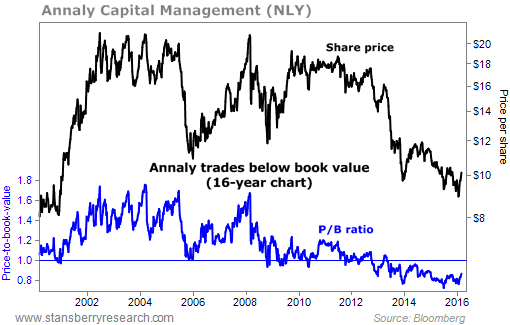
This is what happened recently, and it caused Annaly to trade at a big discount. More from the issue...
As you can see in the chart below, Annaly normally trades above its liquidation value, or "book value." But right now, it's trading at a 13% discount...
As Gundlach said in a recent Barron's interview, "I think for the year 2016, the hikes will be less than what the Fed thinks. And so that risk is overly priced in." He considers Annaly "a way of sidestepping credit risk while getting a yield that's higher than junk bond funds."
Today, Annaly pays a large, 11.8% dividend yield. And according to Gundlach, "it's very unlikely that that dividend will get cut." I suggest buying shares of Annaly [now]... It's one of the safest ways to earn a double-digit yield today.
Shares of Annaly closed at a new 52-week high yesterday, and they rose again slightly today. Subscribers who took Ben's advice are up more than 10%... and they're still in line to collect an 11% annual income stream.
If you still haven't had a chance to watch the replay of last week's TradeStops live training event, be sure to do so soon. This full presentation will only be available to the public until tomorrow night at midnight Eastern time. Click here to view it now.
New 52-week highs (as of 5/10/16): Becton Dickinson (BDX), Johnson & Johnson (JNJ), McDonald's (MCD), Medtronic (MDT), 3M (MMM), Altria (MO), Annaly Capital Management (NLY), Nuveen Premium Income Municipal Fund 2 (NPM), Ritchie Bros. Auctioneers (RBA), Constellation Brands (STZ), Sysco (SYY), and ExxonMobil (XOM).
The praise for TradeStops continues to roll in. Send your letters to feedback@stansberryresearch.com.
"I have been using TradeStops from when they started... then was offered a lifetime membership and took it. I think this the best investment I have made. By (using) TradeStops, I cut my losses in 2015 a lot. This helped me to raise cash, rebalance, and set the right position sizes. Also lowered my (portfolio volatility) below 9%. I have to say thank you to TradeStops and you folks for this." – Paid-up subscriber RCH
Regards,
Justin Brill
Baltimore, Maryland
May 11, 2016
|