

The World's Most Dangerous Bank Is in Trouble
The world's most dangerous bank is in trouble... Germany rules out a Deutsche Bank bailout... Analysts turn gloomy on third-quarter earnings... The 'earnings recession' continues... New troubles for junk-rated debt... P.J. O'Rourke shares the highlights from our conference in Las Vegas...
Editor's note: Be sure to read to the end of today's Digest for a special essay from contributing editor P.J. O'Rourke, who shares his takeaways from a dog, a hypnotist, and a convicted felon from our 2016 Stansberry Conference event in Las Vegas.

 U.S. markets opened lower today on new worries about European banks...
According to a weekend report, German Chancellor Angela Merkel has ruled out another bailout of Germany's biggest bank, Deutsche Bank (DB).
Germany's Focus magazine reported Merkel has no intention of stepping in to recapitalize the troubled lender ahead of the country's national elections in September 2017. It also said Merkel will not get involved with the company's ongoing settlement talks with the U.S. Department of Justice ("DoJ").
Today, Merkel's administration stopped short of denying these statements. From a Bloomberg report this morning...
Steffen Seibert, a spokesman for Merkel, told reporters in Berlin on Monday that there are "no grounds" for speculation over state funding for Deutsche Bank, adding that the government expects a "fair result" in the lender's talks with the DoJ.
As regular readers may recall, the DoJ recently asked Deutsche Bank to pay $14 billion to settle mortgage-securities probes dating back to the 2008 financial crisis. This is much greater than the $2 billion-$5 billion settlements most analysts had expected.
While the final settlement is expected to be less than this amount, there are concerns that even a reduced settlement could decimate investors. As we noted in the September 16 Digest...
The DoJ often opens settlement talks with higher numbers than it's willing to accept, and it has allowed Deutsche Bank to submit a counterproposal.
But the huge gap between the DoJ's opening proposal and analyst estimates suggests the government may have a much larger number in mind.
Why is this important? The bank reported in June that it had about $5 billion in "provisions" set aside to cover settlements and fines. But according to analysts at JPMorgan, any settlement exceeding $4 billion would now "pose questions about Deutsche Bank's capital positions."
In other words, even if the DoJ dramatically reduces its settlement, the company could be forced to raise billions in new capital. And this could be a serious problem...
If Germany won't provide a bailout, this burden will fall on shareholders... who could suffer massive dilution even in the best-case scenario. In the worst case – where the DoJ reduces the settlement by a little, and again Germany does not step in – a default isn't out of the question.
Deutsche Bank shares plunged 7% to a new all-time record low. They're now down more than 50% this year alone...
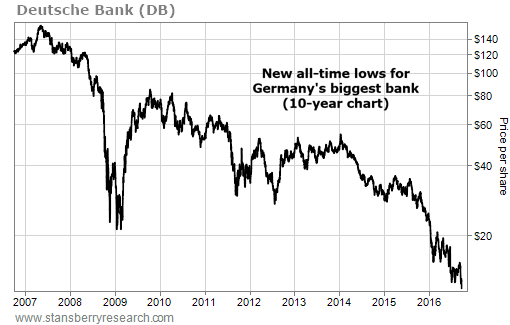
The bank's "additional Tier-1 bonds" (or "AT1s") – the first bonds to take losses in a crisis – also plunged again this morning. They're now trading just pennies above the all-time lows set during the peak of last winter's bond-market panic...
.png)
Of course, what government officials say and what they do are often very different...
Perhaps Merkel intends to make a point this time, and allow Deutsche Bank shareholders to shoulder significant losses. But we remain skeptical she would allow Germany's largest bank to fail outright. It would be a dramatic reversal from recent history.
Still, these are troubling signs for Deutsche Bank shareholders and creditors alike. And if Merkel is serious, the risks may not end with them. As we mentioned in the June 30 Digest...
In a report released this morning, the International Monetary Fund ("IMF") called Deutsche Bank "the most important net contributor to systemic risks." It also warned that the German banking system poses the "highest degree of outward contagion."
In other words, if Deutsche Bank fails, it could take down banks across Europe and around the world.
Here in the U.S., analysts are getting worried the corporate-profits "recession" will continue...
As regular Digest readers know, S&P 500 Index companies have reported five consecutive quarters of earnings declines through the second quarter of this year. But many analysts predicted this quarter would finally be the quarter when U.S. companies returned to earnings growth.
That is no longer the case...
According to the latest poll by market-research firm FactSet, analysts now expect earnings to decline 2.3% in the third quarter.
This would represent the sixth straight quarter of falling earnings... the longest slump since at least 2008. Worse, it would occur despite an improvement in the two biggest "headwinds" for earnings in recent years. As the Wall Street Journal reports...
Many of the factors pressuring U.S. corporate earnings in recent quarters – including a stronger dollar and falling oil prices – have abated in 2016. The WSJ Dollar Index, which measures the U.S. dollar against a basket of 16 currencies, is down 4% this year, versus up 8.6% for all of last year, and the price of U.S.-traded crude oil has risen 20% in 2016, rebounding from its extreme lows.
Still, those moves haven't been enough to project an end to the earnings recession.
On a brighter note, analysts now expect earnings growth to return in the fourth quarter of the year instead. (Though skeptics might point out they were saying the same thing about this quarter less than three months ago.)
Of course, none of this has kept stocks from hitting new highs...
The Journal notes that since the contraction began in March 2015, the S&P 500 has risen about 4.7% and hit 15 fresh record highs.
But while stocks keep climbing, the credit markets continue to urge caution.
Regular readers know defaults have been rising for months. As Porter noted in the September 9 Digest...
We know for sure that a new default cycle has begun because not only are banks tightening, but credit downgrades (by the ratings agencies) have bottomed (in 2014) and continue to grow substantially.
Likewise, outright default rates have bottomed and continue to grow rapidly. Morgan Stanley's top high-yield bond analyst (Meghan Robson) believes the default rate in high yield will hit 14% by the end of 2017 (it was basically zero in 2014). She also says the total default rate will peak at 25% annually within five years.
But junk bond defaults aren't the only concern...
Junk-rated companies have borrowed hundreds of billions via leveraged loans as well. And much of this money is benchmarked to the three-month U.S. dollar London interbank offered rate (or "Libor").
If you're not familiar, Libor is simply the rate at which banks lend each other short-term money. It's a key interest rate for the banks... and the leveraged loan market.
The first "domino" in a series of benchmarks is the 0.75% level...
When that level is breached, a number of junk-rated companies are required to pay more on their floating-rate debt. Three-month Libor is currently at about 0.85% – or one-tenth of a percentage point more than the minimum "floor."
Libor has been rising as a result of new rules for money market funds that begin in October. As Bloomberg reports...
Under the regulations, investors in funds that buy short-term corporate obligations can suffer losses when the value of the assets falls. Funds that only invest in short-term government debt are not subject to the new rules, which has made government-only money market funds much more popular in recent months.
As investors have had less demand for funds that invest in short-term corporate debt obligations, issuers have had to boost yields, lifting benchmark rates
Unfortunately, the current "floor" could be just the beginning...
About $230 billion worth of debt is benchmarked to the 0.75% mark, according to Bloomberg data. But most of the debt in the $900 billion leveraged loan market is set to a Libor floor of 1%.
When the 1% level is breached – and analysts at JPMorgan Chase recently predicted Libor could reach 0.95% by the end of this month – the real trouble could begin.
Finally, we'll close today with something that has absolutely nothing to do with the financial markets...
As you may have heard, our colleague Steve Sjuggerud put on a concert during the Stansberry Conference in Las Vegas last week. And it was a big hit with attendees...
Most folks we talked to expected Steve to stand up and strum a few chords... But instead he showed that he is as talented a musician as he is an investment analyst.

Steve Sjuggerud's guitar skills impressed conference attendees.
Some folks have asked about the crazy guitar Steve was playing. It was built by Rick Toone, who Steve calls "the most creative electric guitar builder in 50 years." And the unusual sounds coming out of it were actually developed by one of our own paid-up subscribers, who is a legend in the music business.
Interested readers can check out a video of Steve's performance right here.
New 52-week highs (as of 9/23/16): none.
Were you at Steve's concert? Let us know what you thought at feedback@stansberryresearch.com. Meanwhile, in today's mailbag, several female readers weigh in on subscriber Rob Wilson's comments on diversity last week...
"I wholeheartedly agree with Rob Wilson. It would seem that long-term success is better attained by looking for the best possible resource without regard to 'race, color, creed or gender.' I attended a Stansberry Conference in Dallas that had a focus on natural resources. Leslie Haines, editor of the Oil & Gas Investor, was one of the speakers. I am sure that she (as would I) would be offended at the idea that she had been selected based upon the fact that she is a woman rather than for her experience and credentials.
"As a woman, I cringe every time I hear someone make such comments. I have to assume that Don T.'s daughter is a wonderful person who has been inundated by our society's endless propaganda stream." – Paid-up subscriber Brenda R.
"Responding to Rob Wilson and Don T comments... I, too, noticed the lack of female and minority speakers, as Don T's daughter did. I also AGREE wholeheartedly with Rob Wilson's response! It does not matter who can provide the advice and/or entertainment, if it is useful, timely, or entertaining!
"You may not have noticed, but the Corporate Counsel Women of Color 12th Annual Career Strategies Conference was across the conference hall from [the Stansberry Conference last week]. So the first day (Wednesday) I spoke to some attendees. To say it politely, it was 'implied' that their conference was for women of color ONLY.
"Now, I realize that 'white' is not technically a color. (In physics, a color is visible light with a specific wavelength. Black and white are not colors because they do not have specific wavelengths. Instead, white light contains all wavelengths of visible light. Black, on the other hand, is the absence of visible light.) However, I would argue that a Caucasian is not technically 'white' either. How sad that ANYONE would close their minds or attention to people of opposite sex, color, gender, etc. We can all learn from each other, but that does not mean I will insist on having a woman or non-white speaker. I want to LEARN, not be politically correct!
"I will say that as a long-term Alliance member, I have noticed a difference in the composition of males/females in the meetings. There are definitely more women attending than in the early years. That said, perhaps more men in the conferences and Alliance meeting will stop asking me which Alliance member I came with!" – Paid-up Stansberry Alliance subscriber Ann
"Hello, I would like to say that I agree... And I'm a woman! I too am so tired of hearing that minorities, women, etc. should be better represented. Whatever happened to hire according to your credentials and experience?
"I can proudly say that I have been a loyal subscriber to various Stansberry Newsletters for close to 14 years. I manage my 4 kids (now adults) investment accounts, my 81-year-young dad's investment account, and my husband's 401(K) account totaling close to a million dollars. So far this year, all three accounts average 39%. My dad never graduated from high school but he diligently saved and invested. My kids had the luxury of saving young. And my husband and I always contributed to our 401(K) and lived below our means to save and invest.
"Where did I learn to invest? Mainly your newsletters and a big curiosity and love of learning on my part. I do have a BA in Commercial economics and have worked in tax preparation and bank auditing. But I didn't learn a thing about investing or world economics during that time! I also took Mark Ford's advice years ago and invested in real estate rentals and I will be making more in 'retirement income' than my husband who has worked for the same company for 30 years! Thanks Mark.
"I don't care if the teacher is man or woman, young or old, college educated or not, black or white – if they can help me be a better investor. Thanks for all your hard work!!" – Paid-up subscriber Sonja M.
"I saw a comment about the first couple days of the conference from a subscriber and his daughter that I would like to address. He and his daughter imply that it is a problem that there were no female speakers. I hope you won't try to include women or minorities just because of their sex or race. I hope you will make your decisions about who will speak based on their capabilities and knowledge alone." – Paid-up Stansberry Alliance subscriber Diane
Regards,
Justin Brill
Baltimore, Maryland
September 26, 2016
Investing Lessons From a Dog, a Hypnotist, and a Convicted Felon
Of course, it was fun... Porter does fun.
And of course, it was smart... Stansberry subscribers don't do stupid.
If you weren't at the Stansberry Conference last week at the Aria Resort and Casino in Las Vegas... you should have been. Because the Stansberry Conference is a full-course meal for the mind (with some great meals for the mouth in between at Aria's array of excellent restaurants).
It's not an experience that can be easily summed up in print. The Stansberry Conference isn't a stick of investment Juicy Fruit gum that I can chew up and spit out in a Digest column.
So I won't try. I'll just point out that all of Stansberry's go-to people were there to talk and, what's more important, to be talked to personally – Porter, Steve Sjuggerud, Doc Eifrig, Jeff Clark, Dan Ferris, Matt Badiali, and more.
The guest speakers shed light on the entire electromagnetic spectrum of investment, from the X-ray wavelengths of portfolio insights to the ultra-low frequency of perfect trading opportunities.
I was taking notes using the "MEGO" index ("My Eyes Glaze Over") and I'm happy to report that not a single presentation caused any naps in the audience.
To name just five of the more than 30 vastly engaging, startlingly informative speakers...
| • | Steven Eisman – the real-life hero behind the movie The Big Short. |
| • | Todd Buchholz – former White House director of economic policy and genius at clearing the murk of econ. |
| • | Robert Edsel – bestselling author of The Monuments Men, about saving Europe's cultural treasures from the Nazis. He's an expert on that intersection where art, money, and politics collide. |
| • | Raven Zachary – pioneer and entrepreneur in the fast-emerging field of unbelievable 3D augmented-reality devices. (They have to be seen to be disbelieved!) |
| • | Hugh Herr – mountaineer and director of the Biomechatronics Research Group at MIT, a double amputee who created bionic legs so good that he can now climb mountains better than he could on the legs he was born with. |
For me, personally, the high point of the conference was the Tuesday morning "Great American Liberty Panel" featuring Porter, Ron Paul, and Buck Sexton, host of The Buck Sexton Show on TheBlaze Radio. Buck is a former CIA officer at the National Counterterrorism Center who has done tours of duty in Iraq and Afghanistan.
For me, personally, it was the high point because I got to moderate the panel. (I was more than a little honored. And more than a little awed.)
Naturally, the subject was this year's confounding election.
Porter is dismissive of politics from a "top down" perspective. He feels politics is a big hole in the ground. It's always going to be there, and you shouldn't step in it.
Dr. Paul is dismissive of politics from a "bottom up" perspective. He has been in the hole. He served 12 terms in Congress and ran for president. When I asked him how we should mark our ballots in November, he said, "Don't vote. It's a scam."
Buck thinks we had better take a good look at the scam going on down in the hole of politics and try to figure out how to fill the hole with the "least worst" candidates.
It was a great panel discussion (even if the panel moderator does say so himself). But – and it's no surprise, given this year's confounding election – the discussion probably didn't win the Stansberry Conference "Cheerful Optimism" award.
Fortunately, the conference was also full of happy surprises – about opportunities in the short term, strategies for the long term, and technological developments soon to come.
And here was the biggest surprise for me: The best pieces of investment advice I got at the Stansberry Conference came from a dog, a hypnotist, and a convicted felon.
Mike Ritland is a former Navy SEAL, professional dog trainer, and founder of Trikos International, a firm that provides bomb-sniffing, drug-detecting guard and patrol dogs for SEAL teams, the Department of Homeland Security, the Department of Defense, and private security services.
A good "warrior dog" and a good investor turn out to be made the same way – with breeding, training, and sticking to the plan.
Breeding is key. Actually, who your sire and dam are doesn't matter much in you as the investor. But it really matters in your investments. Who "conceived" this financial venture? What is their "business bloodline"? Do they come from a strong, healthy, assertive, and loyal "litter" of enterprises? Or are they mangy curs and stray mutts?
Training is what Stansberry – and Ritland – is all about. Nobody becomes a good investor without the ability to obey the commands of economic laws, market forces, and common sense. We all know too many investors who can't learn the difference between "sit" and "fetch."
Then Mike brought his dog Rico out on stage. Rico did everything Mike told him to do as soon as Mike told him to do it, the way a well-bred, well-trained dog should. But Rico was so well-bred and well-trained that when Mike put a thick padded sleeve on his left arm and gave the command, Rico attacked his own master!
Was there ever a better lesson for investors? No matter how much you love an investment and no matter how good that investment has been to you in the past, when the command comes from economic laws, market forces, and common sense, bite the hand that feeds you.
Joel Silverman gave a hypnotic presentation. Which makes sense, since Joel is a hypnotist. Just the fact that hypnosis exists gives investors something to ponder. We can all get hypnotized by the markets. "Watch the market go back and forth, back and forth, back and forth. You are falling into deep s&^%."
Joel snapped us out of it with a brilliant exhibition of his skills. More than a dozen audience volunteers were sent into a trance on stage and provided with subconscious suggestions that made for hilarious scenes.
My favorite was when the volunteers were told that "ladies and gentleman" was a filthy, disgusting, and utterly offensive phrase. Then Joel turned to the auditorium and said, "Thank you, ladies and gentlemen..." The volunteers jumped to their feet and began yelling at Joel, telling him to be ashamed of himself, to apologize to everyone in the room, to never say anything like that again and – as one fellow in a particularly deep trance put it – "Shut the f*&% up!"
But besides the entertainment, Joel was making a bigger point. The subconscious mind is a powerful force. It is a source of immense strength, but sometimes it's also a source of ridiculous confusion.
Joel showed how the subconscious is the reservoir of everything we have in our mind. Be careful what you put in your reservoir. The subconscious can be tapped to provide us with great powers of concentration, focus, and endurance. But you need more than just your "gut instincts."
The conscious mind is where your clear thinking and rational decisions get done. And that, Joel explained, is why even the best hypnotist can't get people to do something they think is wrong.
When the tick-tock of the markets is putting you under, tell your subconscious what Joel told his volunteers: "You will now wake up feeling relaxed, confident, and full of renewed self-determination."
Then came the convicted felon, Andrew Fastow. He gave the Stansberry Conference's final – and to my mind, most powerful – talk. Fastow is the former CFO of Enron who spent six years in federal prison for... following the rules.
Fastow was the architect of the preposterously complex and amazingly opaque "off-balance-sheet special purpose entities" that Enron used in its quarterly balance sheets to conceal the corporation's massive losses.
Fastow knew what he was doing was deceptive, but he didn't think it was "wrong." He had consulted Enron's lawyers and outside counsel and Enron's bookkeepers and independent auditors. They all told him that his financial shenanigans obeyed the letter of the law, conformed to SEC regulations, and dotted the Is and crossed the Ts of generally accepted accounting practices.
"I followed the rules," Fastow said, "but I forgot the principles."
Even after he was convicted, he didn't really feel he was guilty. It wasn't until he had to explain to his teenage son why he was in prison that everything became clear to him.
He told his son, "Suppose I had a rule that you could drive to a party, but you couldn't drink beer there. And when you got to the party, a friend said, 'I know you're not allowed to drink beer. But I have beer pills. They have the same effect as beer, but you won't be breaking the rule because, technically, you didn't drink beer.'"
Fastow asked his son, "Would you take the beer pills?"
"Of course not," his son said. "It would go against the whole point of the rule."
"That," he said, "is why your father is in prison."
Fastow asks the question: How many companies and corporations are following the rules but forgetting the principles in their accounting, market evaluations, tax compliance, conference calls with analysts, and footnotes in their annual reports?
Fastow answered the question: Most of them.
How did a dog, a hypnotist, and a convicted felon make the Stansberry Conference so valuable to me? Use your "warrior dog" nose to sniff out good investments. Be sure that those investments come from a great business bloodline that obeys the commands of free enterprise. Apply all the powers of your conscious and subconscious mind to your investment strategy. And always remember that good principles are at the heart and in the soul of good investing.
Regards,
P.J. O'Rourke
|