
Time to get nervous... More easing in Europe... Wal-Mart disappoints... Treasury yields hit lowest since October... Cisco surges... Trading for income works again... Your last chance to make $2 million 'doing nothing'...
 "I am nervous. I think it's nervous time."
Billionaire hedge-fund manager David Tepper expressed reservations about the stock market at the SkyBridge Alternatives ("SALT") investing conference currently underway in Las Vegas.
Tepper, who runs Appaloosa Management, is one of the best hedge-fund managers in the world... and certainly the highest paid. He made $3.5 billion last year.
But he doesn't feel the need to use flowery language when talking markets... He makes his point simply. And it's usually correct.
Expanding upon his above statement, Tepper told the audience:
|
And he told the audience the market is "getting dangerous" and "don't go too friggin' long."
In particular, Tepper is more worried about deflation than inflation today because "I've never lived through it." And he hopes the European Central Bank will ease in June... "If the ECB does this [easing] thing, the market's probably OK. If they don't do this thing, it's not OK."
We'll discuss Europe in a moment...
It's worth listening to Tepper's market views. He's one of the few guys who gets it. Following the subprime crisis, Appaloosa Management returned 132% – profiting from the rebound in financials.
And in September 2010, when the Federal Reserve pledged to backstop the economy, Tepper got even longer... "What, I'm going to say, 'No, Fed, I disagree with you, I don't want to be long equities'?" he said on CNBC at the time. "We're a bond place, but we changed up to a little bit more equities recently."
As the market trades at all-time highs today, thanks to the trillions of dollars the Fed has created, we see Tepper's move was prudent.
We agree with Tepper's assessment today. The general consensus at S&A is that we're in the seventh inning of the market's bull run... certainly closer to a top in the market than the bottom. We're still long the market, but we're cautious. That's why Porter has begun making short recommendations for his Investment Advisory subscribers, to prepare for a market downturn.
In the January 2014 issue of True Wealth, Steve Sjuggerud went long European equities. He said the Bernanke Asset Bubble – the resulting price inflation from the Fed's quantitative easing – was moving overseas.
Mario Draghi, the head of the European Central Bank, was talking about holding down interest rates (taking a so-called "dovish" stance). Steve wrote:
|
Since then, European stocks – along with the rest of the world's – have marched to new highs.
But the European currency union just reported sluggish gross domestic product (GDP) growth of 0.2% in the first quarter, only half the expected gain of 0.4%. Last week, Draghi announced new stimulus measures will be likely in June. And today, ECB Vice President Vitor Constancio said, "We are determined to act swiftly if required and don't rule out further monetary policy easing."
It looks like Tepper will get his wish for further European easing.
Still, the markets are plunging today... The Dow and the S&P 500 are both down more than 1%.
The world's largest retailer, Wal-Mart, announced first-quarter income of $3.59 billion, down from $3.78 billion a year ago. The company blamed bad weather for some of the decline. Customer visits fell 1.4%. And Wal-Mart estimates cuts to the food-stamp program hurt sales. The stock closed down 2.4% today.
And people are rushing for the safety of Treasury securities. The yield on the 10-year note closed at 2.5%, a low it last hit in October 2013.
One bright spot in the equity markets today is technology giant Cisco (CSCO).
The company beat expectations for quarterly earnings and revenue... It also raised its revenue forecast for the next quarter.
And on the earnings call, CEO John Chambers said he's expecting a "continued, slow, steady recovery" in the U.S.
Shares surged 6% today on the news. And that's good news for DailyWealth Trader readers. On Monday, editor Amber Lee Mason recommended selling puts that expire in June on Cisco... one of her favorite companies to "trade for income." From the May 12 DailyWealth Trader:
|
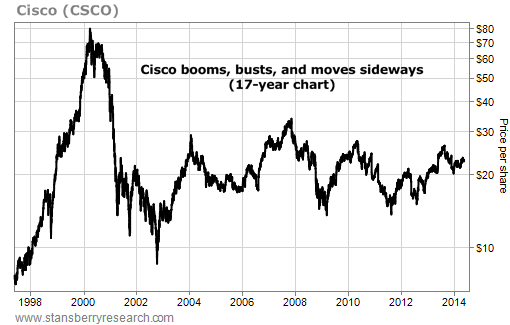
While the stock hasn't gone anywhere, Cisco's business has grown. Sales have doubled and earnings per share are up 141% over the last decade... And Cisco has acquired over 80 companies in that time frame.
Its future growth prospects are good, too. Cisco is well-positioned to take part in big technology growth trends, like the Internet of Things, cloud computing, and Internet security.
With a bigger business and a much lower share price, Cisco is now a lot cheaper than it was during the bubble. It's dirt-cheap. After accounting for its $47 billion cash hoard, shares trade at just 6.9 times forward earnings.
The value of the puts Amber recommended selling on Cisco collapsed today... And they'll almost certainly expire worthless, allowing DailyWealth Trader readers to collect a quick, 2.8% payout on margin.
Cisco is also one of the companies Retirement Trader editor Dr. David "Doc" Eifrig has labeled a "Digital Utility." These are tech firms that produce real products and generate real earnings. Their products and services are so ubiquitous they control near-monopolies in their sectors. (In his most recent Retirement Trader, Doc spelled out the three telltale signs of a Digital Utility.)
Doc's Retirement Trader subscribers will likely also close out their CSCO positions on Friday for a gain of nearly 5% in nine months.
Last Thursday, Steve Sjuggerud hosted a live training event to explain the strategy he uses to rack up huge gains in his True Wealth Systems advisory.
If you're not familiar, True Wealth Systems is Steve's quantitative trading service... In short, Steve and a team of programmers spent years (and a small fortune) designing computer systems to emulate the indicators and triggers that he developed over his career for trading different sectors. (The system works across 40 markets and sectors.)
And how is Steve doing so far in True Wealth Systems?
The average gain for open positions in his portfolio today is 52%... And he has a 92% win rate.
It's an impressive track record. And it has made lots of readers a lot of money. That's why we hosted this event last Thursday... To make sure everyone understood how Steve's system works and how they can use it to improve their trading.
Steve made a special offer to everyone who attended the live training... Unfortunately, the webinar and the special deal Steve offered are over.
But Steve is still offering you a way to get one free year of True Wealth Systems (normally $3,500 a year). But it's only good until midnight tonight. You can learn more here...
Our friends at The Project to Restore America – the political advocacy group Porter founded several years ago in an effort to change America's governance – just passed along a special update on the upcoming political season...
An important Senate primary race took place Tuesday in Nebraska. The GOP is already favored to win the seat in November, so national Republican leadership was watching it closely...
One of the key questions surrounding the primary is whether the winner will be an ally of Senate Minority Leader Mitch McConnell. Our guess is that he won't be.
Two of the candidates, Shane Osborn and Sid Dinsdale, were clear supporters of McConnell. The third, Ben Sasse, was not...
According to a Wall Street Journal article leading up to the election, "Sasse has aired TV ads blasting Mr. McConnell and has trumpeted the endorsement of Sen. Ted Cruz (R., Texas)"...
Sasse won Tuesday's primary with 50% of the vote. Osborn (21%) and Dinsdale (22%) split the other votes.
For what it's worth, after the vote, Sasse pledged his support to McConnell. But of course, he can use the national party's support in the general election. We'll see how long his "make nice" pledge lasts should he get to Capitol Hill.
Sasse has been widely portrayed as a "Tea Party" candidate, representing the loosely defined conservative movement that is challenging the entrenched Republican "establishment" (like Minority Leader McConnell). Much mainstream political commentary has portrayed the election as a Tea Party vs. Establishment showdown.
But our friends at the Project to Restore America say this is misleading...
The Project spent months gathering intelligence and speaking with knowledgeable sources to come up with the "Top Ten Senate Picks 2014" guide to the upcoming elections. The issues factored into their evaluation help identify the candidate who, if elected, could make significant contributions to putting our country and our economy on a sustainable fiscal path.
Ben Sasse is one of the candidates featured in "Top 10 Senate Picks 2014." He is a principled fiscal conservative. When Midland College was nearing bankruptcy, Sasse became the president, implemented balanced budgets, invested in the right areas, and now Midland is Nebraska's fastest-growing college.
The folks at the Project report that he has been consistent in criticizing the ineffectiveness and overspending of both parties in Washington. And as the assistant Secretary of Health for President George W. Bush, he knows firsthand why legislation like Obamacare won't work.
But it's not enough to believe that voting for any so-called "Tea Party" candidate is promoting free enterprise... The Project found that other candidates lumped in that category with Sasse are much less appealing. In many cases, "establishment" candidates actually have stronger track records of supporting personal liberty and robust capitalism.
It is worth learning the "right" candidates before we get further into an important primary season. The Project has compiled its research into a special report. For a limited time, you can receive the report free of charge. Just click here to enter your e-mail address, confirm the action in a separate e-mail, and the Project will e-mail the special report to you.
Be sure to act now before it's too late. Your only source for an epic senate race doesn't have to be the pundits and mainstream media. Get the full story now before it's too late by clicking here.
 New 52-week highs (as of 5/14/14): Brookfield Asset Management (BAM), Energy Transfer Equity (ETE), Market Vectors Small Cap India Fund (SCIF), Sprott Physical Platinum and Palladium Fund (SPPP).
In today's mailbag, a subscriber shares a story about compounding returns... Have you made a fortune by simply buying and holding? We'd love to hear about it... feedback@stansberryresearch.com.
"I have to tell you our little story about Altria. My husband's father died very young leaving four young sons, and his mother took the insurance money and invested it in Philip Morris, a local company, for the boys. Each of them had $1,200 invested in 1981. What with spinoffs and reinvested dividends, that $1,200 has grown to nearly $2 million now. Talk about the power of buy-and-hold!" – Paid-up subscriber Debbi Higginbotham
"I'm a subscriber to S&A and these articles only refer to existing positions. I am interested in recommendations for new positions." – Anonymous
New 52-week highs (as of 5/14/14): Brookfield Asset Management (BAM), Energy Transfer Equity (ETE), Market Vectors Small Cap India Fund (SCIF), Sprott Physical Platinum and Palladium Fund (SPPP).
In today's mailbag, a subscriber shares a story about compounding returns... Have you made a fortune by simply buying and holding? We'd love to hear about it... feedback@stansberryresearch.com.
"I have to tell you our little story about Altria. My husband's father died very young leaving four young sons, and his mother took the insurance money and invested it in Philip Morris, a local company, for the boys. Each of them had $1,200 invested in 1981. What with spinoffs and reinvested dividends, that $1,200 has grown to nearly $2 million now. Talk about the power of buy-and-hold!" – Paid-up subscriber Debbi Higginbotham
"I'm a subscriber to S&A and these articles only refer to existing positions. I am interested in recommendations for new positions." – Anonymous
Goldsmith comment: It sounds like you're confusing the S&A Digest, this publication, with the publication you paid to receive... The Digest is a free, daily letter we send to all paid S&A subscribers. We hope you're getting your money's worth...
For actionable recommendations, please consult your paid subscriptions. If you're not sure which you should be receiving, you can contact customer service at 888-261-2693.
Regards,
Sean Goldsmith
New York City, NY
May 15, 2014

How to make money writing for a living...
It's a topic we know a thing or two about...
In today's Digest Premium, S&A radio host James Altucher shares three ways you can make money writing...
To subscribe to Digest Premium and access today's analysis, click here.
How to make money writing for a living...
Editor's note: Today's Digest Premium is adapted from a recent episode of "Ask Altucher," a new feature on Stansberry Radio, where James Altucher answers listeners' questions on air. Today, he discusses how to make a living by writing...
 Writing for a living is a great way to make a living because you get to do it mostly at home and you can sort of choose your bosses. In many cases, you have multiple people that you're submitting writing to, so no single rejection from a publication will hurt you.
There are basically three ways to make money by writing.
One is by submitting lots of different ideas for articles to publications that pay. This is becoming rarer. I (James) used to make money writing in financial columns, but I would write everywhere. I wrote for the Financial Times, TheStreet.com, Seeking Alpha, Yahoo Finance, and the Wall Street Journal. There are fewer of these opportunities now, so that's not necessarily the route I would go today.
That's an important route to go to build your audience. You want to have people aware of who you are. And the way you do that is by being everywhere. I wrote for all of these different publications, so suddenly, people knew who I was in the financial space... even if I wasn't getting paid.
Gradually, I started writing in other spaces. I wrote for a yoga site. I wrote for various self-improvement sites, and so on. So I was always looking for different opportunities to expand my audience and expose myself to different audiences.
The second way is to write a book. And a lot of people ask me, "OK, I wrote my first book, I published it, now how do I market it?" The best way to market a book is to write a second book. Books feed off each other. If people read your second book, they're going to say, "Oh, this was good. I'm going to go back and read this person's first book."
What if your second book doesn't get any traction? Write a third book. Write a fourth book. Write a fifth book. Write 40 books.
Write more and more books. They don't have to be 300 pages... They could be 30 pages. They could be 20 pages. They could be 80 pages. Just write something that's important, something that's important to you that you have knowledge about, that you've researched, that people want to know about, and that you have a unique opinion about. Then publish it. Publish 40 different books over time.
– James Altucher
Editor's note: In tomorrow's Digest Premium, James explains his path to success and reveals the third way you can make a living writing.
How to make money writing for a living...
It's a topic we know a thing or two about...
In today's Digest Premium, S&A radio host James Altucher shares three ways you can make money writing...
To continue reading, scroll down or click here.