

Uncle Sam Is a Procrastinator
Editor's note: Don't wait around for Uncle Sam...
Despite inflation reaching multidecade highs and no clear end in sight for today's market negativity, the U.S. government appears reluctant to declare that we're nearing a recession.
But Marc Chaikin, founder of our corporate affiliate Chaikin Analytics, believes a recession could be closer than the government is willing to admit. Marc says that just because Uncle Sam hasn't acknowledged the direction we're going, that doesn't mean you shouldn't start preparing now...
In today's Masters Series, originally from the June 30 issue of the Chaikin PowerFeed daily e-letter, Marc asserts that the U.S. is nearing a recession... details why the government likely won't declare a recession officially anytime soon... and explains why it's critical to form a recession strategy right now rather than waiting...
Uncle Sam Is a Procrastinator
It's unquestionable at this point...
The "rolling crash" has rippled into almost every market sector.
The benchmark S&P 500 Index is down about 20% from its early January peak. And the tech-heavy Nasdaq Composite Index is down nearly 30% from its November 2021 peak.
We're more than halfway through 2022 already, too. It's a bloodbath for investors.
But the government might not officially declare that we're in a recession for months. After all, these bureaucrats first want to prove it with their data.
Fortunately, we can take steps today to get ready before the recession officially starts.
That might sound silly. After all, we can't see the future, can we?
Well, when it comes to recessions... we can. No kidding...
The term "recession" is a backward-looking designation. In fact, it takes six months after the start of a recession just to be able to say we're in one.
That's because the government officially defines a recession as a fall in gross domestic product ("GDP") for at least two straight quarters.
And that's if the government even gets around to it that quickly. History shows us that government economists can wait as long as a year before officially declaring a recession.
But that doesn't change the stark reality we're facing today...
U.S. GDP fell by an annualized 1.6% in the first quarter of 2022. We've gotten our warning shot.
Now, 1.6% might not sound like much to you. But remember, we're talking about a roughly $24 trillion economy...
Imagine that 1.6% decline carrying through the entire year. That 1.6% loss would translate to around $384 billion in lost economic activity.
That's about the same as erasing tech giant Apple's (AAPL) entire year of revenue in 2020. And it's like wiping away more than a decade of revenue from fast-food leader McDonald's (MCD).
This decline is an unquestionably massive event. And I know most investors are feeling it.
We're on the edge of a recession.
It would take a dramatic shift over the next few months to change this inevitability. But you need to know something important...
By the time the government officially calls this recession, we'll likely be near the other side of it.
As I noted, the government doesn't "call" a recession until after it has already happened for at least six months. That's critical for investors to understand...
You see, most recessions don't last much longer than that. Take a look...
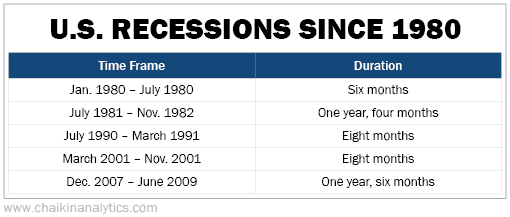
From 1980 through today, all five recessions in the U.S. lasted less than two years. And three recessions didn't even carry on for an entire year.
That means if you waited until the government officially called for a recession those three times... you would've waited until the end of the recession to adopt a "recession strategy." And the other two times, you would've missed a large chunk of the recession as well.
That's a big deal for investors.
To understand, think about the housing bust and the great financial crisis that followed...
The government waited until December 1, 2008 to officially declare that the U.S. had entered a recession. The problem was, it said the recession had started in December 2007 – a full year earlier.
If you waited for the "official call" to protect yourself, you would've lost a lot more money. By December 2007, the S&P 500 was already down roughly 6% from its previous high less than two months earlier. But by December 2008, the index had crashed nearly 50%.
Folks, we're in a similar predicament today...
The S&P 500 is already down a staggering 20%. The economy is in turmoil. And yet, it will take the government at least another month before it even thinks about officially calling a recession.
It could take even longer, too. That's just how the wheels of bureaucracy turn.
So remember, when it comes to protecting yourself and your investments...
You need more than Uncle Sam.
The government is busy dealing with something else. I'm just not sure exactly what.
Good investing,
Marc Chaikin
Editor's note: The government is biding its time, and Marc believes that millions of investors are about to miss out on one of the greatest moneymaking opportunities of their lifetimes...
That's why he recently published a special presentation revealing how his Power Gauge system can help you avoid dangerous stocks in the market and identify the best opportunities to grow your portfolio. Get the details here.