
What's wrong with Apple?... The last 'painful correction'... One big difference today... Every number looks 'amazing'... An update on the White Marlin Open... Have you asked this question?...
 The financial media are worried about Apple...
We discussed the latest earnings from the computer and consumer-products giant last month. As we wrote in the July 23 Digest...
The company announced record third-quarter results. Sales were up 33% and earnings were up 45% from the same period of 2014. In the last 12 months, Apple has generated nearly $225 billion in sales... more than $50 billion in earnings... $70 billion-plus in free cash flow (up 39% from 2014)... and now sits on a cash pile of more than $200 billion (enough to pay off its debt almost four times).
And yet investors were unimpressed...
They focused on the fact that Apple "only" sold 35% more iPhones and "only" made 59% more revenues in the third quarter compared with the same period of 2014. Shares opened down nearly 7% yesterday before closing down 4.2%.
Shares have continued lower since then and hit a six-month low last week before closing slightly higher. The stock was up more than 3% as of midday trading today, but it is still down 10%-plus from its pre-earnings high.
And as a recent article in the Wall Street Journal noted, some are worried the stock could be headed for a repeat of its last "painful correction"...
Beginning in September 2012, the stock went into a sustained slump, falling 44% by the following April.
The catalyst then was the same one that has underpinned the long-term growth in Apple's value: the iPhone. The iPhone 5, launched that fall, didn't produce nearly the level of sales growth that previous models enjoyed. And Apple's profitability was pressured by the rising costs of keeping its devices competitive. Its gross margin fell to 37.4% in the January-March quarter of 2013, having peaked at 47.2% a year earlier.
Worries about the iPhone are also a factor in the latest selloff. The earnings report two weeks ago showed unit sales jumping 35%, year over year, in the June period, which actually just met analysts' forecasts.
In addition, there are concerns about the new Apple Watch. The company has not yet released official sales figures, but some estimates suggest sales have been weaker than expected. And there are worries that China – which is already responsible for about 25% of Apple's revenue – is slowing and could hurt the company's biggest driver of sales growth today.
As the Journal notes, none of these issues are likely to be resolved quickly. But there are reasons to believe the latest selloff is a buying opportunity. More from the article...
There is one key difference from the iPhone 5 correction: Apple already looks relatively cheap compared with back then.
When the stock began falling in fall 2012, Apple's stock traded at a 13% discount to the Nasdaq Composite, based on forward earnings multiples. When the current selloff began, that discount was already 37%. Apple's current multiple of 11.9 times puts it at a 44% discount to the Nasdaq – equal to the valuation gap reached at the trough in mid-2013.
Apple can also pull another lever this time: buybacks. It had no such repurchase program in place in 2012. And it is possible, of course, that the next iPhone – likely to be unveiled next month – will spark more interest than currently assumed. Steve Milunovich of UBS estimates only 27% of the total iPhone user base will have upgraded to the 6 and 6 Plus models by the end of September, leaving plenty of sales potential for the next model.
And several Stansberry Research analysts agree...
Our colleagues Dr. David "Doc" Eifrig and the Stansberry's Investment Advisory team are bullish on Apple shares today.
Doc updated readers on his thoughts on the selloff in the latest issue of Retirement Trader...
The trouble is that while Apple performed extremely well, market observers expected it to perform even better.
This is how the stock market works. It's forward looking. If you knew what a stock's price would be tomorrow, you'd make it that price today. But tomorrow, it would be priced for the day ahead of that, and so on.
In the short term, expectations matter. So when Apple sold fewer iPhones than expected, a few short-term investors bailed out.
Doc believes investors selling Apple today will regret their decision. He noted that not only did Apple beat earnings expectations, but nearly every other major financial number he follows on the company looks "amazing." More from Doc...
Total quarterly profit grew to $10.7 billion from $7.74 billion in the third quarter last year. Quarterly revenue rose 33% to $49.6 billion. It's astounding to see one of the largest companies in the world still growing at that pace. The company's gross margin – a measure of profitability – grew as well. People want iPhones so badly that Apple was able to charge about $100 more per phone this quarter. And the company booked its highest-ever number of conversions from Android to Apple products.
The company does have some weak points. The sales of iPads (and tablets, in general) have slowed. Customers don't want the newest tablet every two years like they do with the iPhone. And while the company isn't yet announcing official numbers on the Apple Watch, analysts estimate there have been about 1.5 million sold. That's on the lower end of Apple's hopes, but the product still has plenty of time to catch on.
As we discussed in the July 23 Digest, if you're looking for new investment opportunities in the U.S., we believe you can add Apple to the relatively short list of good values to consider buying today.
Speaking of Apple, you may have seen Doc's live video presentation about selling put options on the company's stock.
We received an important question about the strategy in the mailbag, and we're answering with a special response below. A subscriber wanted to know what happens with Doc's strategy when share prices fall, like Apple's have recently. If you've asked that question, too, be sure to read on... But first, an update on the White Marlin Open from Porter...
As longtime readers know, one of my passions outside of work is big-game fishing. I (Porter)run a 65-foot Viking sportfishing yacht out of the Miami Beach Marina. If you ever want to catch a big blue marlin, your best shot is during the spring in the Bahamas. My crew knows these islands well. We've caught all kinds of billfish (blue marlin, white marlin, and sailfish), "tanker" wahoo, and giant tuna in all of the best spots, like North Bimini, the "pocket" near Chub Cay, Cat Island, and throughout the Abacos. (Yes, my boat is available for charter. Book now. Slots will fill up long before January arrives.)
But during the hot summer, the biggest fish flee the islands, cruising north inside the Gulf Stream. This warm, clear, blue water pushes far to the north, running between 60 to 100 miles offshore of the mid-Atlantic region all summer. In July, we follow the fish north, taking the boat to the Outer Banks. Then, in August, we bring the boat up to Ocean City, Maryland, for the world's richest fishing tournament – the White Marlin Open.
The tournament includes serious prizes for catching the three largest white marlin, blue marlin, tuna, mahi-mahi, and wahoo – more than $3 million in total prize money. However, to be eligible for prize money, all fish must surpass a minimum size threshold. These gigantic fish are said to "qualify." To determine which fish qualify, they must first pass a minimum length measurement. Fish that are long enough are then weighed at the docks each night to see who has caught the biggest.
For example, in the blue marlin category, fish must be at least 105 inches long to make it to the weigh station. If your fish isn't long enough, it doesn't qualify to be weighed in and you must release it. If it is long enough, you harvest the fish and take it to the dock. (All fish brought to the dock are donated to the Maryland Food Bank.)
Last year, our boat caught the longest white marlin of the tournament – 72 inches. We thought we had a winning fish (the next-largest fish was only 68 inches long). First place in this category last year was worth $1.3 million.
But... our fish must have been on a diet, because he was two pounds under the qualifying weight. Even though we caught the second-biggest fish, we walked away with nothing... not even second place (which would have been worth about $500,000).
That left us hungry to get back to the tournament this year... and catch a winning fish. And once again, my team performed incredibly well.
Out of more than 300 boats in the tournament, less than 10% made it to the scales. Only nine white marlins were brought to the scales this year, and only one blue marlin qualified.
Meanwhile, my crew caught a length-qualified fish each day we went out. (Competitors fish three out of five days. We fished Monday, Wednesday, and Thursday as bad weather was expected on Friday.)
We weighed a yellowfin tuna on Monday that, for a time, held third place.
Then we caught an even bigger tuna on Wednesday (77 pounds). It qualified to be weighed in, but we didn't bother because we knew it wouldn't place in the top three. (The winning tuna weighed in at 200 pounds on Friday.)
We also caught a 400-pound blue marlin on Wednesday (101 inches) that was just short of qualifying. If it would have been four inches longer, it would have come in second place in the blue marlin category and been worth around $500,000.
Finally on our last fishing day, we caught two white marlins. One was small (around 50 pounds) and clearly wouldn't qualify. The other was a beast – 68 inches long, eligible to go to the scales. Would this be our year?
Nope.
Once again, our fish was too skinny. He was only 62 pounds – even smaller than last year's. So once again, we're left waiting for next year.
It was a great performance – I believe the best all-around performance of any boat in the tournament. Congratulations to Captain Steve Hubbard, First Mate Bruce Campbell (BJ), and Mate Lance Larkins (a.k.a. Kid Fish). Bravo, gentlemen. We'll get them next year.
About 10,000 folks come to see the weigh-ins over the course of the tournament. We "bombed" this crowd with more than 1,000 T-shirts and our boat (see below – that's the view from the weigh station) did its best to spread the Stansberry Research brand. Come see us next year... We're planning to have a live band on the foredeck during the weigh-ins.
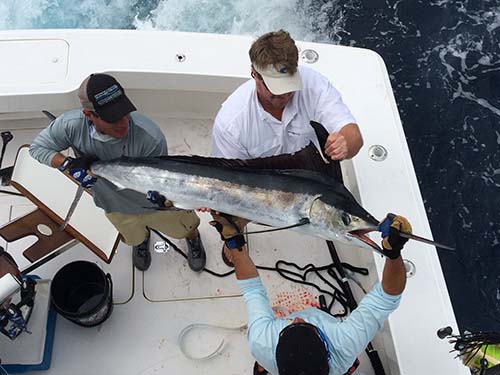
We released the smaller of our two white marlins.
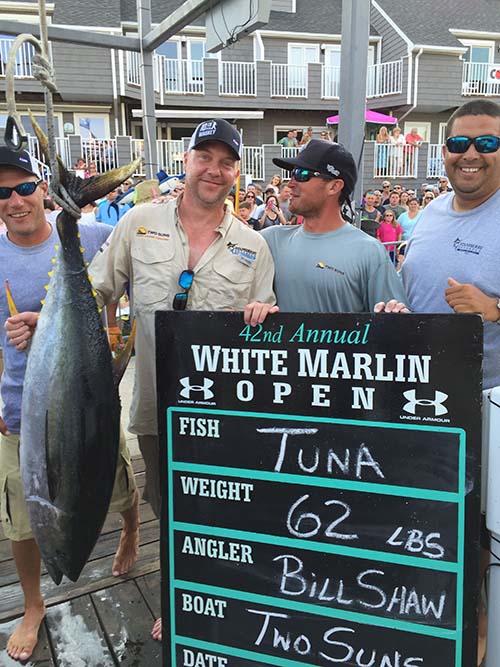
For a time, we held third place with this 62-pound tuna.
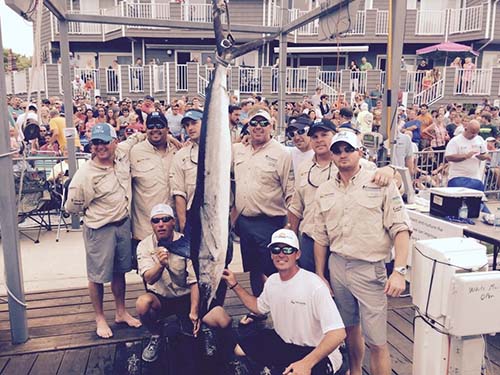
For the second year in a row, we just missed catching
a qualified white marlin by a few pounds.
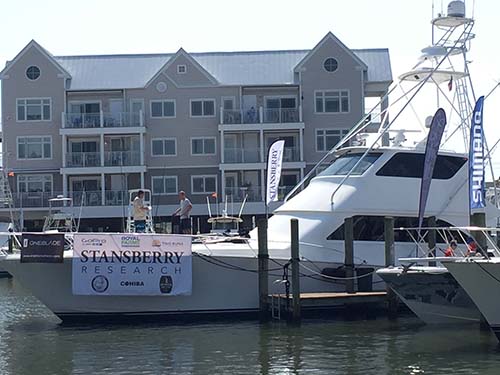
My boat, Two Suns, was sporting some fancy sponsors this year –
none more appreciated than Stansberry Research.
|
New 52-week highs (as of 8/7/15): American Financial Group (AFG), Activision Blizzard (ATVI), and W.R. Berkley (WRB).
In the mailbag, a question about selling puts and what happens when share prices fall. Send your questions and comments to feedback@stansberryresearch.com.
"Referencing Doc's video concerning selling puts presents the perfect time to ask a question that has always bothered me about this type of transaction. I need to make some assumptions in order to facilitate my question.
"Let's assume Doc visited the farmer in June and Apple's price was at $125.70. So, with the price at $125.70 he sells the Aug $125 puts for whatever the premium happened to be at that time, say $400 [per contract]. Then Apple goes into a dive, as it recently has, and ends up at the Aug expiration date at about $114 (or possibly lower) as it is right now.
"What would you have had the farmer do during this time as Apple was falling well below the strike price? If he waited and was put the stock at $125 it wouldn't be possible to sell a call and get enough premium to turn it into a winning trade. If he got Apple at $125 and it was sitting at $114 you certainly couldn't say he got the stock at a good price, and it could conceivably take a couple of years (or more) to get back to $125 if things were timed poorly. Like if we were starting into a bear market. Or, would you have told him at some point during Apple's fall to go ahead and get out of the trade and take a small loss?
"By the way, I do sell puts occasionally so I am not being critical of the process. However this question never seems to be addressed when touting selling puts. I just wonder how a professional would handle the situation were it to arise, and of course it has to every once in a while." – Paid-up subscriber D. Pond
Brill comment: As always, we can't give individual investment advice. But this is a common concern we hear about selling puts... and the hypothetical example you mention is a great opportunity to help clear up some confusion.
It's great when a put expires worthless and you simply keep the "premium." And that's frequently the case. But sometimes the stock will trade below the strike price at expiration, and you may be "put" the stock (meaning you're required to buy shares). This is when the real safety of Doc's strategy becomes clear.
The easiest way to understand how this works is to think about the strategy not as options trading... but rather as an alternative to buying high-quality, dividend-paying stocks. Or, better yet, a safer alternative to buying high-quality, dividend-paying stocks... while earning even more income than you could from dividends alone. That's how Doc explains it to his Retirement Trader subscribers.
That might sound unbelievable. But as you'll see, it's true...
We'll use the same numbers you used above. But rather than sell the one put option contract as he did, suppose the farmer had just purchased 100 shares of Apple at $125.70 instead. (Remember, one options contract controls 100 shares of stock.)
As an Apple shareholder, the farmer would be eligible to collect an annual dividend of approximately $2 per share, or a little more than 1.6%.
Two months later, shares have pulled back to $114, and his position in Apple is showing a 9.3% loss. Assuming a normal stop loss of 20% to 25%, the farmer is still safely holding the stock.
He might not be thrilled about the decline, but as an investor in one of the world's greatest companies at a fair price, he isn't losing sleep, either.
Now... let's compare this with what would have happened if the farmer had sold the put option as you said...
Because Apple closed below the $125 strike price at the expiration date two months later, he would be "put" the stock and be required to buy shares at $125 each (the strike price of the put he sold).
In this case, he's already paying $0.70 per share less than he would have if he had bought the shares up front (because he was put shares at $125 instead of buying them outright at $125.70). But he also received $400 – or $4 per share – in options premium for selling the put. This puts his cost basis at $121 per share ($125 minus $4 in premium).
With Apple trading at $114, he's still showing a loss... but he's only down 5.8%, since the premium he received up front helped offset the loss.
As you can see, in either case, the farmer becomes an ordinary shareholder in Apple. But when he sells the put option instead of buying shares up front, he becomes a shareholder at a discount. He gets to buy Apple shares for a better price than was possible in the market at that time.
Because the farmer believes Apple is a great company and an even better value now, he can simply hold shares, collect his dividends, and wait for shares to move higher.
But that isn't his only option...
As Doc's 228-for-236 track record shows, these positions can often be closed as a profitable trade down the road. This involves selling the appropriate covered calls against these positions, along with a handful of other lesser-known strategies. And this is where Doc's decades of experience are especially valuable for his Retirement Trader subscribers.
Of course, if you use this strategy long enough, sooner or later you will be stopped out for a loss. But that's the case any time you invest in the stock market. And this is why Doc recommends selling puts only on great companies trading at good prices... stocks that you'd be happy to own anyway.
It's also why we constantly emphasize the importance of proper position sizing. If you're selling puts on speculative or high-priced stocks – or selling 10 options contracts when you should be selling one or two – you aren't following Doc's strategy. You're just gambling.
Still, even in these rare cases when you are stopped out, you still have an advantage.
As you can see, Doc's strategy gives you an additional layer of safety and a little more "wiggle room" with your stop losses than simply buying shares up front. In other words, the "worst case" scenario is owning great, dividend-paying stocks at a discount to buying them outright.
Now, let's quickly review the upside...
Using the same numbers from your example, let's suppose Apple closed above the $125 strike price at expiration. The put option would expire worthless, and the farmer would keep his $400 premium.
This equals a yield of more than 3% on his capital at risk in just two months... compared with earning just 1.6% in dividends in an entire year by simply holding shares. And in this case, the farmer could redeploy his capital by selling another put on Apple later and doing the same thing again.
This is how Doc's Retirement Trader subscribers have been able to make 12% to 20% annual income in safe, dividend-paying stocks.
It's easy to make put selling sound complicated... and that's why many folks are afraid to try it. But when you look at it this way, the benefits are clear: No other strategy offers the upside of safe income from the world's best companies while also taking less risk than simply buying the same stocks outright.
Regards,
Justin Brill
Baltimore, Maryland
August 10, 2015

|