
When Stansberry analysts agree... Three housing charts you need to see... Another way to make 50%-plus from housing... China devalues the yuan (again)... A 'win-win' for China?... Steve Sjuggerud's latest thoughts...
 It's often a good sign when several Stansberry Research analysts are bullish on the same sector or stock. And today, we're seeing that play out again...
Regular readers know True Wealth editor Steve Sjuggerud has been bullish on housing for years. As we explained in the March 10 Digest...
Steve personally put his money where his mouth was. He purchased 70 acres of waterfront property in Florida, a beachfront condo for half its current market value, and raw land in northern Florida for less than 10% of what it was under contract for in 2008.
Last week, DailyWealth Trader co-editors Brian Hunt and Ben Morris joined Stevewith a big bullish callon housing. They highlighted the opportunity in homebuilders in particular.
Most folks remember the real estate crash in 2007. People were borrowing far too much money to buy homes. As a result, homebuilders were quickly building as many homes as they could.
Eventually, home prices came crashing down. Homebuilders saw their stocks crash. The iShares U.S. Home Construction Fund (ITB) – which holds a basket of homebuilders – fell 85%, from $45 a share in 2007 to less than $7 a share in March 2009.
But as Brian and Ben explained, things have turned around considerably since bottoming in 2009...
|
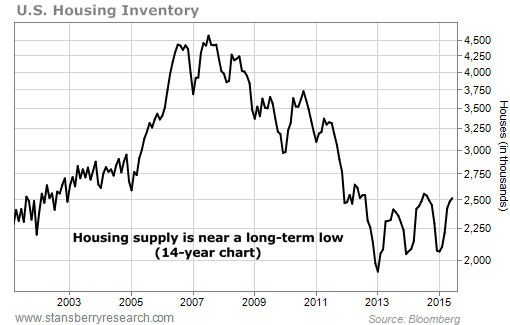
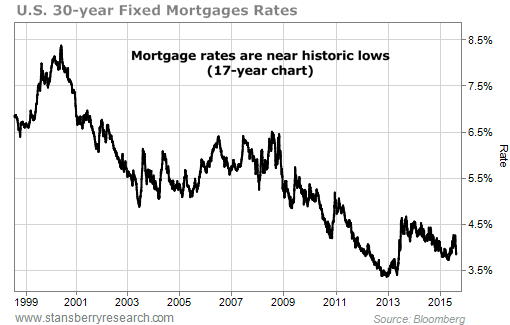
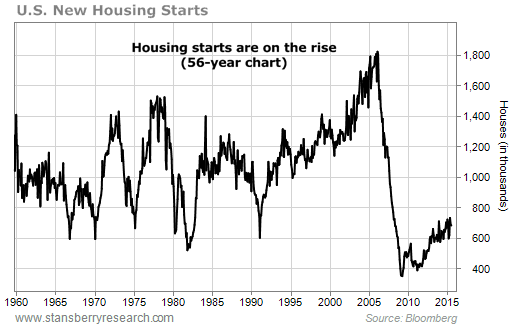
They noted that housing starts are still well below their historical average, meaning there's a lot of room for shares of homebuilders to rise from here.
Their favorite way to profit is through the SPDR S&P Homebuilders Fund (XHB), which holds around three dozen companies that will profit from this trend – from homebuilders (like D.R. Horton) to home-furnishing stores (like Williams-Sonoma) and companies that sell building materials (like Home Depot).
Brian and Ben believe XHB shares have 50%-plus upside over the next year. As they noted...
Some folks are still bearish on the housing market. But housing supply and mortgage rates are at long-term lows... And demand is growing. It's a recipe for a boom in all things related to building homes. This trend has a long, long way to run.
As we mentioned yesterday, China surprised the world by devaluing its currency – the "yuan" or "renminbi" – Tuesday morning. The yuan fell by nearly 2% versus the U.S. dollar, making it the biggest one-day currency move since 1993.
China's central bank – the People's Bank of China ("PBOC") – described the move as a step toward a more "market-driven" exchange rate.
For some background... The PBOC sets a midpoint – known as the "daily fixing" – for the yuan against the U.S. dollar each day. The yuan is then allowed to trade 2% above or below that point.
In theory, the bank would set the midpoint based on how the yuan trades the previous day. But as an article in the Wall Street Journal explained, that has often not been the case...
The central bank sometimes ignores the daily moves, at times setting the fixing so that the yuan is stronger against the dollar a day after the market has indicated it should be weaker.
With Tuesday's move, the fixing will now be based on how the yuan closes in the previous trading session. As a result, the yuan's fixing was weakened by 1.9% Tuesday from the previous day, leaving it at 6.2298 to the U.S. dollar, compared with 6.1162 on Monday. The yuan dropped as much as 1.99% from its previous close to 6.3360 against the dollar in Shanghai and fell as much as 2.3% in Hong Kong in early trading.
The central bank said in a statement posted on its website that the yuan's midpoint has diverged quite a bit from the market rate for a relatively long time and that it was time to make the midpoint more market-based.
Many in the financial media took the PBOC's comments to mean the devaluation was a "one-time adjustment" and the government would be more "hands off" with the yuan. But that stance has already been called into question just one day later.
This morning, the PBOC set the currency's daily midpoint at 6.3306, even weaker than Tuesday's devaluation. The yuan again fell nearly 2% to four-year lows versus the dollar, and is now down close to 4% since Monday. While that might not sound like much, it's a huge move in such a short period of time for a major currency.
It's not clear if today's move was a second intentional devaluation or if the PBOC was simply following through with its pledge to respond to market forces.
Regardless, even China appeared to be concerned about the large decline in the yuan. From an article in today's Wall Street Journal...
China intervened to prop up the yuan Wednesday, according to people familiar with the matter, just a day after it had let it decline sharply, underscoring the tricky balancing act now facing its central bank: how to keep the country's currency from free-falling. The intervention in Wednesday's final moments of trading came after the yuan had weakened nearly 2% – the maximum allowed in mainland China – to where $1 would buy about 6.45 yuan, its lowest level against the U.S. currency in four years.
The intervention followed an earlier message from the central bank attempting to reassure investors that yesterday's devaluation wouldn't lead to a continued decline. More from the Journal...
In a statement released by the central bank, the PBOC described greater volatility in the yuan's trading as a "normal phenomenon" and pledged to keep the exchange rate "basically stable."
But that message largely failed to calm the market, as traders rushed to sell the yuan and businesses flocked to convert their yuan holdings into dollars. The PBOC then instructed state-owned Chinese banks to sell dollars on its behalf in the last 15 minutes of Wednesday's trading, according to people close to the state banks.
The result: The yuan jumped about 1% in value against the dollar in the last few minutes of trading, bringing it to 6.3870 yuan against the dollar. "The not-so-secret weapon of the Chinese central bank is that it can order state banks to buy renminbi," said Derek Scissors, a resident scholar at the American Enterprise Institute, a Washington think tank. "Once state entities start buying, the signal will deter many sellers."
As we mentioned yesterday, Tuesday's devaluation set off fears across the financial media of a new round of currency wars – the trend of major governments competitively devaluing their currencies.
These "competitive devaluations" are ultimately a race to zero. But they do allow governments to pay off their massive debts more cheaply... or to temporarily boost their economies by making their exports cheaper to the rest of the world.
We've discussed the recent turmoil in China's stock market. And there are growing fears that the country's once-booming economy is slowing down.
At the same time, the U.S. and other major economies have long been pressuring China to open up its markets and economy.
The timing of this week's devaluation suggests China could be using this pressure as cover to weaken its currency and attempt to boost its economy.
But there could be another reason behind the move...
As regular readers know, Steve Sjuggerudhas also been following China and its currency closely.
In short, he believes China is determined to have the yuan added to the International Monetary Fund's ("IMF") list of global reserve currencies.
Adding the yuan to this basket would bring China new global status... and could potentially send trillions of dollars into China's economy.
While all signs suggest China's currency could be added to the list as early as this year – IMF managing director Christine Lagarde has said it's a "matter of when, not if" – some hurdles remain.
The IMF updated its stance in a report last week. From an article in the Financial Times (emphasis added)...
A judgment about whether the renminbi is "freely usable" is crucial to the IMF's final decision. As part of the review process, the board recently held an "informal meeting" to discuss the staff report.
"Across a range of indicators, the renminbi is now exhibiting a significant degree of international use and trading. At the same time, the four freely usable currencies (already in the [basket]) generally rank ahead of the renminbi," the IMF staff said in the report.
"The report signals that the decision about the renminbi's inclusion in the basket hinges on financial market development, further opening of the capital account, and greater exchange rate flexibility," said Eswar Prasad, former IMF country head for China.
In other words, the IMF wants the yuan to trade more freely. Yesterday's move could be a big first step toward that goal... and apparently the IMF agrees. More from the FT...
The International Monetary Fund has offered a cautious endorsement of China's move to let the market play a greater role in setting the value of its currency, signaling the step could help Beijing's bid to win much-prized reserve currency status for the renminbi alongside the dollar, euro, yen and sterling.
In a statement issued as Beijing on Wednesday lowered the value of the renminbi by the second-largest amount in two decades, following Tuesday's 1.9 per cent devaluation, the IMF said China's new pricing regime was "a welcome step as it should allow market forces to have a greater role in determining the exchange rate." It cautioned, however, that the "exact impact will depend on how the new mechanism is implemented in practice."
This week's devaluation appears to be a "win-win" for China. It moves the yuan one step closer to reserve currency status, and could potentially boost China's economy.
But further declines in the yuan – especially large declines or an outright crash – could cause investors to flee the currency and put its IMF inclusion in jeopardy. This may explain the PBOC's late-day "intervention" to prop up the yuan.
So while we can't predict China's next moves, don't be surprised if this "balancing act" continues.
If you're like most folks, you may be wondering whatthe devaluationcould mean for you and your money.
So we checked in with Steve, who shared his thoughts on the situation in a private e-mail with us this morning. As you'll see, Steve believes we need to keep this week's moves in perspective...
In the last 12 months, every major currency is down versus the dollar... except China's currency. It doesn't matter if it's emerging markets or developed markets. Take a look:
Russian ruble, down 36%Brazilian real, down 27%Australian dollar, down 19%euro, down 17%Chinese renminbi, up 0.3%So China's currency has gotten incredibly expensive relative to other currencies in the last year. While I admit I didn't see the devaluation coming, I don't see it as that surprising, or as that big of a deal. It's a way for China to keep its exports competitive with its neighbors.
One positive here is that it is another step toward China "liberalizing" its currency... allowing it to trade more freely. This will get it closer to "approval" as a reserve currency, which is the Chinese government's goal.
In other words, China is allowing the yuan to play "catch-up" with the recent moves in other currencies. And the move is unlikely to have long-term effects outside China and its neighbors. He also thinks further large declines are unlikely...
The short-term risk – and I don't expect this – is that China keeps letting its currency weaken. My guess is that they will stop its fall soon, but I could be wrong. We have two China income funds in my True Wealth letter, and those would be hurt if China's currency kept weakening... so I will be watching this situation closely and I will report on it in my True Wealth letter next week.
While Steve doesn't expect this week's move to have serious effects on investments here in the U.S., he thinks the yuan's eventual inclusion in the IMF's reserve currency basket will.
Steve says it could trigger one of the most profound transfers of wealth in our lifetime. It won't just affect China... It will affect every American, and anyone else who holds U.S. dollars.
It's so important, Steve recently sat down for an interview in Washington, D.C., to explain what's going on. If you haven't seen it, we urge you to take a few minutes to understand the details of a story most Americans have never heard. You can watch Steve's interview for free by clicking here.
New 52-week highs (as of 8/11/15): American Financial Group (AFG), Prestige Brands Holdings (PBH), Constellation Brands (STZ), Valero Energy (VLO), and W.R. Berkley (WRB).
In the mailbag, someone accuses us of being deceptive with the charts we publish. What's troubling you lately? Let us know at feedback@stansberryresearch.com.
"Why do you use log charts on almost all publications? Those are very confusing and mostly deceptive. They squeeze the action in order to make the chart look more convincing according to the perspective of the writer. What is wrong with just showing the straight data as it is in reality?? It just forces me to go get my own chart myself to see what's really going on (waste of time).
"I of course don't think you are doing anything deceptive (I would never have signed up as a Flex Alliance member if I was suspect of your service). I just don't get the rationale for log charts. Thank you!!" – Paid-up subscriber Chris Michals
Brill comment: We default to using logarithmic for all price charts for one reason: They take percent changes into account. For example,a move from $10 to $20 (+100%) is not the same as a move from $20 to $30 (+50%). A non-logarithmic chart displays both moves equally. Of course, for charts that display percent changes, we don't use logarithmic because a move from 5% to 10% is the same as a move from 80% to 85%. For more on the logarithmic argument, be sure to read the August 8, 2013 DailyWealth.
Regards,
Justin Brill
Baltimore, Maryland
August 12, 2015

|