

Where the Reach for Yield Could Be Headed Next
The spread of negative rates continues... Why stocks are hitting new highs... Where the reach for yield could be headed next... The latest on corporate earnings... What to make of today's conflicting signals... Uber hits an astonishing milestone... 'The greatest speculative opportunity of the last half-century'...
 The recent rally in bonds has been one for the record books...
Regular Digest readers know central banks have embarked on the biggest monetary experiment in history. They've pushed short-term rates to near zero (or below)... and they're buying up billions of dollars' worth of bonds and other assets every month through their quantitative-easing ("QE") programs.
This has pushed bond prices to record highs... and pushed bond yields to record lows. (Remember, bond prices and yields move inversely. Yields fall when prices rise, and vice versa.) And it has led to a situation that would have been unthinkable even a few years ago...
More than 90% of Japanese government bonds carry a negative yield today – meaning "investors" in these bonds have to pay interest, rather than receive it. About 84% of German government bonds (known as "bunds") – the benchmark debt of Europe – trade with negative yields as well.
But central banks haven't only been buying government bonds...
The Bank of Japan has expanded its QE program to include Japanese exchange-traded funds ("ETFs") as well. It's now a top-10 shareholder in a majority of Japanese blue-chip stocks. And there is talk that Japanese corporate bonds could soon be included, too.
The European Central Bank ("ECB") has already expanded its QE program to include European corporate debt, including some high-yield (or "junk") corporate bonds. But a further expansion is likely here as well...
According to a report from Bloomberg this morning, the ECB is quickly running out of German bunds to buy. As the benchmark debt of Europe, these bonds are required to make up the largest percentage of the ECB's monthly purchases.
Today, more than 60% of German government debt now trades with a yield below the ECB's short-term rate of negative 0.4%... meaning it is now ineligible to be included in QE purchases. Analysts from financial services firm UBS estimate the ECB could literally run out of German bunds to buy as early as next month if the program isn't expanded again.
Meanwhile the spread of negative-yielding debt continues...
On Monday, the Canadian Imperial Bank of Commerce ("CIBC") became Canada's first bank – and the first bank outside of Europe – to issue negative-yielding debt. CIBC sold $1.79 billion worth of six-year covered bonds with a yield of negative 0.009%.
According to Canadian newspaper Globe and Mail, investor demand was so strong that the value of the orders was double the deal size. Apparently, some investors have given up on earning yield... and are happy to simply pay less to own bonds.
Of course, we assume most investors are still interested in earning yield wherever possible.
As we've discussed, this "reach for yield" helps explain the recent rally in U.S. bonds... Even though the Federal Reserve stopped its last QE program in late 2014, U.S Treasury bonds have soared of late... pushing yields on 10-year and 30-year Treasury bonds down to new all-time lows of 1.3% and 2.1%, respectively, earlier this month.
Yield-starved investors are likely driving the recent breakout in U.S. stocks, too... In fact, it may be just a matter of time before they flock to the last significant source of (relatively) big and (relatively) safe yields in the world today: U.S. dividend-paying stocks.
According to Christine Hughes of OtterWood Capital Management, an incredible 63% of stocks in the benchmark S&P 500 Index are now yielding more than 10-year U.S. Treasurys. As Hughes noted, in a world of negative interest rates, more than two-thirds of the U.S. stock market looks pretty good right now.
Our colleague Ben Morris agrees. Regular readers may recall Ben believes the recent breakout in the S&P 500 means additional gains are likely in U.S. stocks this year. And Ben thinks dividend-paying stocks could lead the way.
But he thinks one particular group of dividend-paying stocks could do even better than the others. As he explained to his DailyWealth Trader subscribers on Thursday...
Over the past 12 months, shares of large businesses have outperformed smaller ones. That's to be expected...
For most of the last year (the first seven months), stocks dropped across the board. And when stocks fall, "small cap" stocks (so called because they have small market capitalizations) usually fall more than large-cap stocks. They're more volatile. But when stocks rise, "more volatile" means small caps tend to rise more than large caps, too. That's what's happening now...
As you can see in the chart below, the benchmark large-cap index – the S&P 500 – is up more than 2% over the past year. The benchmark small-cap index – the Russell 2000 – is down more than 5%.
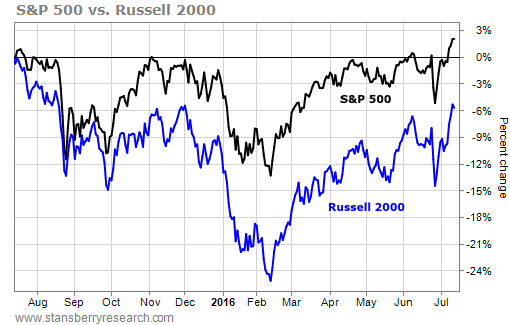
As Ben noted, the Russell 2000 is still more than 7% away from its 2015 high. But new highs may not be far off... If the large-cap S&P 500 continues higher like he expects, small caps could soon play "catch up" and close the gap.
Given these trends, Ben says small-cap dividend-payers could be among the biggest winners in coming months...
There are three big ideas to keep in mind today. When stocks hit new highs, they tend to continue higher. When stocks rise, small-cap stocks usually outperform. And in a low-interest-rate world, dividend-paying stocks are in higher demand.
Ben recommended his favorite way to profit from this move – a small-cap dividend-payer that yields nearly 3.5% today, and offers a chance at capital gains of 20% or more over the next year. Ben says it's still a "buy" today.
You can get instant access to this recommendation and all of Ben's best research with a subscription to DailyWealth Trader. Get the details here.
Yesterday, we mentioned several big U.S. banks are reporting earnings this week, but they're not alone...
The Wall Street Journal reports more than 90 of the biggest U.S. companies will report earnings by the end of the week, providing a "clearer picture" of second-quarter corporate earnings.
Regular readers know both revenues and profits have been declining for several straight quarters... and analysts believe that is likely to continue. From the Journal...
Based on analysts' forecasts for companies in the S&P 500 Index, Thomson Reuters predicted that adjusted earnings per share for the second quarter were down 4.7% from a year earlier. That follows a 5% drop in the first quarter and would be the fourth straight period of declines.
Revenue, meanwhile, is expected to slip 0.8%, marking the sixth straight quarter of declines.
So far, that appears to be the case...
According to financial-research firm FactSet, earnings data through last Friday – representing about 7% of S&P 500 companies – show second-quarter profits are on pace to decline 5.5%, while revenues are on track to fall 0.6%.
At the risk of enraging thousands of readers for talking out of both sides of our mouth, history says this is a bad sign for stocks...
As Porter noted on Friday, the S&P 500's earnings have declined for at least three consecutive quarters 17 times. And 14 of those streaks were followed by a bear market within three months.
What should you make of this conflicting information?
Again, we are living through the biggest monetary experiment in history. While it is virtually certain to end in disaster, there is no way to know exactly what will come next... or when.
Stocks appear likely to continue higher, but the underlying risks in the market remain.
We continue to recommend the same "boring" strategy: Focus on proper asset allocation (including plenty of cash and precious metals) and position sizing... reserve new purchases for high-conviction opportunities and speculations... and be sure to follow your trailing stop losses (or use Dr. Richard Smith's excellent TradeStops service).
If you follow these guidelines, you'll do well... and be prepared to take advantage of whatever comes next.
Finally, we note ride-sharing service Uber reported yesterday that customers have used its app to take more than 2 billion rides.
This is a massive acceleration in growth, coming just six months after the company announced it hit the 1 billion ride mark.
To put this in perspective, consider it took the company more than five years to deliver its first billion rides... and just one-tenth of that time to deliver its next billion.
Uber CEO Travis Kalanick wrote in a Facebook post that 147 trips started in the same second to tie for the two-billionth ride...
These trips happened in 16 countries on five continents, from Costa Rica to Russia and from China to Australia. The longest of the bunch lasted more than an hour as the rider and driver worked their way across Jakarta, Indonesia's capital. The shortest, a POOL trip in Changsha, China, lasted just three minutes.
Today, Uber is in 450 cities around the world.
The company's growth is extraordinary. But it shouldn't come as a surprise.
An incredible wave of technological innovation has been taking place "behind the scenes" over the past several years. And it has already transformed industries across the United States. For example...
You can now hold a detailed map of the U.S. – down to a high-definition street-level view – in the palm of your hand. You can host a live video phone call with someone halfway around the world. And the first self-driving cars – Tesla's problems aside – are already on our streets.
And just like Uber's growth, the speed of change will only accelerate in the next several years...
Longtime Stansberry Research subscribers may remember Amber Lee Mason as the co-editor of our DailyWealth Trader advisory for several years.
Today, Amber is the managing director of our corporate affiliate Bonner & Partners, and she recently alerted us to an opportunity from her newest editor, Jeff Brown – a 25-year veteran of the high-tech startup world. She writes...
Within the next 18 months, you could see spectacular gains from a subset of the market that is almost guaranteed to move – thanks to three key factors that are merging together for the first time in 50 years.
Amber says this move has nothing to do with earnings calls, drug approvals, or anything like that. Instead, it's all about the technologies being quietly developed today that will make "normal" life look incredibly different in the next few years...
If you're not familiar, Jeff has spent 25 years as a high-tech executive, doing everything from building startups to running billion-dollar businesses.
At last year's Stansberry Alliance conference, he explained why we are on the cusp of a technological revolution that will lead to millions of lost jobs... and cause wealth inequality far beyond what we're seeing today.
But while this scenario could be a catastrophe for millions of Americans who don't understand this technological shift, this "new world" could create true financial security for those who do.
Jeff has been watching this trend grow for nearly 30 years... And now, he believes we're about to reach the tipping point.
When it hits, nearly everything about our everyday lives – including how we shop, travel, work, relax, and even retire – could radically change. And he believes these changes could happen sooner than almost anyone would believe possible.
Understanding this wave of innovation now – before it hits – could mean the difference between a life of "unprecedented luxury" and just struggling to keep up. Even better, Jeff says this trend could offer "the greatest speculative opportunity of the last half-century."
Investors who buy the right companies today could make life-changing gains... And thanks to a change in U.S. investment law, many more individual investors can take advantage of this technological shift than ever before.
Jeff's research has uncovered 21 private companies poised to go public in the next 12-18 months – including one Jeff says could become the next Apple (AAPL). He says every single one has the potential to hand early investors gains of 1,000% or more.
Amber has prepared a special presentation with all the details on this urgent opportunity. Click here to see it now.
New 52-week highs (as of 7/18/16): Cisco (CSCO), WisdomTree SmallCap Dividend Fund (DES), Western Asset Emerging Markets Debt Fund (ESD), Cedar Fair (FUN), Welltower (HCN), iShares Core S&P Small-Cap Fund (IJR), Newmont Mining (NEM), Paycom Software (PAYC), Regions Financial – Series B (RF-PB), Gibraltar Industries (ROCK), VanEck Vectors Russia Fund (RSX), and ProShares Ultra MSCI Brazil Capped Fund (UBR).
The "fire Porter" comments continue to roll in. Send yours to feedback@stansberryresearch.com.
"I had to chuckle at the very direct comments by Thomas N. about whether or not to fire Porter. I have to admit his frank criticism rings true but in Porter's defense I admire the fact that he allows negative comments about him to be printed in his advisory. I have also made some very nice gains in my portfolio, especially from Stansberry Gold Investor and Stansberry's Credit Opportunities." – Paid-up subscriber Elaine D.
"+88.79%, +82.69%, +63.71%, +75.95% as of 7/18/16. I've spent a few thousand over the last... Wow! Has it been 15 years? Those percentages are winning positions, only one of which is over a year old! I took Porter's advice. He was right about GM; he was right about the housing mess; I wasn't going to miss him being right a third time. Fire Porter? Men like Porter don't get 'fired'; they take some sort of 'golden parachute' and move on to the next big adventure. The company has his name on it, for Christ's sake!
"I'm writing this from a modest home I made a down payment on using profits from Stansberry publications. Unlike others, I have no original ideas, but sometimes, a man like me gets lucky, and reads something written by the right man, in the right place, at the right time. Luck? Three times in 15 years? Bull! Like the commercial used to say, 'Luck is for rabbits.' 'Luck' is when fortune meets planning and preparation, and that's not my thought either, don't remember who said it.
"You all keep up the great work; Porter may make me mad occasionally, but I find I'm able to get over it! Porter, Dr. Sjuggerud, if either you ever find yourself in the Springfield, IL area or St. Louis, MO for a day or so, call me. Customer service has my number. I'll buy either of you the best cut of meat we can get to – and the rest of the meal as well! A simple 'thank you' is somehow not enough. P.S. The only regret I have is not joining the Stansberry Alliance back in 2003. $5000 seems like a real bargain to me now!" – Paid-up subscriber Steve Heitzig
Regards,
Justin Brill
Baltimore, Maryland
July 19, 2016
|