
Who's first with more QE?... Leaked information from the ECB... Japan cuts inflation forecasts... But makes another one anyway... This global economic bellwether just hit a new low... Jim Chanos is skeptical of Tesla... Discussing IBM's latest earnings... The biggest opportunity of Dan Ferris' career...
 Stocks are rallying today on news that the European Central Bank (ECB) has proposed monthly bond purchases of 50 billion euros. Several news agencies reported the news, citing an unnamed source. The Wall Street Journal and Bloomberg say the program will last one year.
We'll know for sure tomorrow, when the ECB makes its official announcement. In the meantime, we're seeing more and more reasons to buy gold today. (The "safe haven" asset briefly eclipsed the $1,300 mark today.)
Japan's central bank, the Bank of Japan (BoJ), cut its inflation projection for the fiscal year starting in April from 1.7% to 1%. The BoJ is targeting 2% annual inflation.
The BoJ initiated its 1.7% forecast only three months ago... clearly another spot-on call from the central bankers of the world...
But don't fret... According to BoJ forecasts, inflation will hit 2.2% starting April 2016. BoJ thinks gross domestic product will grow 1.6%. That's based on Dubai crude oil increasing to $70 a barrel before March 2017. (It's trading for less than $45 a barrel today.)
BoJ Governor Haruhiko Kuroda said there is "no concern of Japan being beset by a deflationary mindset again."
He added that the BoJ doesn't need to ease further. That's good to know, considering that less than three months ago, the BoJ expanded its quantitative easing to a record $678 billion a year. Japanese interest rates sit at 0%.
Remember, oil prices were $10 a barrel in 2000... And yesterday, Iran said it was fine with oil falling to $25 a barrel. Plus, the world is still awash in oil... And we don't see any major boosts to demand soon.
Despite the already accommodative stance (and the fact that central bank projections are garbage), we wouldn't be surprised to see more easing to combat deflation in Japan.
In further easing news, the Bank of Canada cut its benchmark interest rate from 1% to 0.75%. The central bank said it, too, was trying to combat the deflationary effects of falling oil.
For further proof of a global slowdown, check out shares of manufacturing-equipment giant Caterpillar (CAT)...
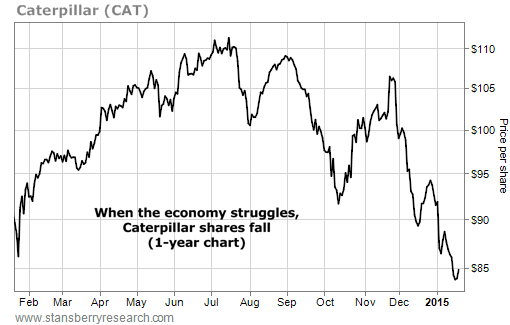 Caterpillar is one of the best economic bellwethers... Its machines are used in everything from drilling oil wells to building shopping malls. When the world is growing, Caterpillar shares tend to do well. When things are slowing down, Caterpillar pulls back.
Caterpillar's poor performance shouldn't be a surprise to regular Stansberry Research readers. We've been following the story since 2013.
Caterpillar is one of the best economic bellwethers... Its machines are used in everything from drilling oil wells to building shopping malls. When the world is growing, Caterpillar shares tend to do well. When things are slowing down, Caterpillar pulls back.
Caterpillar's poor performance shouldn't be a surprise to regular Stansberry Research readers. We've been following the story since 2013.
DailyWealth Trader co-editor Brian Hunt noted the bearish argument for Caterpillar as presented by short-selling wiz Jim Chanos. Chanos is the billionaire founder of short-selling hedge fund Kynikos Associates.
Chanos has correctly predicted the collapse of everything from Enron and WorldCom to Brazilian oil company Petrobras.
Chanos recently appeared on CNBC to update his short-Caterpillar thesis. He said the company has three main businesses – construction, mining, and energy – the latter two of which are highly troubled today.
The construction business is fine. Mining and energy "are increasingly challenged," Chanos said.
While he doesn't have a price target on the stock, he says the firm's numbers are still way too high.
At the end of the day, it all boils down to slowing growth in China. From the August 20, 2013 DailyWealth Trader...
|
China's economy is growing at a reported 7.5% a year, down from double-digit annual rates from 2003 to 2011. That's impressive growth for a $10 trillion economy. But resource and infrastructure companies like Caterpillar soared on the China growth story. And with little to no growth happening in the rest of the world today, the future doesn't look so bright.
Chanos also recently made some negative comments about one of our favorite short targets, electric-car manufacturer Tesla. As he said on CNBC last Friday...
|
Chanos didn't say whether he was short Tesla. But he has a problem with the company's valuation based on 2025 earnings when it can't even accurately forecast its next quarter.
Chanos also has a small short position in IT giant IBM. And although shares have been falling recently, we're still bullish on the company's future.
IBM announced earnings yesterday. Shares are down 3% today. We asked Extreme Value research analyst Mike Barrett for his comments on the earnings and IBM's valuation today. As he explained...
|
As Mike points out, IBM actually posted some positive numbers that most analysts simply ignored...
|
At the end of the day, IBM is still generating huge amounts of cash. And Mike reiterated that the company is still worthy of its "World Dominator" status...
|
Extreme Value editor Dan Ferris also chimed in on the debate in a private e-mail, noting...
|
Today, IBM is the only World Dominator in "buy range" in the Extreme Value portfolio. And Dan is clearly optimistic about the company's prospects going forward. But that isn't the opportunity that Dan is most bullish about today...
Dan says one area of the market is currently offering the biggest opportunity he has seen in his investing career: Resource stocks.
Dan studied the cyclical pattern of resource stocks going back 30 years... As Digest readers know, resource stocks boom and bust like crazy. Dan believes we're on the verge of a boom today... and a certain handful of resource stocks could return 300%.
He doesn't think we'll get another opportunity like this in at least a decade.
Keep in mind, Dan is only recommending a few specific stocks. These aren't just mining companies or small gold stocks.
These companies will profit from a rebound in all the blown-out resource sectors – gold, silver, uranium, agriculture, energy, etc.
At least one of these companies is a "deal maker" in the resource markets... and is loaded up with cash and looking to buy distressed assets today. These are deals you would never personally get the chance to invest in... And when the market inevitably heads higher, the value of these newly purchased assets should soar.
We can add Dan to the roster of Stansberry Research analysts who are bullish on gold and other resources today. You can get the full story from Dan right here.
New 52-week highs (as of 1/20/15): ProShares Ultra Nasdaq Biotech Fund (BIB), Brookfield Property Partners (BPY), CDK Global (CDK), Invesco Value Municipal Income Trust (IIM), Altria (MO), OCI Resources (OCIR), Osisko Gold Royalties (OR.TO), and ProShares Ultra 20+ Year Treasury Fund (UBT).
In today's mailbag, a question about trailing stops and what a pullback in stocks would mean. Send your missives to feedback@stansberryresearch.com.
"I have been using TradeStops for a few years. However, I am worried about this concept in a severe bear market. It seems that almost all stocks will drop if there is a significant downturn. So, even with good asset allocation and diversification you could lose more than a little of your portfolio before the stops are hit. Opinion?" – Paid-up subscriber Don
Goldsmith comment: Don, the situation you describe is exactly why we recommend using trailing stops. Trailing stops and proper position sizing prevent you from taking huge losses. If a stock makes up 4% of your portfolio and it falls 25%, you'll only lose 1% of your total portfolio.
Also, as we always say, you should never enter your stops in the market. Regular readers know that our favorite way to track trailing stops is through our corporate affiliate TradeStops, which can import your information directly from your broker and send you notifications when you hit your stops. You can learn more about TradeStops at TradeStops.com.
Regards,
Sean Goldsmith
January 21, 2015
