
Editor's note: Successful investing is about more than just following the pros...
Taking tips from legendary investors like Warren Buffett can help you build long-term wealth. But amid volatile markets like today's, you can't let your emotions get in the way...
That's why it's critical to go into every investment with an exit strategy.
Today's Masters Series essay comes from Karina Kovalcik, a senior quantitative analyst at our corporate affiliate Chaikin Analytics. Karina studied under Nobel Prize winners Robert Shiller and William Nordhaus before graduating from Yale University.
This essay is adapted from the December 15, 2021 and March 21, 2022 issues of the free Chaikin PowerFeed daily e-letter. In it, Karina discusses a simple strategy that could save you from massive losses... details the rule she uses to remain disciplined... and explains how the "technicals" can help you lock in gains at the right moment...
Win or Lose... You Need to Know When to Sell
Not long ago, my friend confessed something that no one ever wants to admit...
He lost big in the stock market.
And he wasn't exaggerating, either... He was down 65% on a position – and yet, he was still holding on.
Unfortunately, this isn't the first time I've heard such a story. Many of my friends have confided in me about their market losses over the years.
Of course, losses happen. They're an unavoidable investing reality. No one finds winners 100% of the time. Even the world's greatest investors like Warren Buffett fail sometimes.
But that doesn't mean you need to let losses wreck your portfolio. While I can't give personal stock advice, I can help you learn what to do when you're in a situation like this.
To deal with losses, you need a plan.
The truth is, none of the friends who've confided in me over the years planned ahead for how they would handle losses. They all ran headlong into positions that were "sure to be winners."
Obviously, we should all use a strategy to avoid – or at least minimize – our losses from the outset. It's important to go into every investment with a sound risk-management approach. Always consider proper position sizing and use stop losses to protect your capital.
But I get it... people make mistakes. And before long, like my friends, they're in a deep hole.
So how do you handle losses once they've happened?
It's simple... You must know when to fold your cards and walk away.
Many folks fail to consider what it really takes to recover a losing position. Think about it...
Let's pretend we invested in DUD Company at $100 per share.
The stock tanked soon after we bought shares. Now, it's down to $50 per share. That's a 50% loss. However, to get back to our original $100-per-share investment, the stock now must double – a 100% gain.
You can see a few basic scenarios in the following table...
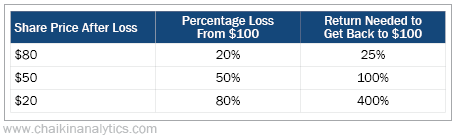
While we all wish the math worked out the other way, it just doesn't. As the losses get bigger, the hole you must dig yourself out of gets deeper.
Nobody wants to be in this position. But the reality is that nearly every investor has experienced losses at one point or another.
The key to long-term success is staying disciplined. In order to do that, I like to follow what I call the "20-35-50" rule. It works like this...
If I hit a 20% loss on a stock, I ask myself one question... "Is the reason I bought the stock still true?" I'll stick with it if my answer is a resounding "Yes!" Otherwise, I'll move on.
If I answer "Yes!" to that question but then the stock continues to drop, I'll give it until a 35% loss. At that point, the stock would need to appreciate a little more than 50% to get back to breakeven. If I don't believe the stock has a good chance of bouncing back in the next year, I'll fold.
And finally, if I wake up one morning and realize that my stock is showing a 50% loss, I'll admit that it's time to get out. A stock that goes down 50% isn't likely to double in value in the next year.
It might seem elementary, but I've seen folks hold positions that would require a 200% gain to get back to breakeven. That's simply not likely – especially with a stock that just tanked.
Never forget, good investors know when to walk away from losing positions.
They don't ride them down to zero. And they sure as heck don't wait around for a stock to move up 200% just to get back to breakeven.
So from time to time, you must be OK with walking away and accepting losses.
That's how you'll live to fight another day. And as long as you can minimize your losses, you'll grow your wealth over the long term.
But there's another side of the equation...
Picture this... despite all the uncertainty in the world, you're sitting on a big winner.
First, congratulations! Winning feels great. But now comes the hard part...
Should I sell now? Should I sell later? Should I sell at all?
It's a great first step to find a winner. But a lot of traders make the mistake of getting into a winning investment without knowing when to get out. It shouldn't happen, but it does.
Now, I've already explained how to know when to walk away from a losing trade. But walking away from a winning trade is an entirely different ballgame...
You want to hold on for as long as you can. No one wants to leave money on the table.
So let's go over a simple trick I use. It's how I know it's time to book a winner...
It works especially well on trades designed to last a few months or less. And it'll give you the confidence to say to yourself, "OK, I won. It's time to move on to the next idea."
Folks, there are no "magic bullets" in investing. But we can use specific tools to analyze the price action of stocks and exchange-traded funds ("ETFs")...
In short, we can look at the "technicals."
This analysis can be as simple as how much a stock gained from one day to the next. And it can get more complex, too – from tracking moving averages all the way to recognizing key patterns over long periods.
When I'm looking for the right time to close a winning trade, I focus on one key technical indicator. It's called a "Keltner channel."
A Keltner channel is made up of three lines. The middle line is an exponential moving average. And the top and bottom lines are based on another technical indicator called "average true range."
The math behind all of it gets a little in the weeds. But using the channel is as easy as it gets. Take a look...

When a stock crosses above the top line, I know that a move down is likely just around the corner. And it's even clearer when the stock is trading in a regular pattern between the two bands – like retail juggernaut Walmart (WMT) in the above example.
The reason has to do with the wonky math behind the Keltner channel.
Put simply, the channel is volatility-based. So when the stock crosses above the upper line, you know it has experienced an unusual spike in upward volatility. (The opposite is true when a stock crosses below the lower line, too.)
You can see that this indicator worked well for Walmart over the past year. And I believe you'll find that you can use the Keltner channel with many other stocks and ETFs, too.
It's a near-instant way of answering a simple question... "Is this trade overextended?"
Chaikin Analytics founder Marc Chaikin researched the perfect parameters for this technical indicator. And now, it's a basic feature on the "Workspace" page of our premium research platform.
So when I find myself staring at the screen, pondering whether I should sell a stock or not, I look at where the stock is in its normal range. If it's above the range or pretty close, I know it's likely time to sell – especially if it's not a "buy and hold" type of opportunity.
It's really that simple.
Good investing,
Karina Kovalcik
Editor's note: Chaikin Analytics founder Marc Chaikin believes we're approaching a critical inflection point in the markets. There's more devastation ahead – and folks like you need to know where and when it's coming.
But at the same time, not all stocks will crash. According to Marc, you'll also have a shot to take advantage of a historic buying opportunity before most people even know it exists.
Marc recently hosted a special online event to explain all the details. He also shared the names and ticker symbols of a stock to own and a stock to avoid as everything plays out. If you missed it, that's OK... For the next few days, you can watch the FREE replay right here.