

Yellen tapers, but Bernanke still looms...
Yellen tapers, but Bernanke still looms... A spate of giant takeovers... Gold is soaring... Silver falls to less than $19 an ounce... Why we're bullish on silver... One of the best natural resource investments you can make today...
 Thanks to the easy-money policies of the Federal Reserve, the rich are getting richer. Yes, the new Fed Chair Janet Yellen announced another $10 billion "taper" in the central bank's quantitative easing policy, bringing its total monthly bond purchases to $45 billion... But the effects of the policies put in place by her predecessor, Ben Bernanke, are still working their way through the system.
It's no surprise capitalists everywhere bemoaned the loss of the man who did as much as anyone in history to increase the wealth of those with the assets and access to credit. And the wealthy took full advantage while the "getting was good."
As Porter wrote in his October 2013 Stansberry's Investment Advisory, "So Long, Ben"...
|
Growth in capital investment has further concentrated the wealth in the upper echelons... Meanwhile, wage earners are stuck with stagnant GDP growth (the U.S. economy grew 0.1% in the first quarter) and rising prices.
But the madness continues in the capital markets...
This week, we learned Big Pharma company Pfizer made a $100 billion offer for AstraZeneca, the major British pharmaceutical company. At $100 billion, it would be the second-largest pharmaceutical deal in history behind Pfizer's $112 billion acquisition of Warner Lambert in 2000.
Even so, AstraZeneca refused the bid, saying Pfizer "very significantly undervalued" the firm. Pfizer announced this week it was still willing to pay a "significant premium" to the company's market price.
Staying in the pharma world, Valeant Pharmaceuticals (a serial acquirer) offered $46 billion for drug maker Allergan, best-known for the Botox treatment for facial wrinkles.
Last night, we learned telecom giant AT&T is interested in purchasing satellite-TV firm DirecTV. The second-largest pay-TV operator with 20 million customers, DirecTV's market value is $42 billion after a 6% jump today. So it's another potentially giant acquisition.
And let's not forget how DirecTV's larger competitor, Comcast, took the top spot... Comcast agreed to buy Time Warner Cable for $45.2 billion in stock in February of this year. The combined company serves some 30 million customers.
Note, this deal was done in all stock... It's easier to make huge acquisitions when you're paying with an overvalued stock.
And mobile company Sprint is meeting with banks to fund an estimated $50 billion purchase of smaller rival T-Mobile U.S.
Gold is up around 7% year-to-date... And it's holding steady around $1,300 an ounce today. Silver, gold's more volatile counterpart, is down on the year... It dropped to less than $19 an ounce today.
 In yesterday's Growth Stock Wire, S&A Resource Report analyst Brian Weepie, told you "why you should buy silver right now." It has to do with a ratio investors use to value silver... And right now, that ratio is the widest it has been since 2010...
|
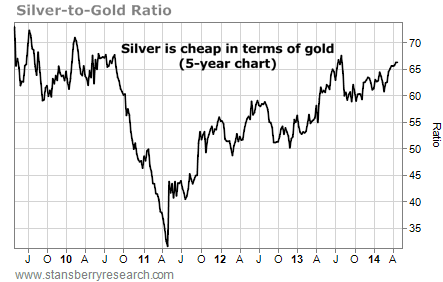
Today, the silver-to-gold ratio is over 67.
 New 52-week highs (as of 4/30/14): American Financial Group (AFG), Berkshire Hathaway (BRK), Calpine (CPN), ProShares Ultra Oil & Gas Fund (DIG), Dorchester Minerals (DMLP), SPDR Euro Stoxx 50 Fund (FEZ), Cambria Foreign Shareholder Yield Fund (FYLD), Lorillard (LO), Superior Energy Services (SPN), and ExxonMobil (XOM).
Have we helped you make money in the past year? Nothing is more gratifying than hearing subscriber success stories. Send yours to feedback@stansberryresearch.com.
"I think it was Porter who said he would consider buying Apple if it dropped under $400 a share. The beginning of last year it started slowly dropping, I put in a limit order for $394 that was filled in early April. As of right now I am up 56%. Thanks!" – Paid-up subscriber Dan McCampbell
New 52-week highs (as of 4/30/14): American Financial Group (AFG), Berkshire Hathaway (BRK), Calpine (CPN), ProShares Ultra Oil & Gas Fund (DIG), Dorchester Minerals (DMLP), SPDR Euro Stoxx 50 Fund (FEZ), Cambria Foreign Shareholder Yield Fund (FYLD), Lorillard (LO), Superior Energy Services (SPN), and ExxonMobil (XOM).
Have we helped you make money in the past year? Nothing is more gratifying than hearing subscriber success stories. Send yours to feedback@stansberryresearch.com.
"I think it was Porter who said he would consider buying Apple if it dropped under $400 a share. The beginning of last year it started slowly dropping, I put in a limit order for $394 that was filled in early April. As of right now I am up 56%. Thanks!" – Paid-up subscriber Dan McCampbell
Goldsmith comment: Porter made that call in the February 5, 2013 S&A Digest Premium. Apple was trading for more than $440 at the time. Digest Premium subscribers can read the full piece here. Here's an excerpt:
|
Regards,
Sean Goldsmith
New York, New York
May 1, 2014

Rick Rule: Why this resource up-cycle could be the greatest of my career...
Editor's note: Today's Digest Premium is taken from Episode 233 of Frank Curzio's S&A Investor Radio podcast. On the episode, Frank – editor of Small Stock Specialist and Phase 1 Investor – interviews Rick Rule, the president and CEO of Sprott U.S. Holdings.
 I've lived through enough of these cycles in enough cyclical... industries that I understand bear markets are the authors of bull markets. One would hope that you could time them, but I think I'm living proof that you can't. On the other hand, I have become a very, very, very wealthy guy simply by understanding that bear markets are the authors of bull markets.
Listen, Buffett famously said nobody should buy a share of a company [that]... they wouldn't be delighted to see fall in price 20% the week after... so they could buy a bunch more cheaply. Now unfortunately, I've tested that thesis dozens of times in my career. I wish I would have bottom-ticked every trade. But the truth is that the process over the last 35 years has been extraordinarily good for me. And my suspicion is that I am coming into an upcycle in resources... resources and frontier markets that will be the most dramatic of my career...
The best of the best times that I've ever enjoyed. And as you know, I've enjoyed some very good times in past recoveries.
[Editor's note: Rick responds to Frank Curzio asking if the market for junior-mining stocks has bottomed...]
Very useful question, Frank. Let's begin by saying, in the best of times, you have to be worried about investing in junior-mining stocks because, as a group... they're valueless.
Let me repeat that: As a group, they are valueless. You speculate in them because the best 5% or 10% perform so extraordinarily well – better than any asset class I'm familiar with – that they add credibility and occasionally luster to a sector that's almost terminal.
The Toronto Stock Exchange Venture – TSXV – which is the investment ghetto that most of the junior miners are consigned to, is off by 75% over four years, which is a different way of saying it's 75% more attractive.
The whole thesis that existed in 2009-2010 with regards to resources – worldwide demographics, inflation, debt – is as true today as it was in 2010. The narrative hasn't changed at all. What has changed is that the market is 75% less expensive...
Having said that, it is important that investors who want to participate in a market that could increase fivefold or tenfold (in hopes of finding stocks that could increase twentyfold) understand the qualitative differentiation. Securities analysis is absolutely the name of the game in junior miners.
Mercifully, for me, it's something that I've learned in hard fashion over 30 years, and we invest a lot in. So it's a circumstance, an opportunity that doesn't fill me with trepidation at all. I'm elated about the set of circumstances in front of me, but I could understand why it would be more challenging for other speculators.
– Frank Curzio and Rick Rule
Rick Rule: Why this resource up-cycle could be the greatest of my career...
Investor Rick Rule has made a fortune buying at the bottom of natural resource cycles... And he thinks today could be one of the most lucrative entry points of his 35-year career. Rick explains why in today's Digest Premium...
To continue reading, scroll down or click here.