
Your best chance for 100% gains... Rabid demand from Chinese retail investors... PBOC gets dovish... Why this giant valuation spread is closing... A new high for homebuilders... Steve's latest thoughts on 'currency wars'...
 Steve Sjuggerud said it was "the best chance for 100% gains in the next two years." We're almost there... but so far, it has only taken six months.
As regular Digest readers know, Steve has been urging his True Wealth subscribers to invest in China since October.
We laid out the bullish case for China in the December 15 Digest. The Chinese government wants to send its stocks higher. As a result, it's loosening investor regulations and cutting interest rates. Steve explained that the "Bernanke Asset Bubble" – pushing interest rates lower and implementing stimulus to push assets of all kinds higher – was just getting started in China.
Two weeks ago, we noted that the Shanghai Composite Index hit a seven-year high. Today, the Shanghai Composite Index closed at nearly 3,790. Chinese stocks are up more than 3.3% since mid-March... a huge move in just two weeks.
The index closed 2.6% higher yesterday after dovish comments from the country's central bank, the People's Bank of China (PBOC). Governor Zhou Xiaochuan said growth in China has fallen "a bit" too much and inflation has fallen "too quickly." In other words, the PBOC – like almost every other central bank around the world – is willing to do whatever is necessary to stoke inflation.
It's another sign the global currency wars are moving full steam ahead. We'll discuss the latest developments in this arena later in today's Digest.
The Chinese market is also benefiting from a surge in retail investor participation.
As we noted above, the Chinese government is loosening regulations to encourage trading. From the December 15 Digest...
|
Individual investors have always dominated trading in China...
Over the last five years, retail investors were responsible for 80% of the volume in A-shares, according to investment bank UBS. That ratio hit 90% this year.
According to investment journal Barron's, as of March 19, retail investors purchased a net 470 billion yuan worth of stocks, compared with institutional investors' 78 billion yuan. And in the third week of March alone, 1.1 million people opened investment accounts in China.
According to financial-research firm BCA Research, there are now 125 million investor accounts in the Shanghai Stock Exchange... nearly triple the peak in 2007. Those accounts amount to more than 16% of the urban population, up from 6% in 2007.
So while Shanghai isn't cheap at around 21 times earnings today, it's still a far cry from the 48.8 price-to-earnings ratio we saw in 2007. And given the soaring interest in Chinese stocks, coupled with an accommodative stance from the PBOC, it doesn't look like this bull market will slow down any time soon...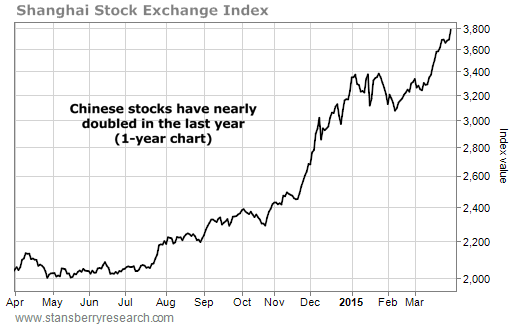 In the January issue of True Wealth, Steve told subscribers how to buy the largest Chinese blue chips (companies like mobile-phone provider China Mobile, which has 800 million customers) for a fraction of their value on the Shanghai Stock Exchange. You just had to buy shares on the Hong Kong Stock Exchange.
As you can see from the chart below, the valuation difference was huge...
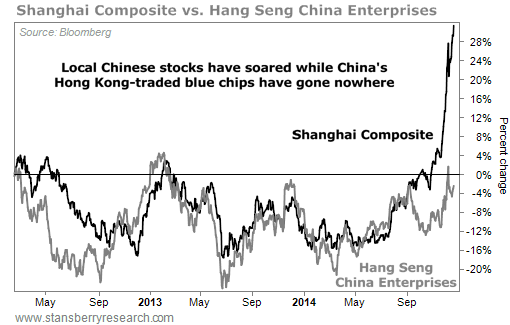 Steve said of the opportunity...
|
Two days ago, the Chinese government announced it would allow Shanghai mutual funds to buy Hong Kong stocks. The massive premium between Shanghai and Hong Kong stocks only exists because the Chinese can't buy across borders. And China just made it a little bit easier...
Shares of the iShares China Large-Cap Fund (FXI), which holds a basket of Chinese blue chips trading in Hong Kong, jumped more than 5% over the next two days.
I spoke with Steve this morning about the opportunity. He said there is no difference whatsoever in the share class you're purchasing. The only difference is that one trades in Shanghai and the other trades in Hong Kong... And at the peak, the shares that trade in Shanghai had a 40% premium to their Hong Kong counterparts.
Think of it like this... Say you could buy shares of Warren Buffett's Berkshire Hathaway in the U.S. for $218,000 a share, or you could buy shares in Canada for $130,000 (disregard the currency difference for the sake of this example). It's the same company. Which would you choose?
Steve has been urging subscribers to buy Chinese stocks in True Wealth and in the mainstream media. And people always asked him, "How will that premium go away?" As he explained to me...
|
But the bull market in Chinese stocks isn't over. In the March 24 DailyWealth, Steve explained how little foreign interest there is in Chinese stocks today...
|
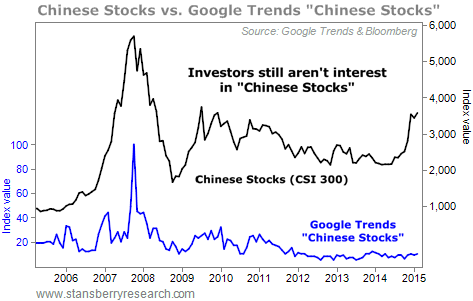 So Steve says the Chinese market has "absolutely not" peaked. No foreigners are buying Chinese stocks yet.
FXI soared 279% from September 2005 to September 2007 (when Chinese stocks peaked). True Wealth subscribers are already up 12%... But Steve says triple-digit gains are on the way.
Another one of Steve's recommendations has been doing well lately... and it shows that the Bernanke Asset Bubble is still alive and well in the U.S...
U.S. home prices in January rose 0.9% from December 2014 and 4.6% over January 2014, according to the latest S&P/Case-Shiller home price index. The numbers were in line with expectations.
And there were more bullish housing numbers last week...
The Wall Street Journal reported that sales of previously owned homes rose 1.2% from January to February, and that total houses available for sale rose 1.6% over the same period.
Quoting economists John Ryding and Conrad DeQuadros, the Journal reported...
|
Also last week, the U.S. Department of Commerce reported that new home sales hit a seven-year high last month. Sales hit a seasonally adjusted annual rate of 539,000 new homes – a 7.8% jump from January.
The Journal quoted John Johnson, CEO of homebuilder David Weekley Homes, who said...
|
Meanwhile, publicly traded homebuilders like Lennar – the second-largest holding in the iShares U.S. Home Construction Fund (ITB) – reported that "orders were up 18% in its quarter ended February 28 from a year earlier," according to the Journal.
Steve has urged readers to buy real estate for years. But he says the good times aren't over. Mortgage rates are still low and "housing affordability" is still high.
His True Wealth subscribers are now up 117% since his recommendation in February 2011...
.png) Finally, I asked Steve for his updated views on the ongoing currency wars. His thoughts below...
Finally, I asked Steve for his updated views on the ongoing currency wars. His thoughts below...
|
Regardless of what the Fed does at its next meeting, it's imperative you understand the forces at work in the economy today. Global central banks are cutting interest rates and printing money to devalue their currencies. But despite their best efforts, we're not seeing inflation. Interest rates around the world are going negative... meaning you're paying for the right to loan some governments (and companies) money.
It's a warped economy... But it can only play out one way: Eventually, the central banks (and their printing presses) will win. We'll see massive inflation. The values of certain assets will soar while others get destroyed.
It's a complicated story. But luckily, our colleague Jim Rickards has written the playbook for today's economy in his latest book, The Death of Money.
As longtime Digest readers know, Jim is a financial lawyer with a doctorate and multiple advanced degrees. He's also a hedge-fund manager and a New York Times best-selling author.
Today, Jim serves as an advisor to the Office of the Director of National Intelligence, which oversees the Central Intelligence Agency, National Security Agency, and 14 other U.S. intelligence agencies. He previously helped the government investigate the stock market "tells" preceding 9/11 and consulted with the Pentagon on the national-security risks of financial chaos.
And we've arranged for you to get a free copy of The Death of Money. (We just ask you to pay less than $5 to cover the shipping and handling costs.) Plus, Jim wrote a special chapter just for Stansberry Research readers sharing the specific assets he recommends buying today to protect yourself from inflation. New 52-week highs (as of 3/30/15): Aflac (AFL), Deutsche X-trackers Harvest China A-Shares Fund (ASHR), Global X China Financials Fund (CHIX), iShares China Large Cap Fund (FXI), iShares U.S. Home Construction Fund (ITB), Prestige Brands Holdings (PBH), and ProShares Ultra FTSE China 50 Fund (XPP). We were surprised to see so many comments coming into the mailbag about the term "paid-up subscriber." Porter explained the meaning behind the phrase on Friday. Want Porter to answer one of your questions? Send them to feedback@stansberryresearch.com. "What will readers rant about next? You have a business to make money, and it is assumed that you will promote yourselves and encourage others to buy your products. I personally don't care if a person who writes in is a paid up subscriber or not. I am only interested in looking for ideas and insights that I haven't thought of or don't understand enough of.
"Wisdom is gained by listening to others, as I firmly believe that more brains are better than my single brain. I do the best I can to make my own stock purchases, preferring to do my own homework and come to my own conclusions. But, that doesn't mean I am an expert. It simply means that I am doing my best due diligence possible. More perspectives helps me. So, I read various newsletters, written by both bullish and bearish perspectives. I then weigh the data to hopefully attain a better understanding (and wisdom) as to what I am thinking.
"I don't have much respect for people who are too lazy to do their own due diligence, but rather pay for subscriptions to people to make the stock decisions for them. They can then blame someone else if their investments don't perform to their expectations. Or, they simply pay for subscriptions to people who fit their own bearishness or bullishness regarding the markets. Either way, it is a money making proposition for firms such as yours, as there is an obvious need for them.
"I write in to share ideas, to provoke thought, to agree, disagree, etc. with what you are publishing. That's the end of it. You guys do what you think works best for your business. There will always be someone ranting about the dumbest of things. There is a round file for those dumb complaints that have nothing to do with what your business is all about." – Paid-up subscriber William Durst
"Why take umbrage at the term? I like that someone is referred to as a 'paid up' subscriber. It either means that he (she) had enough going for them that they paid cash for the subscription, or that they (as I) earned enough along the way to become 'paid up'. In any event, Kudos for a job well done." – Paid-up subscriber Art Linaschke "I read with some amusement the reader feedback from Sebastiano. I was thinking, 'Jeez, who pissed in this guy's Wheaties this morning?' While I had always been curious as to why you did it, I would never have been so crass as to dress you down for doing it. Thanks for the explanation, though, because now we all know. Keep up the good work!" – Paid-up subscriber Kerry Leavins
Regards,
Sean Goldsmith
March 31, 2015
