

A big warning from Herb Greenberg; Back and forth between Adani Group and Hindenburg; What about when activist short sellers are wrong?; Ackman on lessons from Herbalife; Short Sellers Feel the Pain in Stock Market's 2023 Rally; Palm Beach becomes latest community stricken with antisemitic messages
1) For decades, my colleague Herb Greenberg has been warning his readers about fads, frauds, and other risks in the markets...
So when he put together his latest presentation – sharing the details about 235 U.S. cities set to experience "money blackouts" in 2023 – I had to check it out.
These "blackouts" could change your money forever.
But according to Herb, if you're one of the lucky few who get out in front of this and take a simple step to protect your money from the aftermath, you could come out of this in a far stronger financial position than ever before.
2) Following up on Wednesday's e-mail about Hindenburg Research's short report on India's Adani Group, which has knocked more than 25% off its value (and the net worth of Asia's richest person)...
Yesterday, Adani released a 413-page response, which you can read here. Here's a summary from Reuters: Adani hits back at Hindenburg, says it made all disclosures. Excerpt:
India's Adani Group issued a detailed riposte on Sunday to a Hindenburg Research report that sparked a $48 billion rout in its stocks, saying it complies with all local laws and had made the necessary regulatory disclosures.
The conglomerate led by Asia's richest man, the Indian billionaire Gautam Adani, said last week's Hindenburg report was intended to enable the U.S.-based short seller to book gains, without citing evidence...
"All transactions entered into by us with entities who qualify as 'related parties' under Indian laws and accounting standards have been duly disclosed by us," Adani said in the 413-page response issued late on Sunday.
"This is rife with conflict of interest and intended only to create a false market in securities to enable Hindenburg, an admitted short seller, to book massive financial gain through wrongful means at the cost of countless investors," it added.
It only took hours for Hindenburg to respond: Our Reply to Adani: Fraud Cannot Be Obfuscated by Nationalism or a Bloated Response That Ignores Every Key Allegation We Raised. Excerpt:
On January 24th, we released a report outlining numerous issues of suspected fraud at the Adani Group, the 2nd largest conglomerate in India run by the world's then-third richest man.
Hours ago, Adani released a "413-page response." It opened with the sensationalistic claim that we are the "Madoffs of Manhattan."
Adani also claimed we have committed a "flagrant breach of applicable securities and foreign exchange laws." Despite Adani's failure to identify any such laws, this is another serious accusation that we categorically deny.
It also predictably tried to lead the focus away from substantive issues and instead stoked a nationalist narrative, claiming our report amounted to a "calculated attack on India." In short, the Adani Group has attempted to conflate its meteoric rise and the wealth of its Chairman, Gautam Adani, with the success of India itself.
We disagree. To be clear, we believe India is a vibrant democracy and an emerging superpower with an exciting future. We also believe India's future is being held back by the Adani Group, which has draped itself in the Indian flag while systematically looting the nation.
We also believe that fraud is fraud, even when it's perpetrated by one of the wealthiest individuals in the world.
In terms of substance, Adani's "413 page" response only included about 30 pages focused on issues related to our report.
The remainder of the response consisted of 330 pages of court records, along with 53 pages of high-level financials, general information, and details on irrelevant corporate initiatives, such as how it encourages female entrepreneurship and the production of safe vegetables.
- Adani Failed to Specifically Answer 62 of Our 88 Questions
Of the Questions It Did Answer, the Group Largely Confirmed or Attempted to Sidestep Our Findings
- We Asked About the Source of the Billions of U.S. Dollars That Have Flowed From Vinod Adani-Associated Offshore Shell Entities Through the Adani Group
Adani's Defense: "We Are Neither Aware nor Required to Be Aware of Their 'Source of Funds'"
- Our Report Outlined Numerous Irregularities and Connections Between Suspected Offshore Stock Parking Entities and Adani Promoters, Raising Key Questions About Whether Promoter Holdings Were Fully Disclosed
Adani's Response Claimed It Simply Doesn't Know Who Its Largest Public Holders Are
- Of the Questions Adani Answered, They Largely Confirmed Our Findings, Argued Points We Didn't Raise, or Sidestepped the Key Issues Altogether
While I haven't done the work on Adani myself, it seems clear to me that Hindenburg's research and conclusions are likely to be proven correct...
3) Nate Anderson of Hindenburg Research is no doubt making a fortune on his bearish bets against Adani Group. This is as it should be – investors should be rewarded for unique, in-depth, correct research – whether on the long or short side.
Anderson no doubt did months of intensive research – and has assumed tremendous personal, professional, and financial risk – to expose what appears to be one of the largest (if not the largest) frauds of all time. If he's right – and the market is saying he is, based on the stock's crash, which I predict will continue – he should get a medal from investors as well as the Indian government.
But what if this is a "short and distort" campaign, as pretty much every company targeted by an activist short seller claims (and which the U.S. Department of Justice is investigating, in what I've called "a wild goose chase")?
Well, imagine for a moment that a nefarious short seller looking to manipulate a stock targeted one of America's largest companies, comprised of dozens of subsidiaries in a wide range of industries, all run by one of the world's richest men: Berkshire Hathaway (BRK-B).
The short seller could publish a 100-page report with all sorts of claims and a price target 85% below the current price (as Hindenburg did), but the market's reaction would be... nothing, because Berkshire has nothing to hide, isn't manipulating its own stock, or any such nonsense.
In conclusion, as I wrote in Wednesday's e-mail, activist short sellers aren't always right – but so what? The 99% of people who publish bullish reports on stocks they're long aren't always right either... And my experience is that the market does a pretty good job of ignoring the unpersuasive short reports.
4) The real problem is that the market and/or regulators often ignore correct short reports, which is one of the many reasons why – despite Hindenburg's recent profits – investors shouldn't forget that shorting is a terrible business.
Just ask my friend Bill Ackman of Pershing Square, who waged a multiyear campaign against multilevel marketer Herbalife (HLF)...
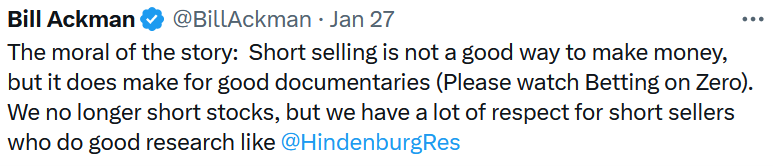
As Bill notes in this Twitter thread, pretty much every major claim he made was later shown to be true (and the stock has declined by 24% during a period when the S&P 500 has tripled) – but still, as Bill writes, "Pershing Square lost $1 billion when it was forced to cover its short."
Bill's conclusion is 100% correct:
5) After short sellers enjoyed a highly profitable 2022, the market's rally this year – especially among the most speculative, beaten-down, heavily shorted stocks – has inflicted $81 billion of pain on them according to this cover story in today's Wall Street Journal: Short Sellers Feel the Pain in Stock Market's 2023 Rally. Excerpt:
The market's comeback in 2023 has been very bad news for one group: short sellers.
Short sellers profit from stock declines by borrowing shares of companies that they believe are overvalued, selling them, and then buying them back at a lower price later. They made huge gains in 2022, when markets around the world tumbled.
But their fortunes have reversed in January as the stock market has clawed back some of its losses.
A Goldman Sachs index tracking the 50 most shorted stocks in the Russell 3000 has returned 15% so far this year through Thursday, substantially outperforming the S&P 500, which is up 6%. Other stocks that got crushed in 2022 have also raced higher. Tesla (TSLA), coming off its worst year on record, has staged a 44% January rally. Meanwhile, money-losing cryptocurrency exchange Coinbase (COIN) is up 73%.
Short sellers who have incurred hefty losses are actively trimming their positions, said Ihor Dusaniwsky, managing director of predictive analytics at S3 Partners. Investors betting against stocks have racked up $81 billion of mark-to-market losses on short positions this month through Thursday after accumulating $300 billion in gains in 2022, Mr. Dusaniwsky said.
My advice to 99% of investors remains the same: Don't short!
6) My friend Doug Kass of Seabreeze Partners, whom I quote often in my e-mails, was the target of an antisemitic incident this weekend. How awful!
And he's not the only one in Palm Beach – see this story by the local TV station: Palm Beach becomes latest community stricken with antisemitic messages.
Doug writes, "This is what was thrown on my front lawn in Palm Beach yesterday on a bag of corn," and sent me these pictures.
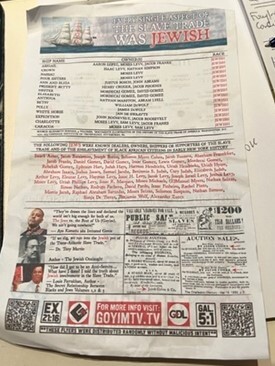
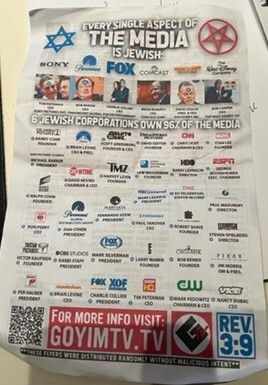
This kind of hateful behavior is terrible and has no place in Palm Beach – or anywhere.
Best regards,
Whitney
P.S. I welcome your feedback at WTDfeedback@empirefinancialresearch.com.