

A Jobs Report Without Silver Linings; Nasdaq Seeks Board-Diversity Rule; The Children of Pornhub
1) This chart on the front page of Saturday's New York Times does a good job of capturing the slowing economy reflected in the November job numbers that came out on Friday:
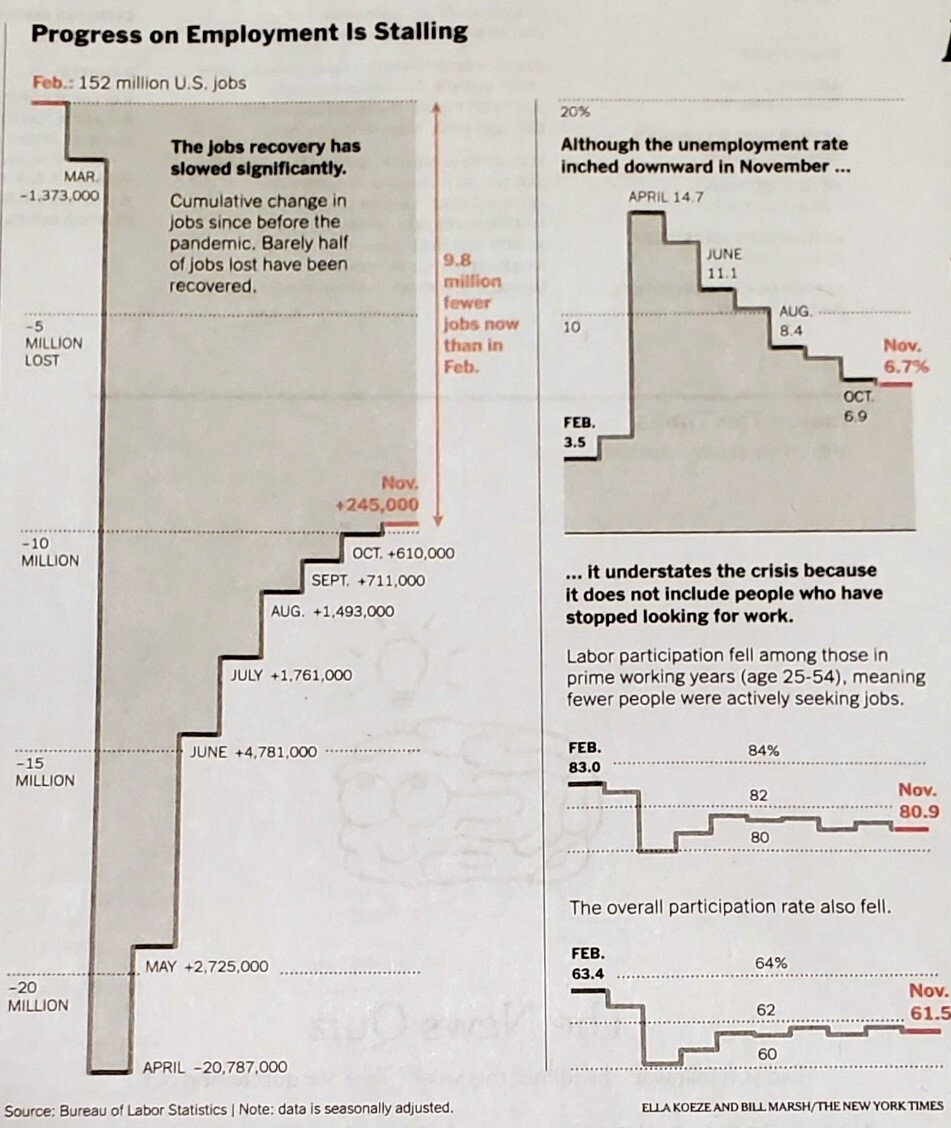
Here was the accompanying article: A Jobs Report Without Silver Linings. Excerpt:
The thing that is most worrying is what seems to be happening among the people who have lost their jobs because of the pandemic. The jobs report offers clues that what was once temporary unemployment is becoming more permanent – in ways that, if unchecked, could do long-term damage to millions of families and to the economic potential of the United States.
Although the unemployment rate fell last month, to 6.7% from 6.9%, it was for the worst of reasons: Many Americans gave up even looking for work. The number of adults not in the labor force – neither working nor actively seeking work – rose by 560,000, as the labor force participation rate dropped by 0.2 percentage points.
The share of prime working-age Americans working – those between 25 and 54 – was unchanged in November at 76% and remains far below its 80.5% share in February. The number of people who are not in the labor force but say they want a job is 2.2 million higher than it was in February.
A growing share of the unemployed have been out of work for a long time. The number of Americans unemployed for more than 27 weeks rose by 385,000 in November. Since only September, the number of these long-term unemployed is up by a devastating 1.5 million people – a 64% increase.
Put those numbers together, and the pattern is clear: Many people who lost jobs in the spring have been without work continuously since then, and some of them have given up looking...
This is normally the point in analyzing a bad jobs report where one points out silver linings – those little reasons for optimism that are hiding if you know where to look.
This month, they are hard to find...
But the real hope for 2021 is that enough unemployed and nonemployed Americans can come back to work quickly enough that the long-lasting effects of the last scarring downturn can be prevented from recurring.
This weakness, combined with the surging third wave of the pandemic, underscores the need for Congress to pass a relief bill.
I (and most other investors, if the stock market is any guide) expect a deal to happen – interestingly, in part because many red states are now getting clobbered by the virus. This has shifted many Republicans' views away from viewing this as a "blue-state bailout," to quote Senator majority leader Mitch McConnell.
2) I have mixed feelings about this idea: Nasdaq Seeks Board-Diversity Rule That Most Listed Firms Don't Meet. Excerpt:
Nasdaq (NDAQ) is pushing to require the thousands of companies listed on its stock exchange to include women, racial minorities and LGBT individuals on their boards, in what would be one of the most forceful moves yet to bring greater diversity to U.S. corporations.
The exchange operator filed a proposal with the Securities and Exchange Commission on Tuesday that would require listed companies to have at least one woman on their boards, in addition to a director who is a racial minority or one who self-identifies as lesbian, gay, bisexual, transgender or queer. Companies that don't meet the standard would be required to justify their decision to remain listed on Nasdaq.
Banks, asset managers and lawmakers in California have taken various steps to diversify the predominantly white and male boardrooms of American corporations. Nasdaq's move could have greater impact because of its ability to set rules for the nearly 3,000 corporations listed on its exchange.
In a review carried out over the past six months, Nasdaq found that more than three-quarters of its listed companies would have fallen short of the proposed requirements. Around 80% or 90% of companies had at least one female director, but only about a quarter had a second one who would meet the diversity requirements...
I think America – and America's public companies – would be better off with more diversity on corporate boards. And my observation – based on statistics as well as serving on a public company board, Cutter & Buck from 2005 to 2007 – is that they're classic old (white) boys' clubs.
That said, I also agree with what Berkshire Hathaway's (BRB-B) Warren Buffett wrote in his 2006 annual letter:
In selecting a new director, we were guided by our long-standing criteria, which are that board members be owner-oriented, business-savvy, interested and truly independent...
Charlie and I believe our four criteria are essential if directors are to do their job – which, by law, is to faithfully represent owners. Yet these criteria are usually ignored. Instead, consultants and CEOs seeking board candidates will often say, "We're looking for a woman," or "a Hispanic," or "someone from abroad," or what have you. It sometimes sounds as if the mission is to stock Noah's ark. Over the years I've been queried many times about potential directors and have yet to hear anyone ask, "Does he think like an intelligent owner?"
The questions I instead get would sound ridiculous to someone seeking candidates for, say, a football team, or an arbitration panel or a military command. In those cases, the selectors would look for people who had the specific talents and attitudes that were required for a specialized job. At Berkshire, we are in the specialized activity of running a business well, and therefore we seek business judgment.
Hence my mixed feelings...
3) Blasting business leaders who do the wrong thing in order to profit (typically by boosting their stock prices) is a regular theme in my e-mails.
Pornhub is perhaps the most extreme example I've ever come across, as New York Times columnist Nicholas Kristof documents in one of the most powerful, important, and I suspect, policy-changing articles of the year, The Children of Pornhub. Excerpt:
Pornhub prides itself on being the cheery, winking face of naughty, the website that buys a billboard in Times Square and provides snow plows to clear Boston streets. It donates to organizations fighting for racial equality and offers steamy content free to get people through COVID-19 shutdowns.
That supposedly "wholesome Pornhub" attracts 3.5 billion visits a month, more than Netflix, Yahoo or Amazon. Pornhub rakes in money from almost three billion ad impressions a day. One ranking lists Pornhub as the 10th-most-visited website in the world.
Yet there's another side of the company: Its site is infested with rape videos. It monetizes child rapes, revenge pornography, spy cam videos of women showering, racist and misogynist content, and footage of women being asphyxiated in plastic bags. A search for "girls under18" (no space) or "14yo" leads in each case to more than 100,000 videos. Most aren't of children being assaulted, but too many are.
This is sickening...
Best regards,
Whitney