

Bank stocks; Plug Power restates financials; Evidence for the 'Mother of All Booms' ('MOAB') (part 2)
1) Today marks the one-year anniversary when, amidst a collapsing market and widespread panic, I bought a basket of seven bank stocks in my personal account. I shared my bullishness in my e-mail that day and another later that week.
Since then, they're up an average of 79% versus a 57% return for the benchmark S&P 500 Index:
|
Morgan Stanley (MS) |
145% |
|
Bank of America (BAC) |
74% |
|
Citigroup (C) |
72% |
|
JPMorgan Chase (JPM) |
65% |
|
U.S. Bancorp (USB) |
61% |
|
The Bank of New York Mellon (BK) |
56% |
|
S&P 500 Index |
57% |
(I also bought Wells Fargo (WFC), but had to sell it before we recommended it in our Empire Stock Investor newsletter on September 2 last year. It's up 59% since then versus 14% for the S&P 500.)
I'm not inclined to sell these stocks, as I think banks will benefit from the coming economic boom, rising interest rates, and releasing tens of billions of dollars in excess reserves – as this front-page story in yesterday's Wall Street Journal highlights: U.S. Banks Will Turn Last Year's Fear Into This Year's Profits.
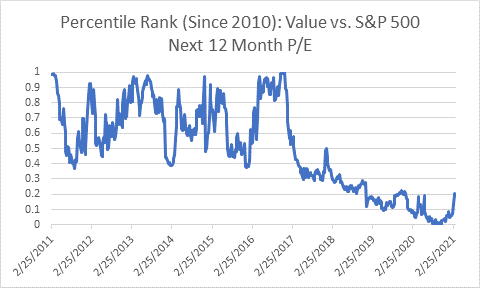
And this chart with data from Jefferies Trading Desk makes me think value stocks (including banks) have a lot more room to run, as they're still in the bottom 20% of their historical valuation range relative to the S&P 500 based on next 12 months' price-to-earnings (P/E) ratio:
But I wouldn't argue with my friend Doug Kass of Seabreeze Partners, who writes:
I have recently reduced my very large, outsized holdings in bank stocks to medium-sized because the easy money has been made. Bank investors are no longer fearful and bank stocks are no longer providing a historically attractive upside reward versus downside risk, as they did 12 months and even six months ago.
2) In my January 21 e-mail, I warned my readers:
Veteran short-sellers know that hydrogen fuel cell company Plug Power (PLUG) is nothing but a long-running promotion, dating back more than two decades.
This led one of my friends to dump the 10,350 shares he owned at $63.80, as I discussed in my March 10 e-mail.
I wasn't the slighted bit surprised to see the company issue this press release after the close yesterday: Plug Power to Restate Previously Issued Financial Statements.
The stock is crashing today, down 13% earlier this morning to around $37, so my friend has now saved approximately $275,000.
3) Picking up where I left off in yesterday's e-mail, here's further evidence for the coming "Mother of All (Economic) Booms" ("MOAB")...
Consumer demand for a wide range of products is surging. This is straining global supply chains, as the Wall Street Journal notes: Turbocharged Economy Leaves Factories Struggling to Deliver. Excerpt:
Successful vaccination campaigns in the U.S., accumulated savings, and the $1.9-trillion relief bill are turbocharging consumer demand. That is straining the globe-spanning supply chains companies rely on to deliver everything from toys to cars.
For now, economists don't expect the shortages to be a big drag on the recovery. But some businesses worry that a further surge in demand, led by the U.S., could exacerbate supply-chain disruptions and drive up costs...
Surveys of manufacturers indicate that lengthening delivery times – a sign that capacity is under strain – are now a near-ubiquitous problem. Data firm IHS Markit reported that global delivery times were the second-longest on record in February, with only India and Thailand reporting a decrease during the month.
Shortages are pushing prices higher, according to the surveys. Factories reported the sharpest rise in the prices they pay for inputs in almost a decade, and they, in turn, raised the prices they charged.
The problems are most acute in the global shipping network. It has yet to recover from the disruptions caused first by pandemic lockdowns, followed by the surge in demand for household and electronic goods as people settled into their new, home-centered routines.
Commodities are booming as well, as another Wall Street Journal article notes:
Commodity markets are roaring, stirring a debate about whether prices are headed for an extended upswing. The history of booms and busts in raw materials suggests the conditions aren't right.
Prices for Brent crude, the international benchmark in energy markets, have jumped 82% since the end of October. Copper is more expensive than it has been since 2011. Food hasn't cost as much since 2014, according to a United Nations index.
Some investors and analysts say commodities are in the early stages of a supercycle. That is a period when prices of livestock, grains, metals, oil, and gas all climb for years, even decades.
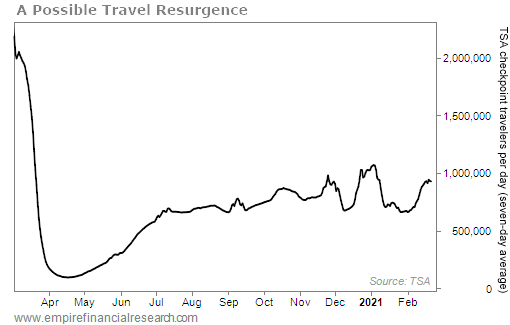
As for travel, the founder of Scott's Cheap Flights (a useful service I subscribe to) said, "The amount of pent-up demand for travel is unlike anything we've ever seen." To wit, in my February 22 e-mail, I wrote:
We may be seeing the start of a resurgence in travel, which is a leading indicator of an economic boom. This chart shows the seven-day average of the number of travelers each day going through TSA checkpoints in all U.S. airports. As you can see, the first weeks of this year were very weak, but there appears to be a rebound underway...
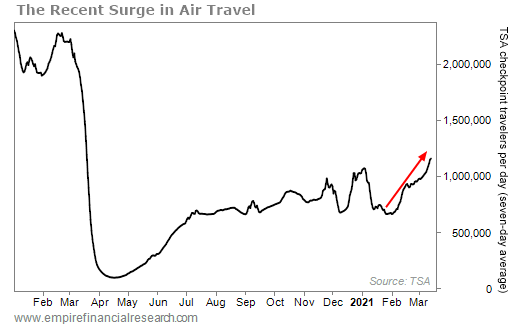
Here's the latest version of the same chart, showing a huge surge in air travel:
It's well known that real estate is white-hot in places like southern Florida and Park City, Utah, but even Manhattan is coming back: Manhattan apartment discounts may be ending soon as sales soar 73% in February. Excerpt:
- Sales contracts in Manhattan for residential real estate soared by 73% in February, and brokers say the days of big price cuts and deals in the city may be ending.
- There were more than 1,110 sales contracts signed in February, marking the third straight month of year-over-year gains, according to a report from Douglas Elliman and Miller Samuel.
- "The bigger narrative is the inbound migration to Manhattan," said Jonathan Miller, CEO of Miller Samuel. "I think the youth renaissance we are going to see in Manhattan is a big part of the story."
Lastly, here are some anecdotes I'm hearing from my colleagues:
- "I landed in Key West, Florida, on Saturday. My wife and kids came down on a separate flight a week earlier. Our flights were showing as empty as recently as three weeks ago, but both were full. Key West is packed. We've been coming here for 20 years and have never seen it this busy. It's very hard to get a reservation at a restaurant. One of our favorites is booked up for lunch and dinner into May. I just tried to book a half-day fishing charter to get my son out on the flats to see the marine life and birds. No availability for a couple of weeks.
"But here's the really interesting part: my in-laws have been here since the beginning of the month and their friends a bit longer. All of the merchants are telling them business suddenly turned about a month ago. Prior to that it was horrible. The timing seems very interesting considering momentum on the inoculation front. I would think stimulus checks will only boost it."
- "My family is in Marco Island. Same story with us. I had a car reserved at Hertz, but they didn't have anything for me. The guy there said were no cars available across all rental companies in Ft. Myers for at least a week. So we had to take an Uber – and the driver said his business has been fantastic recently."
- "The outdoor mall I visited over the weekend in Northern Virginia was packed... even busier than the pre-pandemic normal. And the pricier the store (Tory Burch, Kate Spade, Coach, etc.), the longer the line outside. Lots of pent-up demand, especially on the 'treat yourself' front."
- "Our mall was like Black Friday this weekend."
Best regards,
Whitney