

Bank Turmoil Squeezes Borrowers, Raising Fears of a Slowdown; The Real-World Costs of the Digital Race for Bitcoin; The $76 Billion Diet Industry Asks: What to Do About Ozempic?; Jimmy Chin at the airport
1) Investors should pay close attention to this article on the front page of today's New York Times: Bank Turmoil Squeezes Borrowers, Raising Fears of a Slowdown. Excerpt:
Boxt's worries offer a hint of the economic fallout facing borrowers across the country as credit becomes harder to get. It is too soon to say how much the banking tumult could slow the economy, but early evidence points to increased caution among banks and investors.
Taking out big mortgages is getting harder, industry experts report. The commercial real estate industry is bracing for trouble as the midsize banks that service it become more cautious and less willing to lend. Used car loans are more expensive. And a recent survey by the Federal Reserve Bank of Dallas showed a sizable share of banks in the region reporting stricter credit standards.
The question now is whether banks and other lenders will pull back so much that the U.S. economy crashes into a severe recession. Until comprehensive data is released – a Federal Reserve survey of loan officers nationwide is due in early May – economists are parsing stories from small businesses, mortgage originators and construction firms to get a sense of the scale of the disruption. Interviews with more than a dozen experts across a variety of industries suggested that the effects are beginning to take hold and could intensify.
"People are for the first time in some time using the 'c' words: credit crunch," said Anirban Basu, chief economist at Associated Builders and Contractors, a trade association. "What I'm hearing – and what I'm beginning to hear from contractors – is that credit is beginning to tighten."
Last night I was speaking to the smartest banking sector investor I know and what he told me was very consistent with this article:
I'm shocked that the stock market is doing so well because the banking system – the lifeblood of our economy – is in a crisis... There will be a pullback in credit availability...
If the risk-free rate is 5%, it doesn't make sense to lend at 6% to 7%. The right level is 7% to 9%, but many borrowers can't afford that.
The Fed waited too long to start raising rates, so they raised too fast, which shocked the banking system. They shouldn't have raised more than 250 basis points per year.
There are two solutions. First, there needs to be unlimited deposit insurance, paid for by a 25 basis point surcharge, mostly by the big four banks. This needs to be accompanied by stricter regulation to ensure banks don't take big risks.
Second, the Fed needs to cut rates, which would be an instant capital raise to the entire industry. But at the same time, it needs to sell residential mortgage-backed securities anytime mortgage rates fall to 5%. The right range is 5.0% to 6.5%. This will allow the Fed to shrink its balance sheet and be in a position to inject liquidity if needed.
As Silicon Valley Bank was imploding last month, I wrote that the banking sector was not in a crisis. So do I disagree with my friend? Not really, because we're using the word "crisis" in different ways...
The situation today is nothing like it was in 2008, when a huge bubble and massive fraud in the world's largest debt market (U.S. mortgages) combined with banks being overly levered and holding large off-balance-sheet liabilities created a perfect storm that brought our economy to its knees. That was a crisis!
My friend calls today's situation in the banking sector a crisis, but it's a very different, milder kind. Banks are pulling back credit and raising rates in nearly every area – as the NYT article notes, in mortgages, car loans, business loans, etc. – which is going to slow the economy for sure, but there's no panic. In fact, it's what the Fed intended when it began raising rates: to cool an overheated economy and bring down inflation, which is exactly what's happening.
But the Fed may have raised rates too rapidly, too high, which is why I (and others, like Bill Ackman) last month called for the Fed to pause raising rates. By not doing so, the Fed may tip the economy into a recession and need to start cutting rates by this summer...
How this plays out in the stock market is tough to know. A sharp recession combined with the Fed digging in its heels and refusing to cut rates would be bad for stocks. But a mild recession and a rate cut or two could send stocks soaring...
So for now, I'm mostly sitting tight, feeling neither bullish nor bearish (which is the case most of the time).
But I do think there are some excellent investment opportunities among stocks in the beaten-up banking sector. I'll be sharing a basket of my favorites in the upcoming April issue of our Empire Investment Report newsletter, which you can subscribe to right here.
2) This article, also on the front page of today's NYT, really burns me: The Real-World Costs of the Digital Race for Bitcoin. Excerpt:
Texas was gasping for electricity. Winter Storm Uri had knocked out power plants across the state, leaving tens of thousands of homes in icy darkness. By the end of Feb. 14, 2021, nearly 40 people had died, some from the freezing cold.
Meanwhile, in the husk of a onetime aluminum smelting plant an hour outside of Austin, row upon row of computers were using enough electricity to power about 6,500 homes as they raced to earn Bitcoin, the world's largest cryptocurrency.
The computers were performing trillions of calculations per second, hunting for an elusive combination of numbers that Bitcoin's algorithm would accept. About every 10 minutes, a computer somewhere guesses correctly and wins a small number of Bitcoins worth, in recent weeks, about $170,000. Anyone can try, but to make a business of it can require as much electricity as a small city.
In Texas, the computers kept running until just after midnight. Then the state's power grid operator ordered them shut off, under an agreement that allowed it to do so if the system was about to fail. In return, it began paying the Bitcoin company, Bitdeer, an average of $175,000 an hour to keep the computers offline. Over the next four days, Bitdeer would make more than $18 million for not operating, from fees ultimately paid by Texans who had endured the storm.
The New York Times has identified 34 such large-scale operations, known as Bitcoin mines, in the United States, all putting immense pressure on the power grid and most finding novel ways to profit from doing so. Their operations can create costs – including higher electricity bills and enormous carbon pollution – for everyone around them, most of whom have nothing to do with Bitcoin.
Until June 2021, most Bitcoin mining was in China. Then it drove out Bitcoin operations, at least for a time, citing their power use among other reasons. The United States quickly became the industry's global leader.
Since then, precisely how much electricity Bitcoin mines are using in America and their effect on energy markets and the environment have been unclear. The Times, using both public and confidential records as well as the results of studies it commissioned, put the most comprehensive estimates to date on the largest operations' power use and the ripple effects of their voracious demand.
It is absolute madness that we allow bitcoin mining in this country!
3) Following up on my recent writing about the miraculous weight-loss drugs, here's an article on the front page of today's Wall Street Journal about their impact on the diet industry: The $76 Billion Diet Industry Asks: What to Do About Ozempic? Excerpt:
Annick Lenoir-Peek, a lawyer from Durham, N.C., has struggled with her weight since adolescence. She has tried Atkins and keto and spent thousands of dollars over decades on weight-loss efforts and programs such as Noom, Nutrisystem and WeightWatchers.
Since starting Ozempic in late November, she has lost around 30 pounds. Her cholesterol and glucose levels have improved, and she can eat far fewer calories without feeling hungry, she says. She has felt few side effects and has more energy than when she tried calorie-restricted diets. Currently on a trip through Eastern Europe, she says she is doing more tours than she would have at a higher weight.
People such as Ms. Lenoir-Peek – among the diet business's most reliable customers – are sparking an existential crisis for the industry, which rang up $76 billion in sales in 2022 from weight loss and medical programs, diet soda and low-calorie frozen food, gym memberships and other categories, according to research firm Marketdata LLC.
4) Longtime readers may recall that I ran into one of my heroes while climbing in Ecuador in December 2021. I wrote:
Wow, this is one of the highlights of my year! I just ran into one of my heroes, Alex Honnold (the climber featured in the movie Free Solo) and had a nice chat with him. He's a really nice, down-to-earth guy.
In a totally random, small-world coincidence, he's staying in the same lodge as I am here at the base of Cotopaxi, the world's highest active volcano (19,347 feet). He's here for a big destination wedding for two of his friends, the climbers, mountaineers and extreme skiers Adrian Ballinger and Emily Harrington, whom I also met this afternoon (search for their names on Google and YouTube for some great stories and EPIC videos). They're all climbing Cotopaxi tonight, and I'm climbing it tomorrow night...
Here's a picture of us:
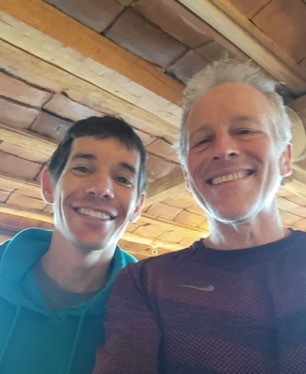
Well, yesterday on my way home from skiing at Jackson Hole, Wyoming, I had a similar experience when I saw Jimmy Chin – the legendary climber, photographer, and cinematographer who co-directed Free Solo – at the airport.
I had a brief chat with him and brought up the connection we both have to Carleton College in Minnesota. He grew up in Mankato, Minnesota, only an hour from Carleton, and graduated from there in 1996, while my oldest daughter graduated five years ago and my youngest is currently a sophomore. (Susan and I are flying there Thursday for a parents' council meeting.) He smiled and said he barely graduated because he was driving west to ski and climb at every opportunity!

Best regards,
Whitney
P.S. I welcome your feedback at WTDfeedback@empirefinancialresearch.com.