

Banks' Bond Losses Caused the Crisis. Now the Crisis Is Reversing the Losses; Warren Buffett and Japan's Trading Titans Would Be Formidable Allies; Highlights from Buffett's CNBC interview; The AI revolution: Google's developers on the future of artificial intelligence; 35 Ways Real People Are Using A.I. Right Now; Google Flights added a low-price guarantee
1) This article in today's Wall Street Journal highlights the irony that rising interest rates caused losses in banks' bond holdings...
This was a major contributor to the turmoil in the sector, which in turn caused interest rates to fall, which is now leading to lower losses in those same bond holdings! Banks' Bond Losses Caused the Crisis. Now the Crisis Is Reversing the Losses. Excerpt:
The ripple effects of the banking crisis are reversing one of the problems that sparked it.
Rising rates over the past year saddled banks with losses on their massive portfolios of bonds. Those losses helped sink Silicon Valley Bank last month. But since that failure sparked turmoil across the banking sector, falling bond yields have narrowed those losses...
After the banking turmoil began, bond yields dropped sharply. Between March 9, the day before SVB failed, and the end of the quarter, the yield on the 10-year Treasury note fell 0.43 percentage point to 3.49%. It edged up to 3.59% on Monday.
That yield, which is the benchmark for many types of bonds stowed in banks' securities portfolios, has been falling largely because the banking turmoil heightened fears of a recession.
In turn, unrealized losses have been shrinking.
I'll be discussing this ironic twist in the latest issue of Empire Investment Report, which is publishing after the close today. In it, I share my five favorite stocks in the sector – ranging in market cap from $21 billion to $100 million – that I think are best poised to rebound from the recent turmoil.
To learn how to subscribe and get on the list to receive this issue if you aren't already a subscriber, click here.
2) This "Heard on the Street" column in today's WSJ has some interesting speculation I hadn't considered: that Warren Buffett's interest in the Japanese trading houses he's invested in might be more than just stock appreciation: Warren Buffett and Japan's Trading Titans Would Be Formidable Allies. Excerpt:
As Mr. Buffett rightly put it, these companies are a bit like Berkshire itself. They also own a lot of different things, often hold them for long periods, and tend to be focused on value and cash flows rather than flashy thematic, unproven companies. Mr. Buffett also suggested that they could potentially be partners in future deals.
"They can call us anytime," said Mr. Buffett in a CNBC interview last week.
That would indeed be an interesting idea, given that the Japanese trading houses have been scouring the globe for opportunities too. They are doing very well off the commodities boom, but they would benefit from further diversification, especially as the drive to decarbonize accelerates globally. That could eventually impact the value of some of their traditional resource businesses.
Mr. Buffett says he was confounded by the chance to buy into the Japanese trading houses at the price on offer. Opportunities to do deals together might amaze him too.
3) Speaking of Buffett and banks, if you didn't have a chance to watch the 160-minute interview he did with CNBC last week (links in last Wednesday's e-mail), Thomas Chua does a nice job of summarizing the transcript in this Twitter thread:
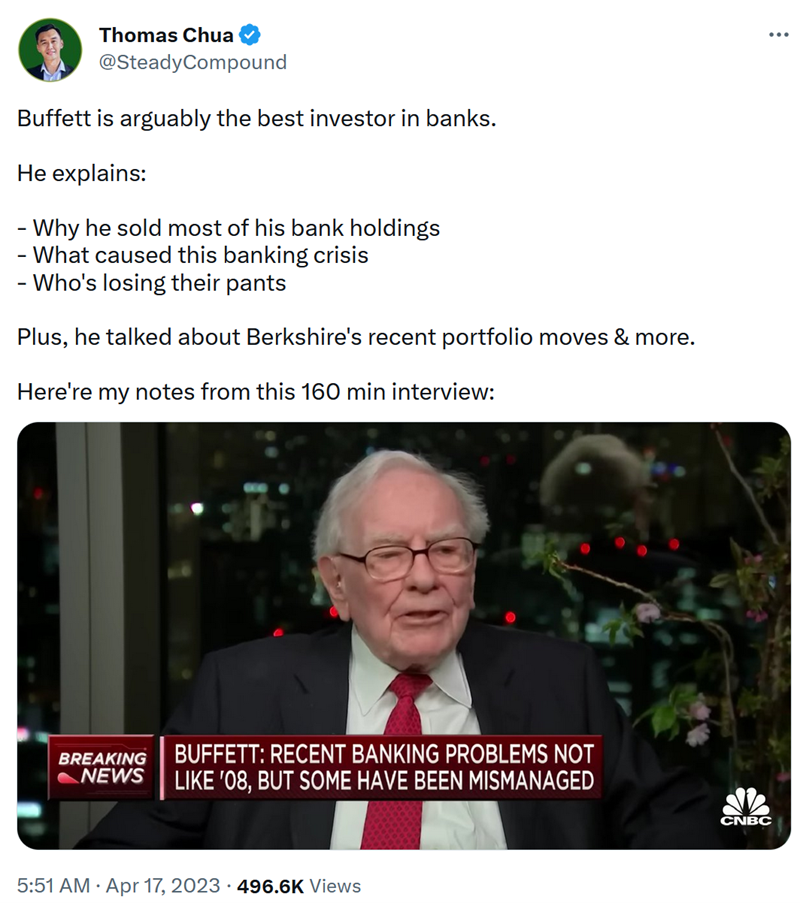
In addition to banking, Chua covers what Buffett had to say about why he bought and sold Taiwan Semiconductor Manufacturing (TSM), why he's trimming Berkshire Hathaway's (BRK-B) position in Chinese EV maker, BYD, his recent investments in Paramount (PARA) and Japanese equities, and Berkshire's moat.
4) Following up on last Thursday's e-mail about artificial intelligence and ChatGPT, 60 Minutes did a double-length 27-minute segment last Sunday on this, focusing on what Alphabet (GOOGL) subsidiary Google is doing, with an interview with CEO Sundar Pichai: The AI revolution: Google's developers on the future of artificial intelligence (transcripts here and here). Excerpt:
Like the humans it's learned from, Bard is flawed. In an essay the AI wrote about economics, it referenced five books; each one was fabricated. This very human trait, error with confidence, is called, in the industry, hallucination. To help cure hallucinations, Bard features a "Google it" button that leads to old-fashioned search. Google has also built safety filters into Bard to screen for things like hate speech and bias.
Google is holding back on releasing more advanced versions of Bard that can reason, plan and connect to internet search on their own so that the company can do more testing, get more user feedback and develop more robust safety layers, Google CEO Sundar Pichai said. He's walking a narrow line in how quickly AI advancements are released.
Critics argue the rush to AI comes too fast, but competitive pressure, among tech giants like Google and smaller start ups, is propelling humanity into the future – ready or not. Society needs to adapt quickly, with regulations for AI in the economy, laws that punish abuse and treaties between nations to make AI safe in the world, Pichai said.
5) In last Thursday's e-mail, I asked readers to share how they were using ChatGPT. Empire Financial Research Editor in Chief Sam Latter weighed in with this:
I use ChatGPT to come up with bedtime stories for my twin boys. To come up with a new story every night, they give me prompts and I type in stuff like "tell me a five-minute children's story about two little boys who save their town and scare away the bad guys." It's turning into a fun tradition!
Here's a New York Times article with other ideas: 35 Ways Real People Are Using A.I. Right Now. Excerpt:
The public release of ChatGPT last fall kicked off a wave of interest in artificial intelligence. A.I. models have since snaked their way into many people's everyday lives. Despite their flaws, ChatGPT and other A.I. tools are helping people to save time at work, to code without knowing how to code, to make daily life easier, or just to have fun.
It goes beyond everyday fiddling: In the last few years, companies and scholars have started to use A.I. to supercharge work they could never have imagined, designing new molecules with the help of an algorithm, or building alien-like spaceship parts.
6) I use Google Flights to book all of my flights, so I'll definitely be using this new feature: Google Flights added a low-price guarantee. Here's the fine print. Excerpt:
It can be agonizing to book a flight these days. If you're trying to find the best airfare, you can lose hours online looking for "The One." Even after you lock in a reservation, you may have lingering anxiety about whether you're getting a good deal or letting a better one slip away. A new feature on Google Flights is trying to assuage some of that misery.
The Google price guarantee, which launched a pilot program Monday, shows travelers when Google Flights predicts that a flight won't get any cheaper before takeoff. You'll be able to notice these flights by the badge next to the price. (It looks like a colorful shield.)
It's a helpful feature for peace of mind, and it works for you after booking, too: If Google gets the prediction wrong, and your flight price does drop, it will pay the difference. Prices are tracked from the time you book until your departure.
Best regards,
Whitney
P.S. I welcome your feedback at WTDfeedback@empirefinancialresearch.com.