

Bill Ackman, Larry Summers, and Paul Krugman debate inflation; TikTok Is Flooded With Health Myths; The end of our Backroads trip
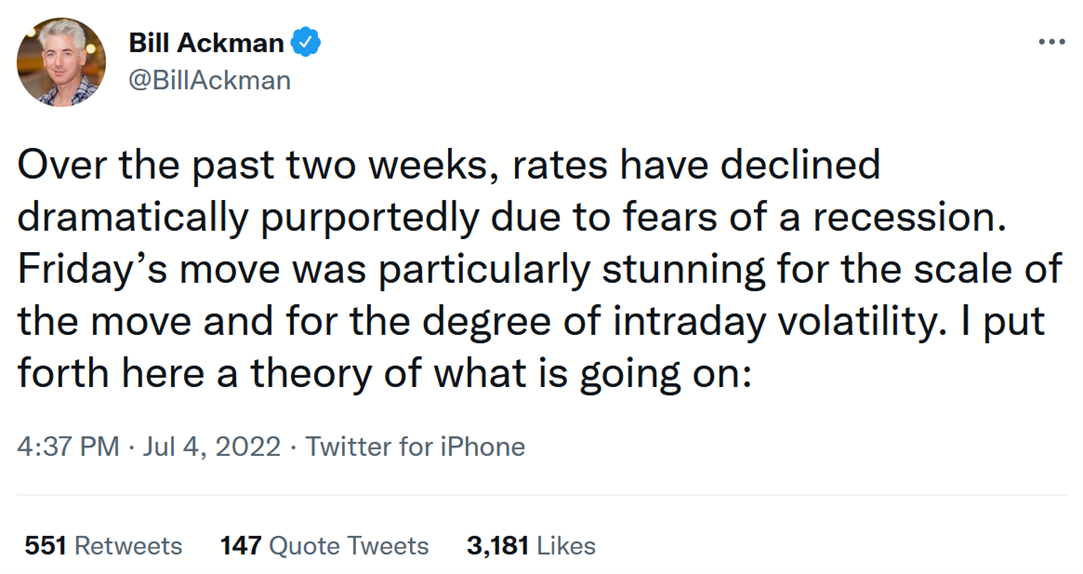
1) The debate over inflation continues to rage. My college buddy Bill Ackman posted his latest thoughts yesterday afternoon in this Twitter thread:
On the risk of a recession: a recession is defined as a two-quarter decline in real, as opposed to nominal, GDP. In a highly inflationary economy, it is more difficult for nominal spending and growth to exceed inflation. In order therefore for today's economy to grow on a real basis, nominal GDP growth must be >8.6%, which is a difficult hurdle to exceed.
It has been 40 years since we have experienced inflation at current levels, and as a result, market participants are used to a world with 4-5% nominal GDP growth and 2% inflation. With inflation at 2%, nominal GDP growth need only decline from 4-5% to less than 2-3% for two quarters in a row for real GDP to be negative and for the economy to be deemed to be in a recession.
Two quarters of negative GDP growth does not however seem to be a reasonable definition during a period with high inflation, particularly when inflation has spiked to nearly 9%. Nominal spending growth of 8% for the last two quarters would technically put us in a recession, but this does not make sense fundamentally.
The economy is continuing to grow rapidly on a nominal basis. Consumers are spending substantially more this year than last. There are about two times as many job openings than people looking for work. The unemployment rate is at a 50-year low. Wages are rising substantially and it is hard to find workers.
Q2 revenues and earnings growth should be strong for most businesses, with earnings misses and margin declines for some companies which have limited pricing power. Consumers have approximately $2.5T of excess savings. While there is a mix shift underway from goods to services, overall demand is extremely strong. We have a supply, not a demand problem. This does not seem like a setup for a true economic recession regardless of the favored definition.
So why have rates declined so dramatically, particularly short rates when the Federal Reserve has become increasingly strident about the need for aggressive tightening to bring inflation back down to 2%?
The answer I believe is largely due to some misunderstanding about what a recession is, but more importantly technical factors that are driving volatility and the downward move in rates.
Market participants speculating in the fixed income market, particularly hedge funds, often use enormous amounts of leverage because it is available and it allows one to make windfall profits if you get the trade right. The bet that rates would rise became one of the more crowded trades in history going into June 15. As speculators covered their shorts on the Fed news, rates began to decline, causing substantial mark-to-market losses particularly for levered participants, who were forced or chose to cover.
With more data points emerging indicative of a slowing economy, the recession narrative took hold, causing a further decline in rates, contributing to more losses, and short covering going into the quarter end when exposures are required to be disclosed in investor reports and financial statements.
Extremely limited liquidity going into the July 4th holiday compounded the move and the volatility and pain for levered market participants, as traders looked to, and in many cases, were forced to exit, or didn't wish to hold open positions over the long weekend.
So what happens from here? Powell has committed to do "whatever it takes" to quell inflation even if doing so causes an increase in unemployment and a recession. Inflation is not coming down soon. Housing and rental costs, energy, ag and food are supply constrained, and higher prices are unlikely to abate for the foreseeable future. Wages are continuing to rise as immigration has been limited, many have exited the workforce and the balance of power has gone from companies to their labor forces. Companies are raising prices because they must in order to cover their costs and because they can. The wage price spiral is underway.
While demand is moderating due to sticker shock and inflation as well as rising rates, overall demand remains strong. Inflation has become imbedded and is a daily experience, in headline news, and a dinner table topic for all. I Savings bonds pay 9.62%!
In order to stop the inflationary spiral, the Fed will need to rapidly raise rates to 4-5% by next year, which hopefully will be enough to snuff inflation. The mild and transitory inflation being priced by the market as of Friday is a fiction. Rates are going up a lot soon.
The sooner the Fed quells inflation, the better for longer-term bonds and long-term financial assets like equities. Don't be misled by short-term, technically driven market movements. Stocks of high-quality businesses with long-term growth and pricing power look cheap. Don't forget that the stock market measures nominal business value. Inflation is hurting business and consumer confidence and slowing growth. Killing off inflation will save the economy in the longer term at the expense of some short-term pain.
Let's hope the Fed gets it right. I welcome your input and rebuttals.
And yes, we put our money where our mouth is. I have often wondered why investors who share their views are often criticized for holding investments on which they will profit if the views they share turn out to be correct. We are 100%+ long high-quality growth businesses with pricing power, and own hedges on which we will profit if rates rise. Our positioning, as always, matches our thinking and stated views.
2) Next, here's a Wall Street Journal interview with former U.S. Treasury Secretary Larry Summers, who, like Ackman, was right in his early warnings about inflation: Larry Summers Nailed Inflation. But Is He Right on What Comes Next? Excerpt:
Prof. Summers set out the case over a late-afternoon dish of cured salmon at a London hotel.
"It's 60-40 that we're going back to something that's kind of secular stagnation," he said. Just as in the aftermath of the 2008-2009 recession, interest rates will be held down by increased savings resulting from an aging population and the uncertainty that comes after a crisis. Rapid technological development will again keep the cost of capital goods down. More savings and less investment means lower after-inflation interest rates are required to balance the economy.
He sees the threat of recession, even with 10-year bond yields at just over 3%, as strong evidence that he is right that the U.S. and the world can't cope with higher rates.
"The fact that such low rates seem to be causing a recession is quite prohibitive," he argues.
Yet, even this only leads him to put a 60% chance on a fast-forward to the past. Governments worried about climate change and energy self-sufficiency might spend big on a green transformation, which would raise investment and real rates. Restrictions on banks brought in after the collapse of Lehman Brothers in 2008 might be relaxed, helping match savings and investments more efficiently.
3) Lastly, here's New York Times columnist Paul Krugman with a contrary viewpoint: Taking the 'Flation' Out of Stagflation. Excerpt:
According to Powell, one factor in the decision was a jump in the University of Michigan's measure of long-term inflation expectations, which he described as "eye catching." I and others warned about making too much of one month's number, especially because other measures of expected inflation weren't telling the same story – and to be fair, Powell acknowledged that this was a preliminary number that might be revised. Sure enough, the number was revised down; apparently, inflation expectations aren't losing their anchor after all. Oopsies.
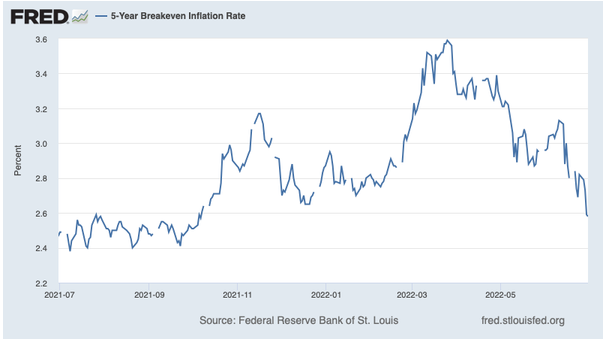
In fact, the big story right now seems to be a quite sharp decline in market expectations of inflation over the medium term. Here's the five-year breakeven – the spread in interest rates between ordinary U.S. government bonds and inflation-protected bonds that are indexed to consumer prices:
... And with growing evidence that the economy is weakening quite fast – it's now looking altogether possible that the economy actually shrank in the second quarter – it seems reasonable to suggest that inflation will also fall fast. That, at any rate, is what the markets seem to be anticipating.
Now, this progress against inflation, if it happens, will come at a cost. The U.S. economy's growth is clearly slowing, and the downturn could easily be sharp enough to be considered a recession, albeit probably a mild one. And because it will take a while for inflation to fully reverse its rise, there's a good chance that we'll see a brief period of economic stagnation combined with continuing inflation – stagflation.
But if I'm right, and the markets are right, the "flation" part of that story won't last very long. And sooner than many people believe, the Fed may find itself reversing course, trying to undo the "stag."
4) Following up on my recent e-mail about TikTok, here's another reason to shut it down: TikTok Is Flooded With Health Myths. These Creators Are Pushing Back. Excerpt:
Unqualified influencers posting misinformation far outnumber the experts debunking it, who are often harassed by other users for their efforts. "For every large creator who is genuinely evidence-based, you've got 50 or 60 big creators who spread misinformation," said Dr. Idrees Mughal, a Britain-based physician with an additional masters in nutritional research, whose account, @dr_idz, has 1 million followers.
He debunks fad diets, unsupported claims that food ingredients are "cancer-causing" and the myth that certain vegetables contain harmful "toxic" chemicals. Misinformation is so ubiquitous that Dr. Mughal says he is tagged in 100 to 200 videos a day from users requesting that he debunk claims. "People are looking for genuine science-based, evidence-based creators," he said.
Misinformation is widespread on all of the major social media platforms, but TikTok's audio capabilities can give false claims particular longevity. Bits of misinformation clipped and saved as what TikTok calls sounds "operate like viral chain messages," according to a 2021 blog post from the Institute for Strategic Dialogue, a London-based center that researches disinformation and extremism online. Even if a video is taken down, the original audio often survives in the work of users who have already borrowed it for their own content.
TikTok has enacted policies to flag such content, including adding informational banners to COVID-19 vaccine content, but one I.S.D. study of more than 6,000 videos related to the vaccines found that 58 percent lacked banners.
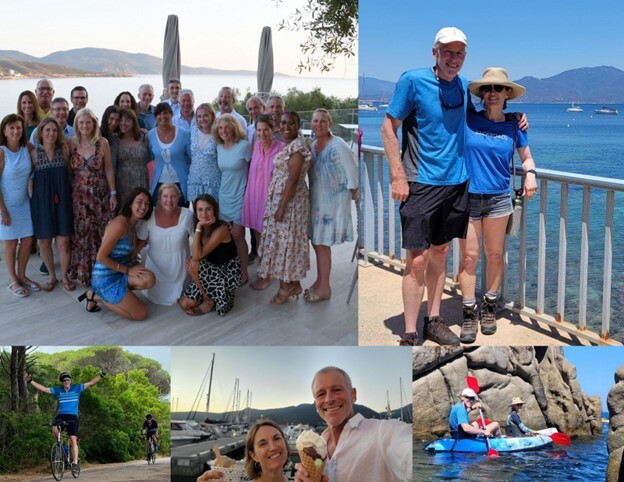
5) We had great fun on the last three days of our Backroads trip on the French island of Corsica.
On Wednesday, we did two 18-mile rides before and after lunch down to the coast, passing through some charming villages before arriving at our lovely hotel in Propriano. That evening we went into town for dinner and gelato and checked out the yachts.
The next morning we took Zodiac boats for 30 minutes to the nearby town of Campomoro where we went kayaking, had lunch, and did a 3.5-mile hike before returning to the hotel for some backflips into the ocean (see Friday's e-mail) and a lovely dinner.
The trip ended Friday morning with a short two-mile hike and then we took a bus to Ajaccio, where most folks caught flights.
We didn't depart until the next morning, so we walked around Ajaccio, checked out the fancy yachts, and went to the National Museum of the Bonaparte Residence in the house Napoleon Bonaparte was born in in 1769.
On Saturday, Susan flew home and I flew to London.
Here are a few pictures, and I've posted 25 more on Facebook here:
Best regards,
Whitney
P.S. I welcome your feedback at WTDfeedback@empirefinancialresearch.com.