

Cathie Wood's Ark Invest slumps as tech bets sour; Nine Hot New Hedge Funds Launched by Leading Women in the Finance World; Women May Be Better Investors Than Men. Let Me Mansplain Why; I summited Cotopaxi yesterday
1) I read this article in the Financial Times with great interest: Cathie Wood's Ark Invest slumps as tech bets sour. Excerpt:
Ark Invest's flagship exchange traded fund has extended its losses this year to 26%, as investors ditch the high-growth but often unprofitable technology stocks that powered its extraordinary rise...
Ark Innovation is a $21.4 billion actively managed ETF , which invests in U.S.-listed companies focused on "disruptive innovation," notably in areas related to DNA technologies, automation, robotics and energy storage, artificial intelligence and fintech.
This year some of Ark's biggest holdings have been hammered, including real estate marketplace Zillow, virtual health care company Teladoc (TDOC), Zoom (ZM) – the video conference platform that was one of the big winners of the pandemic – and Roku (ROKU), a television streaming company.
"There has been an ebbing of enthusiasm for high-growth tech stocks," said Russ Mould, investment director at AJ Bell, the U.K.'s second-largest listed investment platform. "A lot of Ark Innovations' holdings don't make money and, in an environment where interest rates are expected to rise, this is not necessarily the place you want to be."
I've warned my readers to stay away from Woods' funds multiple times this year, most recently on August 24:
I wouldn't say I'm obsessed with Cathie Wood (though some of my readers might disagree, as I wrote about her in February, March, April, April again, May, May again, and June!), but I'm definitely fascinated...
I admire many things about her: her enormous success, especially as a woman in a male-dominated industry (I wrote two articles on this topic for the New York Times website in 2014: Evaluating the Dearth of Female Hedge Fund Managers and A Deeper Conversation on Women in Hedge Funds)... the fact that she got to the top in large part by simply outworking everyone else... and her conviction in her ideas, most notably when it comes to one of the most controversial stocks of all time, Tesla (TSLA).
And while her balls-to-the-wall investment style, taking large positions in high-growth, emerging technology companies, isn't for me, I don't dismiss this approach either. In fact, in many ways, it mirrors what my colleague Enrique Abeyta does so well. I think it's healthy that the three lead investors here at Empire Financial Research – Enrique, Berna, and I – have such different approaches and areas of expertise.
That said, I haven't changed my view that investors should avoid ARK Invest's funds for four primary reasons...
First, Wood reminds me a lot of former Morgan Stanley (MS) tech analyst Mary Meeker, who correctly saw the importance of the Internet in the late 1990s and became known as the "Queen of the Internet" – right before the bubble burst...
Second, ARK's assets under management ("AUM") soared more than 10-fold last year and now exceed $50 billion. I don't think it's a coincidence that ARK's performance has stunk ever since... The flagship ARK Innovation Fund (ARKK) – which accounts for nearly half of the firm's assets – is down 4% this year versus 20.4% and 18.8% gains for the S&P 500 Index and Nasdaq Composite Index, respectively.
AUM growth dragging down returns is an issue for nearly all successful investors, as high returns attract capital, but I think it will prove to be an especially difficult one for ARK to overcome, as the highest returns among emerging growth companies are generally earned by those who invest in them while they're small – something ARK can no longer do, at least in any size.
Third, I think the fact that ARK discloses all of its trades every day is very risky. All is well and good when assets are growing or stable... but if investors start to pull money, ARK has no choice but to sell. This is bad enough if done quietly – I've had to do it myself – but if you're a large shareholder and others see you selling, they're going to scramble to sell (or short) ahead of you, putting even more downward pressure on the stocks you're selling, which leads to more poor performance, more redemptions, etc., which can quickly turn into a dangerous downward spiral...
Lastly, this comment in the NYT article by one of the people Wood worked for early in her career raised a big red flag for me: "I've never met anybody with as much conviction. It's almost mystical, to be very honest with you." It further reinforces a gut feeling I have that she may suffer from dangerous overconfidence.
To be clear, being a successful long-term investor requires a high level of confidence, rooted in good data and analysis.
But it must also be accompanied by a great deal of humility – in particular, to: a) understand that most of the time, the market is right and you're wrong... and b) you must be willing to accept new/disconfirming information, change your mind, admit mistakes, and exit formerly beloved positions.
My extensive experience is that almost everyone in this business has an abundance of confidence... What they're missing is the humility! This is especially true when someone has a run of extreme success.
I've seen again and again (to some extent, it happened to me as well) how making a ton of money and being fawned over by the media can turn the brains of even the most rational, appropriately self-confident investors into total mush – and when this happens, the end result is almost always a train wreck.
2) Speaking of women in the investment business (see links above to the two articles I wrote on this topic for the New York Times website in 2014), I was heartened to see this recent Bloomberg article: 9 Hot New Hedge Funds Launched by Leading Women in the Finance World. Excerpt:
When Mala Gaonkar and Divya Nettimi open their hedge funds in 2022, some bankers and investors expect they could each start with $1 billion or more under management. There has never been such a large launch by a woman-led firm, never mind two in the same year.
They are just the most prominent of a group of women who are opening, or have recently opened, funds around the world. It's been a long time coming. Of the thousands of hedge funds, only about 80 are led by women today, according to the Kresge Foundation, a Troy, Mich.-based philanthropy that tracks diversity of managers.
"It is a watershed moment to have multiple female-led hedge fund launches," says Dominique Mielle, a former partner and portfolio manager at Canyon Capital and author of Damsel in Distressed: My Life in the Golden Age of Hedge Funds.
That said, the news isn't quite as good as the article suggests. My colleague Berna Barshay, a two-decade veteran of the hedge fund industry, commented:
The article is a little exaggerated, as there aren't nine major funds launching helmed by women in the U.S. There are just three. Three major launches led by female portfolio managers is a really, really big deal... but what is going on is a bit less than the headline would lead you to believe.
Of the nine, three are small funds with less than $75 million. It's extremely difficult to break out of that range to the big-time these days. I hope these women can beat the odds and become smashing successes... but it won't be easy.
Unfortunately, launching with $50 to $75 million isn't a hot fund. Rather, these are the types of small-fund launches to which most women have traditionally been relegated because they haven't historically gotten large-scale seed deals or had the network or backing to raise hundreds – instead of tens – of millions of dollars.
Three are in London and Hong Kong, which have historically been more friendly to female managers... At least one of them sounds sizable.
This leaves three genuine big launches in New York by women, which is HUGE progress... but it isn't nine.
All three of the big launches are primarily tech-focused – a sign of the times.
So, overall, it's really good news, but sadly not as good as the headline would imply.
3) It's totally illogical that there are so few professional women investors because many studies show women tend to be better at the craft than men. Here's the latest one: Women May Be Better Investors Than Men. Let Me Mansplain Why. Excerpt:
Merrill was a guy, and so was Lynch. Goldman? A dude, and Sachs as well. Charles Schwab is a man, and so was E.F. Hutton. Gordon Gekko was an alpha male. And Jordan Belfort, the Wolf of Wall Street? Total bro.
Heroes or villains, winners or losers, real or imagined, our iconic investors are very, very male. But that's a mistake – because it turns out that women are often better at investing.
Fidelity offered up the latest evidence this month: Over a 10-year period, its female customers earned, on average, 0.4 percentage points more annually than their male counterparts. That may not seem like a lot, but over a few decades it can add up to tens of thousands of dollars or more.
"Invest like a woman is what you learn from this," said Lorna Kapusta, head of women investors and customer engagement at Fidelity.
This isn't the first time that researchers have found women to be the better investors. The surprising thing about this phenomenon, however, is that neither women nor men seem to be aware of it – and they end up depriving themselves of some lessons that might help both genders invest better.
4) After summiting Cotopaxi yesterday (see my Facebook post here), we drove three hours to the much-lower-elevation town of Baños, where we'll rest for a few days before tackling 20,548-foot Chimborazo on Sunday night/Monday morning.
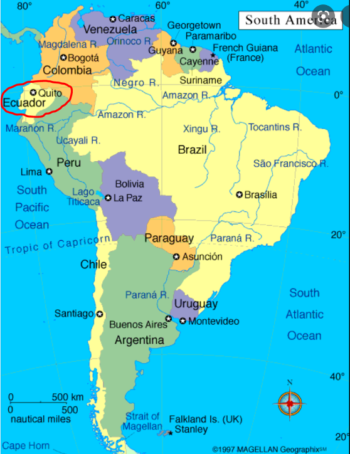
In case you're not familiar with Ecuador, I've circled it on this map of South America:
It's sort of odd that I've never been to Ecuador, given that my family moved to Managua, Nicaragua when I was eight and we lived there from 1974 to 1977, traveling all over Central America.
I still remember seeing the Mayan ruins in Tikal, Guatemala, and the Panama Canal, one of the great engineering feats in history (here's a great book on it: The Path Between the Seas: The Creation of the Panama Canal, 1870-1914).
In addition, I spent half of my senior year in college in late 1988 as an intern at the U.S. Embassy in Santiago, Chile, researching my thesis on Reagan Administration Foreign Policy Toward Chile.
Lastly, I've taken family vacations to Brazil, Argentina, Uruguay, and Peru in the past decade. But I've never been to the other countries in South America...
Ecuador is the 73rd country I've been to in my life (not counting layovers). Here are maps showing them (as well as, embarrassingly, the eight U.S. states I have yet to visit), from an app called Countries Been:
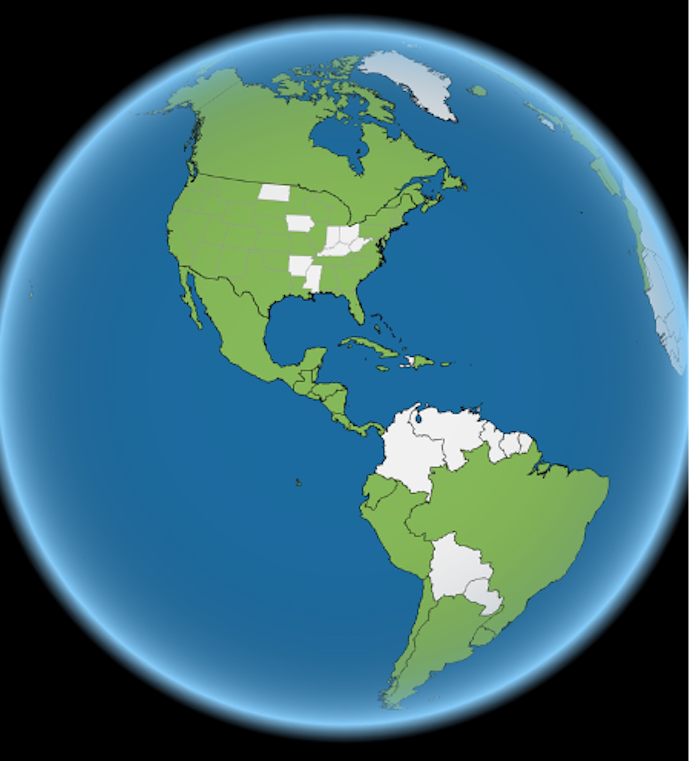
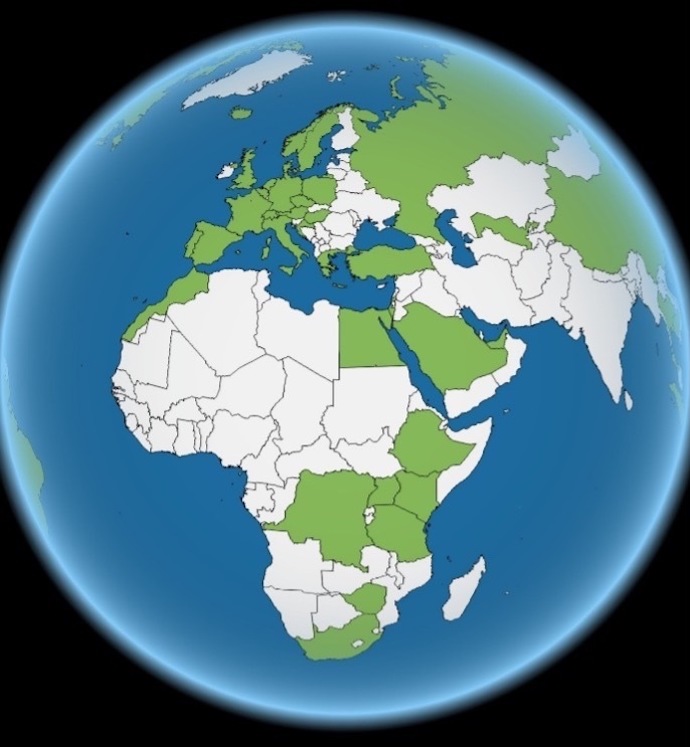
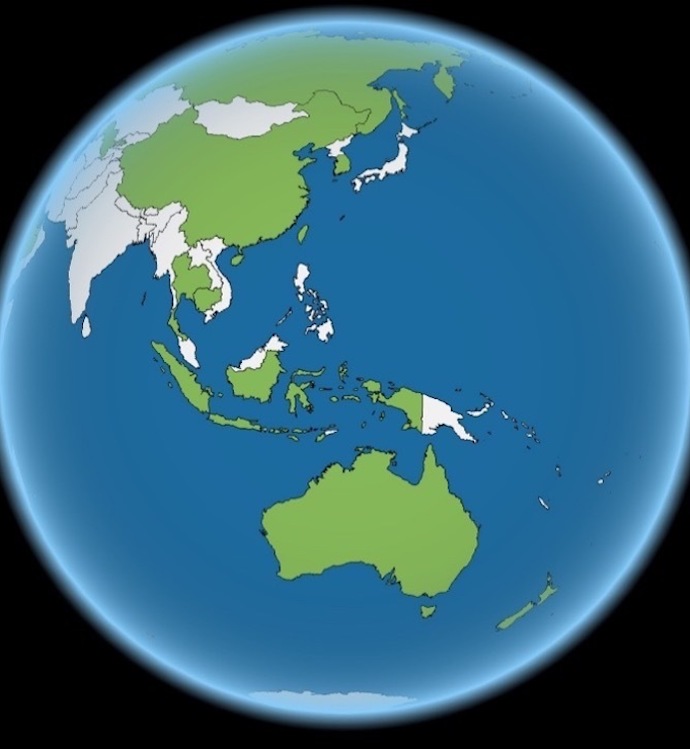
High on my list of countries that I want to visit are Japan (I hear the powder skiing in Hokkaido can't be beat), Nepal (for trekking, not Mt. Everest!), Botswana (the Okavango Delta), Namibia (Skeleton Coast), India (Taj Mahal), Colombia (a buddy lives in Medellín and JetBlue (JBLU) has nonstop flights to Cartagena), and Vietnam (my parents loved it).
But the next new country I'll be visiting is Rwanda. We're doing a family trip to see the mountain gorillas there in March.
Best regards,
Whitney
P.S. I welcome your feedback at WTDfeedback@empirefinancialresearch.com.