

Comments on the banking sector from the smartest bank analyst I know; A mini-bubble forming among a new group of meme stocks; Mark Spiegel's bearish case for the market and Tesla; How Bad Is China's Economy? Millions of Young People Are Unemployed and Disillusioned; How Ivy League Schools Tilt Your Odds in the Lottery of Life
1) In my July 20 e-mail, I highlighted how I nailed the bottom of the crash in small and regional bank stocks in my May 3 and May 4 e-mails. In the latter, I quoted from "the smartest bank analyst I know," who said that day:
The other thing that the markets seem to have wrong is they don't realize that banks have reserved for loan losses and are still going to earn some money as we go through a potential credit cycle. Take Zions Bancorp for example: they have $618 million of loan loss reserves and are expected to earn another $800 million this year. Even if they only earn half of that they still have the power to cover a lot of credit losses.
Not that analysis seems to matter right now, as sentiment in the bank space is as bad as we can ever remember it...
The shorts are being very aggressive in some of the banks like MCB, WAL, ZION, etc. If there is even a hint of an improvement in deposit insurance, we could see a short squeeze for the ages that sends these stocks up 20%-plus in a matter of minutes, and many of them would still be dirt cheap.
Since then, the three stocks he recommended, Metropolitan Bank (MCB), Western Alliance Bancorp (WAL), and Zions Bancorp (ZION), are up 128%, 185%, and 92%, respectively, which has led to articles like this one in the New York Times, How Regional Banks Got Healthy Again, and this one in the Wall Street Journal, Banks Lean On 'Hot' Deposits to Shore Up Balance Sheets.
So is it time to take some profits?
I checked in with my friend yesterday to get his latest thoughts, which he gave me permission to share:
We would say it is quite generous to say that regional banks are suddenly healthy again. Yes, the fear has calmed, but the trends with funding costs are really awful and the earnings outlook for banks is definitely challenged. Banks still have very large amounts of long-term fixed rate loans and securities on their books, so as rates and funding costs continue to rise the portions of their balance sheet that are underwater grows larger.
If the Fed keeps on its path of raising, it is going to make matters a lot worse. There are still a handful of fairly large banks that are very thin on capital if you mark-to-market the balance sheet, and some that even get totally wiped out. The ugliest bank that nobody is talking about anymore is Charles Schwab (SCHW). It is crazy they passed the stress test, but then again Silicon Valley Bank and First Republic probably would have passed that stress test as well.
It feels like all the buying recently has been short covering and passive money driven as bank earnings expectations were so low it wasn't difficult for most banks to beat the estimate. Overall, we have been reducing long exposure and adding to shorts as we think this bounce is a bit overdone.
My friend also shared with me his specific thoughts on the six bank stocks we recommended in our April and May issues of our Empire Investment Report newsletter, which I'll be covering in this month's portfolio update.
Subscribers can access all of our back issues right here... And if you aren't a subscriber, you can learn more about Empire Investment Report and find out how to gain instant access to these banking stock recommendations – and the rest of the portfolio of open recommendations – for 40% off the regular price of a subscription by clicking here.
2) Following up on yesterday's e-mail about the trading in Tupperware Brands' (TUP) stock, which jumped 38.6% yesterday, bringing its gains to more than 600% in less than two weeks (and rose as much as 15% earlier this morning) on no news...
The foolishness isn't limited to Tupperware, as shown in this table of yesterday's gains by the most speculative stocks (including three in my "Dirty Dozen" list, NKLA, WKHS, and AMC):
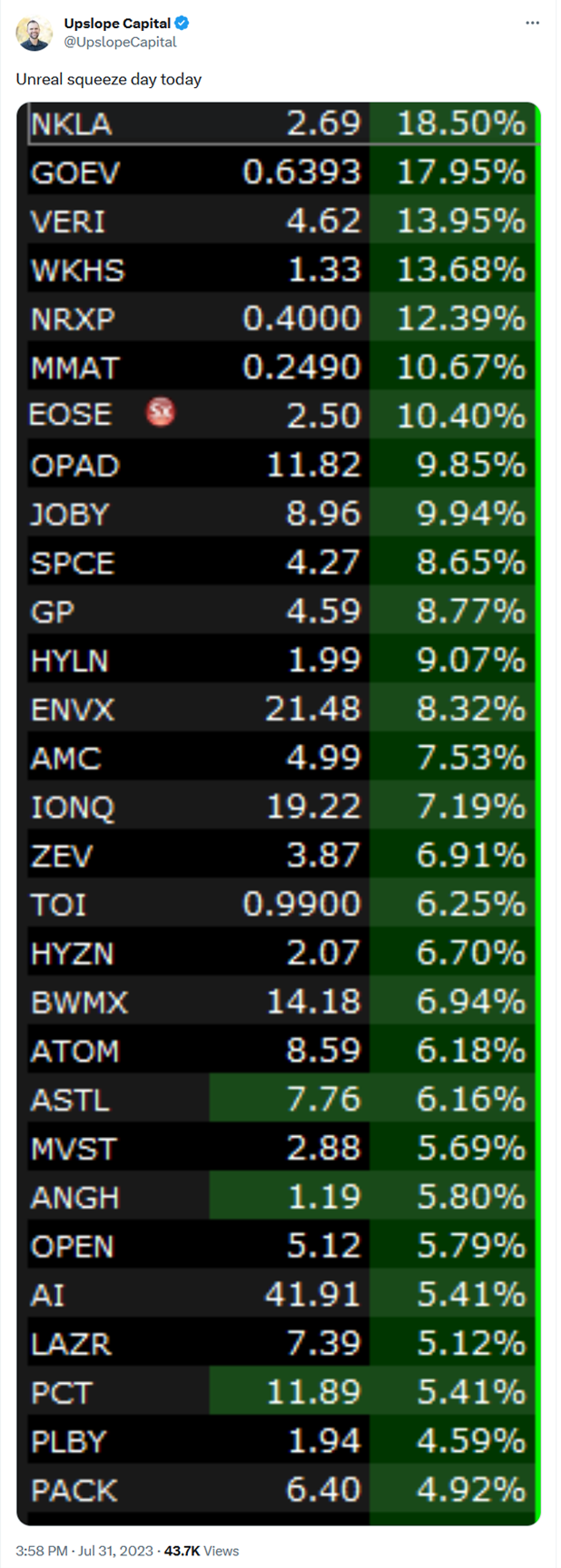
So what should a sensible investor make of this silliness?
For now, nothing... because it's happening in a tiny part of the market and hasn't yet come anywhere close to the extreme that similar collection of stocks reached in January 2021 at the peak of the meme stock bubble (and even then, the market had almost another year of gains before tumbling in 2022).
This is a warning flag I'm monitoring, but not paying too much attention to at this point.
3) Mark Spiegel of Stanphyl Capital has been bearish on stocks, especially Tesla (TSLA), for years, which has been very painful.
In the spirit of sharing a wide range of viewpoints with my readers, even those with which I disagree, here's a link to his just-released July letter.
4) This is a fascinating, in-depth WSJ story: How Bad Is China's Economy? Millions of Young People Are Unemployed and Disillusioned. Excerpt:
More than one in five young people in China are jobless. The government casts much of the blame on the job seekers themselves, insisting that their expectations have gotten too high.
Young people need to stiffen their spines and embrace hardship, says leader Xi Jinping, who labored in the countryside in China's Cultural Revolution. If they can't find jobs they want, they should work on factory lines or engage in poverty relief in rural China.
The government's guidance is ringing hollow with many young people. Growing up in a period of rising prosperity, they were told that China was strong, the West was declining, and endless opportunities awaited them. Now, with the urban youth unemployment rate hitting a record of 21.3% in June, their employment frustrations are posing a new challenge to Xi and his vision for a more powerful China.
For the estimated 11.6 million college graduates in 2023, having heeded calls by the state to study hard, the prospect of resorting to the physical labor that many of their parents performed is distinctly unappealing.
5) Here's a WSJ article on a new study which shows that graduates of the top dozen universities in the country are hugely over-represented at the very highest levels of income and achievement (President, Congress, Supreme Court, Fortune 500 CEO, etc.), which is 100% consistent with my experiences and observations: How Ivy League Schools Tilt Your Odds in the Lottery of Life. Excerpt:
Economists have long scoffed at parents' obsession with getting their kids into an Ivy League college, thanks to research years ago showing it made no difference to a student's future income.
But it turns out that research might have missed something important. A new look at similar data suggests that for a select minority, Ivy League admission does yield a career jackpot.
These findings tend to reinforce the suspicion that the nation's top universities aren't just a gateway to a good job but to the nation's ruling elite. That is especially relevant in the wake of a Supreme Court ruling prohibiting the use of race as a factor in college admissions...
Chetty and his co-authors find top students who didn't attend an Ivy-like school had average incomes in the 79th percentile; those who did attend earned only marginally more: they were in the 81st.
Where an Ivy-like school really made an impact was in the odds of an exceptional, Bezos-like outcome. Among top students, 19% who attend the top schools make it to the richest 1% of the income distribution, versus 12% who didn't attend. Attendance at an Ivy-like institution had an even bigger impact on attendance in graduate school or working at a prestigious firm.
(Chetty also says that 12% of Fortune 500 CEOs or 25% of U.S. senators went to the top schools. Fewer than 100 people, but a remarkable concentration of extreme success.)
"Do you become a highly paid professional at a very good company? For those kind of outcomes, the school you go to matters a little but not a ton," said Chetty. "Where it matters enormously is reaching the upper tail, the path to becoming a CEO, leading scientist at a top graduate school, political leader... these upper-tail outcomes that are rare in percentage terms but incredibly important in society."
Chetty's co-author Deming compares those upper-tail outcomes to winning the lottery: Elite schools have lots of lottery tickets lying on the ground, whereas most other colleges only have a few.
For most people, the lottery ticket will be worth nothing. For a few, it is a jackpot: a classmate who helps implement a billion-dollar idea. Connections that help you run for Congress. A mentor who gets you into a top Ph.D. program.
This suggests the focus on selective college admissions should be less about how much one earns, and more on who wins the lottery of professional success.
Best regards,
Whitney
P.S. I welcome your feedback at WTDfeedback@empirefinancialresearch.com.