

Diverging trends in the U.S. versus the world; Faltering vaccination campaign; Reaching 'Herd Immunity' Is Unlikely in the U.S.; The roots of vaccine skepticism and how to overcome it; Pressure Mounts to Lift Patent Protections on Coronavirus Vaccines
I continue to closely follow the pandemic, sending lengthy e-mails to my coronavirus e-mail list roughly once a week. If you'd like to receive them, simply send a blank e-mail to: cv-subscribe@mailer.kasecapital.com.
Below is the e-mail I sent yesterday...
1) Overall, the big picture hasn't changed since my last e-mail a week ago: cases, hospitalizations, and deaths continue to trend in the right direction in the U.S. (you can see the latest data here), and I'm increasingly confident that this will continue (for more on this, see: The Math That Explains the End of the Pandemic).
However, the trends from around the world are terrible (data here). India continues to be a catastrophe, but as this article notes, It's Not Just India: New Virus Waves Hit Developing Countries. Here's an article about the unfolding disaster in South America: After a Year of Loss, South America Suffers Worst Death Tolls Yet.
2) It continues to boggle my mind and break my heart that tens of millions of Americans are looking a gift horse in the mouth by refusing to get vaccinated, while billions of people globally are desperate to do so.
Since our vaccination rate peaked three weeks ago at 3.38 million doses per day (seven-day average), it's now fallen 32% to 2.29 million daily doses, as you can see in this chart (source):
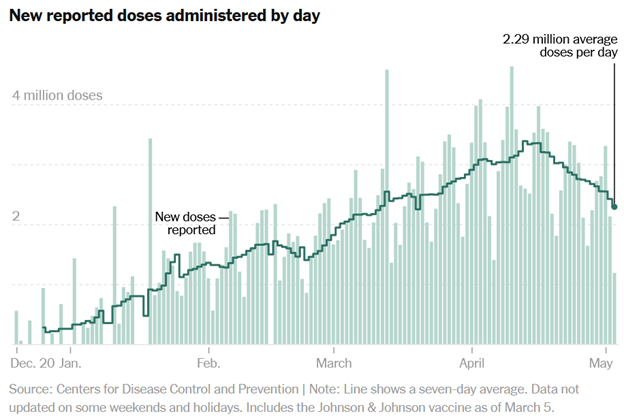
As I noted in my last e-mail, to some extent this is a high-class problem, as we have vaccinated a higher proportion of our citizens than almost any other country (44% of all Americans have received at least one shot and 32% are fully vaccinated... Among those age 65-plus, the figures are 83% and 70%, respectively).
But it is very worrisome that our vaccination campaign is faltering when we're still so far away from herd immunity.
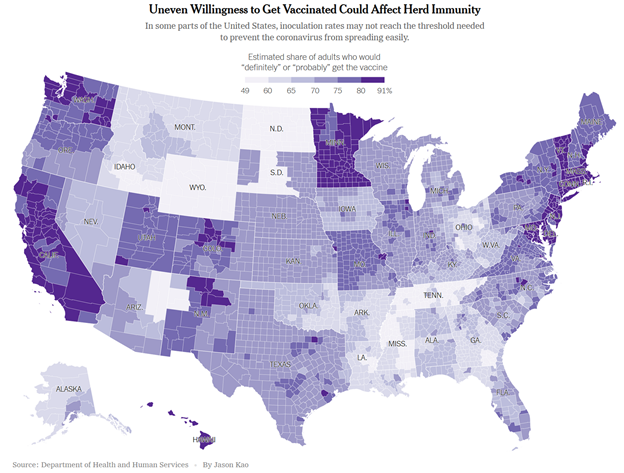
A partial reason for this is lack of access among certain groups – homeless populations, migrant workers, and some communities of color – but the primary reason is skepticism about the vaccines from 30% of Americans, concentrated in rural areas and red states, as this map shows (source):
It's a particular problem among rural hospitals, where an alarming percentage of doctors, nurses, and other medical workers aren't getting vaccinated: Why Lagging COVID Vaccine Rate At Rural Hospitals 'Needs to Be Fixed Now'.
3) I think, unfortunately, that this resistance to the vaccines will persist and this article from yesterday's New York Times will likely prove to be correct: Reaching 'Herd Immunity' Is Unlikely in the U.S., Experts Now Believe. Excerpt:
Now, more than half of adults in the United States have been inoculated with at least one dose of a vaccine. But daily vaccination rates are slipping, and there is widespread consensus among scientists and public health experts that the herd immunity threshold is not attainable – at least not in the foreseeable future, and perhaps not ever.
Instead, they are coming to the conclusion that rather than making a long-promised exit, the virus will most likely become a manageable threat that will continue to circulate in the United States for years to come, still causing hospitalizations and deaths but in much smaller numbers.
How much smaller is uncertain and depends in part on how much of the nation, and the world, becomes vaccinated and how the coronavirus evolves. It is already clear, however, that the virus is changing too quickly, new variants are spreading too easily and vaccination is proceeding too slowly for herd immunity to be within reach anytime soon.
I fear the outcome will be similar to the opioid crisis, in which rural, poor areas with low vaccination rates will suffer a slow burn of the pandemic that will hurt the local economies, drive away the most productive people (who can more easily relocate), and sicken hundreds of thousands (and kills tens of thousands) every year – all of which, like the opioid crisis, will further impoverish, inflame, and alienate the folks that live there.
The tragedy here, of course, is that with multiple miraculous vaccines now widely available, this doesn't have to happen...
4) The Biden administration is pulling out all the stops to address this problem. It just announced this: Biden sets new vaccine goals as White House grapples with its message. Excerpt:
President Biden declared a new goal Tuesday that 70% of adults will have at least one coronavirus vaccine shot by the Fourth of July as the White House grappled with how to send Americans a complex message: A normal life is within reach if you get vaccinated – but the crisis is far from over, so don't fully relax your guard...
Biden also announced Tuesday that millions of dollars from his coronavirus relief package will be made available to support the new vaccination strategies. Nearly $250 million will be allocated to hire workers who will be charged with increasing vaccine confidence and assisting with vaccination appointments in hard-to-reach communities.
The president is also making available $130 million to improve vaccine education and information, particularly targeting health disparities in underserved communities. An additional $250 million will be allocated to assist state outreach efforts, and more than $100 million will be sent to approximately 4,600 rural health clinics.
5) This article takes an in-depth look at what's driving so many folks to eschew the vaccine – and what can be done to persuade them: Millions Are Saying No to the Vaccines. What Are They Thinking? Excerpt:
After many conversations and e-mail exchanges, I came to understand what I think of as the deep story of the American no-vaxxer. And I think the best way to see it clearly is to contrast it with my own story.
My view of the vaccines begins with my view of the pandemic. I really don't want to get COVID-19. Not only do I want to avoid an illness with uncertain long-term implications, but I also don't want to pass it along to somebody in a high-risk category, such as my grandmother or an immunocompromised stranger. For more than a year, I radically changed my life to avoid infection. So I was thrilled to hear that the vaccines were effective at blocking severe illness and transmission. I eagerly signed up to take both my shots, even after reading all about the side effects.
The under-50 no-vaxxers' deep story has a very different starting place. It begins like this:
The coronavirus is a wildly overrated threat. Yes, it's appropriate and good to protect old and vulnerable people. But I'm not old or vulnerable. If I get it, I'll be fine. In fact, maybe I have gotten it, and I am fine. I don't know why I should consider this disease more dangerous than driving a car, a risky thing I do every day without a moment's worry. Liberals, Democrats, and public-health elites have been so wrong so often, we'd be better off doing the opposite of almost everything they say.
Just as my COVID-19 story shapes my vaccine eagerness, this group's COVID-19 story shapes their vaccine skepticism. Again and again, I heard variations on this theme:
I don't need some novel pharmaceutical product to give me permission to do the things I'm already doing. This isn't even an FDA-approved vaccine; it's authorized for an emergency. Well, I don't consider COVID-19 a personal emergency. So why would I sign up to be an early guinea pig for a therapy that I don't need, whose long-term effects we don't understand? I'd rather bet on my immune system than on Big Pharma.
For both yes-vaxxers like me and the no-vaxxers I spoke with, feelings about the vaccine are intertwined with feelings about the pandemic.
Although I think I'm right about the vaccines, the truth is that my thinking on this issue is motivated. I canceled vacations, canceled my wedding, avoided indoor dining, and mostly stayed home for 15 months. All that sucked. I am rooting for the vaccines to work.
But the no-vaxxers I spoke with just don't care. They've traveled, eaten in restaurants, gathered with friends inside, gotten COVID-19 or not gotten COVID-19, survived, and decided it was no big deal. What's more, they've survived while flouting the advice of the CDC, the WHO, Anthony Fauci, Democratic lawmakers, and liberals, whom they don't trust to give them straight answers on anything virus-related.
The no-vaxxers' reasoning is motivated too. Specifically, they're motivated to distrust public-health authorities who they've decided are a bunch of phony neurotics, and they're motivated to see the vaccines as a risky pharmaceutical experiment, rather than as a clear breakthrough that might restore normal life (which, again, they barely stopped living). This is the no-vaxxer deep story in a nutshell: I trust my own cells more than I trust pharmaceutical goop; I trust my own mind more than I trust liberal elites.
The article also has ideas on how to persuade these folks to get vaccinated:
From my conversations, I see three ways to persuade no-vaxxers: make it more convenient to get a shot; make it less convenient to not get a shot; or encourage them to think more socially.
1. Try something like "DoorDash for vaccines."
To get people to participate in an activity they don't really care about, you make it as easy and tantalizing as possible. Some people have already suggested offering money, free food, or even lottery tickets in exchange for vaccination. But one source who asked to remain anonymous suggested that state health departments should offer something like DoorDash for vaccines...
2. Make it suck more to not be vaccinated.
Governments and companies may find that soft bribery is the best way to get the no-vaxxers to the clinics. Michigan Governor Gretchen Whitmer, for example, has linked her state reopening policies to progress in shots, letting restaurants and bars increase their occupancy once 60% of the state has been vaccinated, and promising to lift mask orders when 70% of Michiganders have received both doses.
Millions of people want to go to sporting events, attend concerts, or travel internationally. If those who cannot prove that they've been vaccinated are denied service, I expect that some will sign up for shots purely as a means of reengaging in their favorite activities. "If all or most countries instituted vaccine passports, that might change ," Younes, the attorney, told me.
But the cultural backlash against domestic restrictions could be prodigious...
3. "What if natural immunity isn't enough to protect your grandmother?"
The most common argument against the vaccines is: My immune system is good enough for me. One counterargument is: That's right, but the vaccines are even better at protecting others....
I made this case to several no-vaxxers: Your grandparents, elderly neighbors, and immunocompromised friends will be safer if you're vaccinated, even if you've already been infected. I played with the "COVID is no worse than driving" metaphor that many of them offered. I agree that driving is acceptably safe for most people, I said. But imagine, I added, if you could have a forward collision warning system installed in your car for free? An already-pretty-safe activity would become an even safer activity; and what's more, you'd be protecting other people on the road at minimal cost to yourself.
I can't tell you this argument got a lot of people to drop the phone, sprint to a vaccine clinic, and sign up for a Fauci tattoo on their arm. The truth is that I'm not sure that I changed anybody's mind. But I can honestly say that this argument gave several no-vaxxers a bit of pause. They responded by talking about chains of transmission throughout the community, rather than focusing on their own immune system. Several of them asked to see evidence of my position so that they could examine it for themselves.
The United States suffers from a deficit of imagining the lives of other people. This is true of my side: Vaccinated liberals don't take much time to calmly hear out the logic of those refusing the shots. But it's also true of the no-vaxxers, who might reconsider their view if they grasped the far-ranging consequences of their private vaccination decisions. Instead of shaming and hectoring, our focus should be on broadening their circle of care: Your cells might be good enough to protect you, but the shots are better to protect grandpa.
Here's another article on this: Faith, Freedom, Fear: Rural America's COVID Vaccine Skeptics. Excerpt:
As the beautiful Appalachian spring unfurls across northeastern Tennessee, the COVID-19 vaccine is tearing apart friends, families, congregations, colleagues. "It's a muddy mess," said Meredith Shrader, a physician assistant, who runs an events venue with her husband, another pastor, and who notes that the choice has become about much more than health care. "Which voice do you listen to?"
Communities like Greeneville and its surroundings – rural, overwhelmingly Republican, deeply Christian, 95% white – are on the radar of President Biden and American health officials, as efforts to vaccinate most of the U.S. population enters a critical phase. These are the places where polls show resistance to the vaccine is most entrenched. While campaigns aimed at convincing Black and Latino urban communities to set aside their vaccine mistrust have made striking gains, towns like these will also have to be convinced if the country is to achieve widespread immunity.
But a week here in Greene County reveals a more nuanced, layered hesitancy than surveys suggest. People say that politics isn't the leading driver of their vaccine attitudes. The most common reason for their apprehension is fear – that the vaccine was developed in haste, that long-term side effects are unknown. Their decisions are also entangled in a web of views about bodily autonomy, science and authority, plus a powerful regional, somewhat romanticized self-image: We don't like outsiders messing in our business.
For more arguments in favor of getting vaccinated, comedian John Oliver did an in-depth segment on the topic.
6) This is great news: FDA Set to Authorize Pfizer Vaccine for Adolescents by Early Next Week.
7) A powerful and spot-on op-ed in the NYT: The West Has Been Hoarding More Than Vaccines. Excerpt:
Globally, more than 1.16 billion doses of COVID vaccine have been administered as of Monday. Over 80% have gone to people in high- or upper-middle-income countries and only 0.2% to those in low-income countries like the Philippines. At present, India is suffering from a devastating surge of the virus, with over 350,000 infections and 3,000 deaths daily recorded over the past few days. (These figures most likely undercount the full extent of the horror.) Only 2% of its people have been fully vaccinated. While President Biden's recent deployment of aid to India is commendable, fresh supplies and 60 million potentially spoiled doses of the AstraZeneca (AZN) vaccine will not solve the problem.
On April 23, a group of 24 NGOs, including the Citizens Trade Campaign and the Association of Flight Attendants-CWA, issued a petition calling on Mr. Biden to embrace one potential solution: to back the temporary suspension of a set of intellectual-property provisions that prevent developing nations' access to the technology needed to make their own versions of Western-made COVID-19 vaccines available as quickly as possible.
These provisions make up the World Trade Organization's Agreement on Trade-Related Aspects of Intellectual Property Rights, known as Trips, which strictly enforces patent monopolies for a minimum of 20 years. This change may sound like technocratic legalese. But its impact would be straightforward: A short-term Trips waiver would allow developing nations to quickly ramp up vaccine production and save lives at an affordable cost, as Public Citizen explains.
Here's another article on this: Pressure Mounts to Lift Patent Protections on Coronavirus Vaccines.
Best regards,
Whitney