

Empire Junior Partnership; Thoughts on Musk acquiring Twitter; 'It's Life or Death': The Mental Health Crisis Among U.S. Teens
1) After spending nearly two decades running a hedge fund that was, by law, only open to "accredited" or "qualified" investors – basically, helping already rich people get richer – one of my concerns starting Empire Financial Research three years ago was that I wanted to make as much of our content as possible available to average people at an affordable price...
To that end, I was able to persuade my team to approve a new "Junior Partnership" that I think is the best deal we've ever offered.
However, they're only allowing me to offer it to the first 1,000 people who sign up... so don't wait to watch this video to see if it's right for you.
2) So Elon Musk is going to own Twitter (TWTR). Wow...
I'm not surprised by the outcome, but I am surprised at how quickly the deal came together and the price. I expected other bidders to emerge, but upon further reflection, I can see why nobody else would want the scrutiny that would come with owning one of the world's most important and controversial platforms.
For example, Musk will need to decide whether to let former President Donald Trump back on the platform. This is a no-win decision: no matter what he does, half of the people, politicians, press, and regulators are going to hate him.
(Musk hinted that that he would, which caused my least-favorite stock, Digital World Acquisition (DWAC), to crash 13% yesterday. It's now down 64% since I called its "blow-off top" at $99 only two months ago.)
What public company or institutional investor (such as a large leveraged buyout fund) would want that kind of exposure?
Nor is a wealthy philanthropist likely to swoop in, as Amazon's (AMZN) Jeff Bezos did with the Washington Post in 2013. That only cost him $250 million, whereas someone would have to come up right away with roughly $38 billion by my calculations to take Twitter away from Musk. Even for today's billionaires, that's real money!
So I think it's very unlikely that anyone will come along with a topping bid. The market agrees, as the stock closed yesterday at $51.70. That's a 4.6% discount to the buyout price of $54.20, which seems about right given that the deal will probably take six months or so to close.
I have no doubt that Musk will bring in incredible people – as he has done with Tesla (TSLA) and SpaceX – who will whip Twitter into shape from an operational perspective. The company has been very poorly managed, so no doubt there's lots of low-hanging fruit.
So while some may view this as a vanity project, I think Musk is going to make a fortune.
The effect on humanity is less clear...
Overall, I'm a great admirer of Musk's. As I wrote in 2019, "he is a remarkable engineer and entrepreneur – what he has built at Tesla and SpaceX is truly extraordinary – and humanity owes him a debt of gratitude."
That said, Musk can also be thin-skinned, impetuous, immature, vengeful, and downright nasty. He has no respect for regulators or government in general – he doesn't think laws apply to him. He can't read people at all (likely due to his Asperger's) and doesn't have a shred of empathy.
So, as I think about a guy like this owning one of the world's most influential platforms – what could go wrong?? A lot...
Here is a collection of articles and opinion pieces I've been reading this morning:
- Bloomberg's Matt Levine: Elon Closes In
- Washington Post
- New York Times
- Wall Street Journal
-
- Elon Musk, Twitter, and Free Speech (editorial)
- Twitter in Elon's Hands Is No Idle Distraction (Heard on the Street)
- How Elon Musk Won Twitter
3) Related to Twitter and other social media... Run, don't walk, to read this important article from Sunday's New York Times.
It's so scary what's happening to teenagers – and while poor kids of course have it worst, trust me, there's a crisis among super-rich kids as well. I count my blessings every day that our three daughters are thriving... 'It's Life or Death': The Mental Health Crisis Among U.S. Teens. Excerpt:
American adolescence is undergoing a drastic change. Three decades ago, the gravest public health threats to teenagers in the United States came from binge drinking, drunken driving, teenage pregnancy, and smoking. These have since fallen sharply, replaced by a new public health concern: soaring rates of mental health disorders.
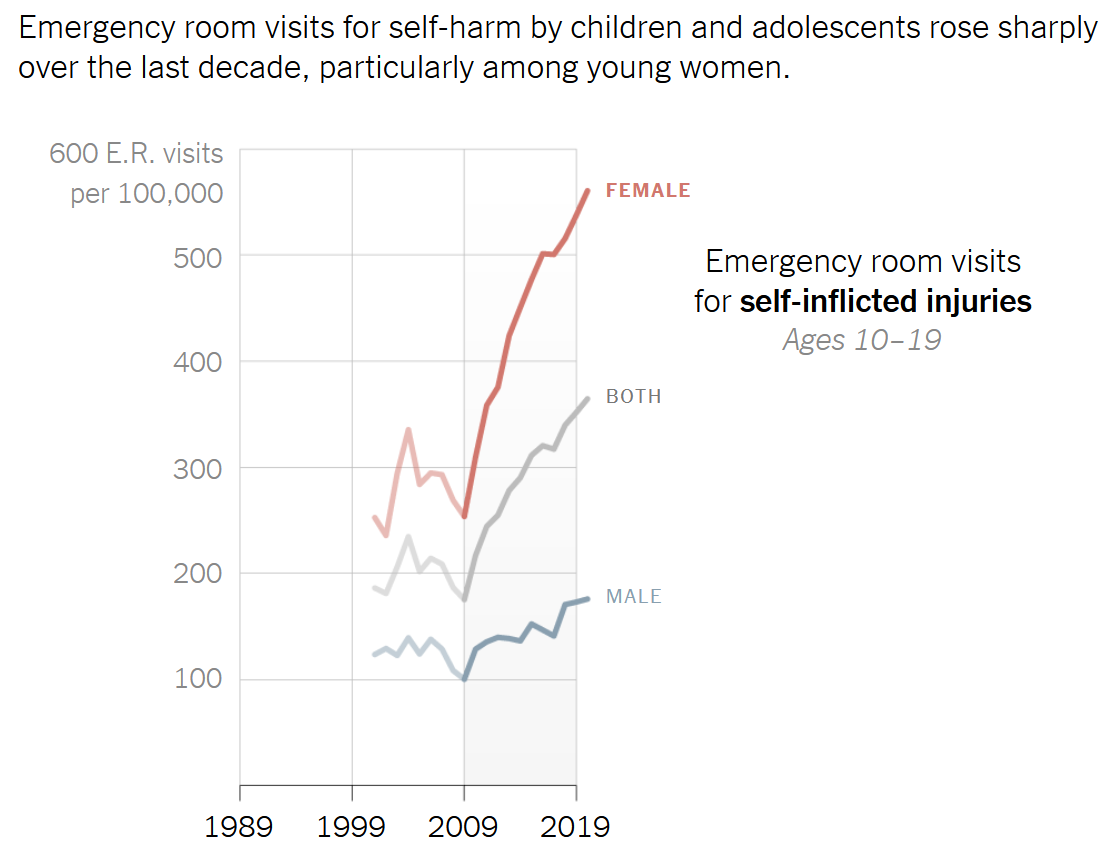
In 2019, 13% of adolescents reported having a major depressive episode, a 60% increase from 2007. Emergency room visits by children and adolescents in that period also rose sharply for anxiety, mood disorders and self-harm. And for people ages 10 to 24, suicide rates, stable from 2000 to 2007, leaped nearly 60% by 2018, according to the Centers for Disease Control and Prevention.
The decline in mental health among teenagers was intensified by the Covid pandemic but predated it, spanning racial and ethnic groups, urban and rural areas, and the socioeconomic divide. In December, in a rare public advisory, the U.S. surgeon general warned of a "devastating" mental health crisis among adolescents. Numerous hospital and doctor groups have called it a national emergency, citing rising levels of mental illness, a severe shortage of therapists and treatment options, and insufficient research to explain the trend.
"Young people are more educated; less likely to get pregnant, use drugs; less likely to die of accident or injury," said Candice Odgers, a psychologist at the University of California, Irvine. "By many markers, kids are doing fantastic and thriving. But there are these really important trends in anxiety, depression and suicide that stop us in our tracks."
"We need to figure it out," she said. "Because it's life or death for these kids."
The crisis is often attributed to the rise of social media, but solid data on the issue is limited, the findings are nuanced and often contradictory and some adolescents appear to be more vulnerable than others to the effects of screen time. Federal research shows that teenagers as a group are also getting less sleep and exercise and spending less in-person time with friends – all crucial for healthy development – at a period in life when it is typical to test boundaries and explore one's identity. The combined result for some adolescents is a kind of cognitive implosion: anxiety, depression, compulsive behaviors, self-harm, and even suicide.
This surge has raised vexing questions. Are these issues inherent to adolescence that merely went unrecognized before – or are they being overdiagnosed now? Historical comparisons are difficult, as some data around certain issues, like teen anxiety and depression, began to be collected relatively recently. But the rising rates emergency-room visits for suicide and self-harm leave little doubt that the physical nature of the threat has changed significantly...
Times have changed. Federal research shows that 38% of high-school-age teenagers report having had sex at least once, compared with roughly 50% in 1990. The teen birthrate has plummeted.
So has cigarette and alcohol use. In 2019, 4% of high school seniors reported having a cigarette in the last 30 days, down from 26.5% in 1997. Alcohol use by high schoolers hit 30-year lows at the same time. Use of OxyContin and other illicit drugs among high schoolers is down sharply over the last 20 years. Vaping of both nicotine and marijuana has risen in recent years, although both dropped sharply during the pandemic.
Best regards,
Whitney
P.S. I welcome your feedback at WTDfeedback@empirefinancialresearch.com.