

Empire's Financial Research's 'on location' special investigation; Transcript of Munger meeting; Carson Block: The Man Who Moves Markets; Nate Anderson takes a bow on Sorrento Therapeutics; The Art of Short Selling; The new ambulance I bought for my humanitarian mission
1) Empire Financial Research is about to make a historic first in our business...
It's an "on location" special investigation into my next big investment idea – we hired a full film crew to document all the details of this historic situation at a location I handpicked myself.
On February 23, we'll be releasing this full video investigation to the general public. But you can get a free "sneak preview" on what we uncovered – and put yourself on the list to be alerted when we release our full investigation – right here.
2) Following up on yesterday's e-mail about Charlie Munger's Daily Journal (DJCO) annual meeting, here's a transcript.
3) Here's an in-depth profile in The Atlantic of my friend Carson Block of Muddy Waters, who's one of the best activist short sellers in the world: The Man Who Moves Markets. Excerpt:
When the investor Carson Block arrived for an appointment at the Pierre hotel, in Manhattan, in 2017, he knew he was about to meet with an impostor. In the elegant Rotunda Room, surrounded by marble columns and a sky-blue mural, Block sat across from the dark-haired man who had extended the invitation. A security team that Block had brought with him fanned out around the hotel. After fielding a few pointed questions from the man, Block turned the conversation around. He raised his phone to film the encounter and said, "I'd like to know who you really are."
For more than a year, the mystery man, who spoke with a French accent, had presented himself in e-mails as a Paris-based reporter at the Wall Street Journal named William Horobin. But Block had already made an approach to the real Horobin, who has an English accent, and learned that he hadn't sent those e-mails.
Based on the impostor's inquiries, Block had a strong suspicion about why he was there. Beginning in 2015, Block's hedge fund had published a series of highly critical research reports about Groupe Casino, an international retailer based in France. Block believed that Groupe Casino had sent this man on a spying mission to suss out his next moves.
Confronted on camera, the man denied it. He looked around the room and flashed an awkward smile that quickly fell from his face. Then he ran for the door, managing to evade Block's security team.
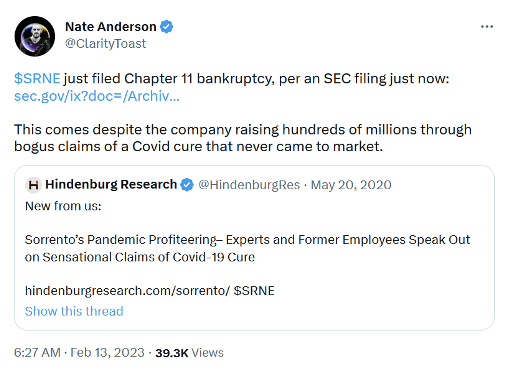
4) Speaking of the world's best activist short sellers, Nate Anderson of Hindenburg Research – most famous these days for exposing the fraud that pervades India's Adani Group – takes a bow for nailing Sorrento Therapeutics (SRNE), which just filed for bankruptcy:
5) Here's an insightful look at short selling, which quotes me among many others – Warren Buffett, David Einhorn, Barton Biggs, John Hempton, and Joe Feshbach: The Art of Short Selling. Excerpt:
"A market without bears would be like a nation without a free press. There would be no one to criticize and restrain the false optimism that always leads to disaster." – Bernard Baruch
Among all the activities in finance, short-selling remains one of the most misunderstood. To many, the practice of selling something you don't own with the intention of buying it back later at a cheaper price appears... abstract. Few balk at the idea of buying low and selling high, but reverse the chronology and it sows confusion.
Even the Wall Street Journal, a business-focused newspaper of record, often has to explain the concept to its readers. When Russia's central bank banned short-selling at the outset of the war on Ukraine, the Wall Street Journal reported that the regulator had "ordered brokers to stop allowing traders to place bets against Russian shares, a practice known as short-selling."
It went on: "Short sellers borrow stocks they believe are overvalued and immediately sell them, hoping to repurchase the shares for a lower price when they need to be returned and to pocket the difference."
Short selling is as old as markets. For as long as centralized markets have existed, traders have hedged risk and speculated on prices. But because they profit from bad news and exercise such apparent trickery putting on positions, short sellers in the stock market are cast as easy villains.
6) As I discussed in recent e-mails, this week I traveled around the world to pick up a fully stocked ambulance yesterday and delivered it this morning to an area that desperately needs it (for security reasons, I can't disclose the destination until I'm home, so keep your eye on my e-mails next week).
I only bought it seven days ago and saw it for the first time last night. It's unbelievable – one of the sweetest vehicles I've ever seen: a brand-new (plastic on the seats, zero miles on the odometer) Toyota Land Cruiser with a monster 4.5-liter V8 engine. And, critically, it's a 4x4, which is absolutely necessary to navigate the terrible roads in the crisis area.
Below are two pictures, but to really get a feel for it, check out this eight-minute video I recorded last night. In it, after I describe the vehicle, my new friend Jesse Jonkman gives me the camera, opens up the back, and describes everything inside.

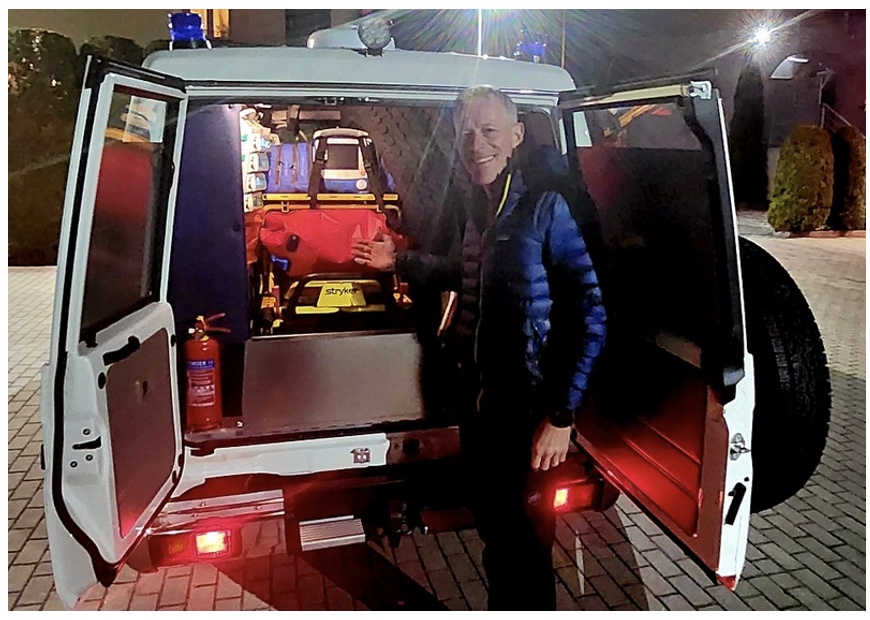
Jesse runs a family business that his father started 30 years ago called DIAC Medical. The company takes a range of vehicles (mostly Land Cruisers and Mercedes Sprinter vans), converts them into ambulances, and fills them with whatever medical equipment the customers want: a stretcher, monitor/defibrillator, ventilator, suction unit, infusion pumps, etc. (plus, in this case, five much-needed spare tires). You can see some of DIAC's ambulances here.
We'll be accompanied by a van full of the half-ton of supplies that I packed into 14 huge bags and flew over with: 340 hospital gowns, 240 hospital sheets, six emergency trauma medic kits, 24 field trauma kits, etc.
We'll meet up with two people from a wonderful charity that is currently operating a fleet of 30 ambulances and 100-plus medical staff. They desperately need more ambulances because their existing fleet is rapidly wearing out. Most urgently, four of their ambulances have been totaled and need to be replaced right away.
I was introduced to the charity by a mutual friend and, hearing the need, I immediately committed to buying one fully stocked ambulance, which costs about $131,000.
I can't really afford that myself, but I figured my wonderfully generous friends and family would step up and pitch in – and I was right! We're now over $200,000 and counting, so I'm already talking to Jesse about ordering additional ambulances.
If you're interested in learning more about this humanitarian mission and supporting it, you can send me an e-mail by clicking here.
Best regards,
Whitney
P.S. I welcome your feedback at WTDfeedback@empirefinancialresearch.com.
P.P.S. The Empire Financial Research offices are closed on Monday in observance of Presidents' Day. Look for my next daily e-mail in your inbox on Tuesday, February 21.