

Enphase Energy; Enrique Abeyta on unicorns subsidizing urban millennials; Twilight of the Stock Pickers: Hedge Fund Kings Face a Reckoning; Ted Seides on hedge funds; My family and I are forced to wear Tesla bling
1) The most intriguing idea I heard at the Robin Hood conference yesterday was a short pitch for Enphase Energy (ENPH), which manufactures inverters for solar panels.
It was an especially timely pitch, as the company reported earnings after the close yesterday and the stock is down big today. Nevertheless, it's still up more than 200% this year, as sales and profits have exploded to the upside. The question now is whether this is sustainable. Yesterday's presenter made a compelling case that it's not.
The conference was off the record, so I can't share the details of the stock pitch, but if you're interested in reading the bear case, check out these two write-ups that hedge fund Prescience Point Capital Management posted in July and August. The folks at Prescience were early, but may eventually be proven correct...
2) My colleague Enrique Abeyta is launching his brand-new newsletter, Empire Elite Trader, so I'm giving my readers a taste of his work. Here are his thoughts on how unicorns are subsidizing urban millennials...
As regular readers know, I've been spending a lot of time thinking about the analogies between 1999 and today for tech stocks.
Back then, I was 27 years old and living in New York City. Many of my friends were working at Internet 1.0 technology start-ups, and they told me crazy stories! It was a period of serious excesses.
I've been thinking about those days during the last few years as I've watched the rise of various Internet 2.0 companies, especially the ones pricing below their costs as they pursue growth no matter what. For example, five years ago I told my friends to enjoy watching Netflix (NFLX) for only $8.99 a month because that price had nowhere to go but up. (That's proven true, though Netflix, to its credit, has materially expanded and improved its content.)
When I started my digital media company, Project M, a few years ago, I was amazed at the value that WeWork provided. How could it possibly make money while offering so much, yet charging so little? I wondered the same for many services I use on a day-to-day basis like Uber (UBER), Grubhub (GRUB), etc. I don't have to wonder anymore – none of them are making any money! (Uber is a great short, and Grubhub's stock plummeted more than 40% on a terrible earnings report yesterday.)
As opposed to 1999, when only a small number of people benefited from this foolishness, today millions of folks are enjoying their benefits, especially young urban consumers.
I thought of this when I read this recent article in The Atlantic: The Millennial Urban Lifestyle Is About to Get More Expensive. Excerpt:
To maximize customer growth they have strategically – or at least "strategically" – throttled their prices, in effect providing a massive consumer subsidy. You might call it the Millennial Lifestyle Sponsorship, in which consumer tech companies, along with their venture-capital backers, help fund the daily habits of their disproportionately young and urban user base. With each Uber ride, WeWork membership, and hand-delivered dinner, the typical consumer has been getting a sweetheart deal.
For consumers – if not for many beleaguered contract workers – the MLS is a magnificent deal, a capital-to-labor transfer of wealth in pursuit of long-term profit; the sort of thing that might simultaneously please Bernie Sanders and the ghost of Milton Friedman.
But this was never going to last forever. WeWork's disastrous IPO attempt has triggered reverberations across the industry. The theme of consumer tech has shifted from magic to margins. Venture capitalists and start-up founders alike have re-embraced an old mantra: Profits matter.
And higher profits can only mean one thing: Urban lifestyles are about to get more expensive.
What are the implications of this? Probably not much for the average consumer, who will just have to pay a little more. These emerging companies (whose growth rates will slow) and their investors (who will likely see the companies' valuations contract) will bear the brunt of the pain. To the extent that we'll see a reduction in the amount of capital being misallocated, our overall economy will be the better for it...
You can try Enrique's Empire Elite Trader newsletter absolutely risk-free for 30 days by clicking here. Don't wait – this special offer ends Friday evening!
3) I read an interesting and in-depth article in the Wall Street Journal about how hedge funds are dog meat these days, with more funds closing than opening and a net outflow of funds.
That's what happens to an asset class that trails the S&P 500 for 11 consecutive years, by an average of 9% annually... So do I think stock-picking is dead? No, but it's much harder. To succeed, I believe you have to do even more differentiated research, invest in an even more concentrated way in your best ideas, and hold even longer than before... Twilight of the Stock Pickers: Hedge Fund Kings Face a Reckoning. Excerpt:
What changed? For one, volume. There were just 530 hedge funds in 1990, managing a total of $39 billion. Today there are more than 8,200, all trying to find winning bets for what is now a vast trove of $3.2 trillion of investor money.
For another, managers say the rise of quantitative and passive investing has distorted how stocks move and reduced the chances to profit. Quants can spot and eliminate certain mispricings of securities that once offered opportunities to stock pickers. Further complicating matters, stocks in recent years have had an increasing tendency to move in tandem, whether on signs of a Federal Reserve rate move, a presidential tweet on trade or other events.
Low interest rates also make life tougher, by reducing interest payments short sellers earn on cash they get when they sell borrowed stock, known as "short rebates." In addition, the emergence of inexpensive financing means companies the short sellers target are less likely to go bust...
Blackstone, which invests about $81 billion in hedge funds, shifted much of what it used to invest in fundamental stock-picking funds to quant funds.
Other investors are favoring stock-picking funds they think have a particular advantage, such as biotech-focused ones that employ scores of Ph.D.s and M.D.s, or so-called platforms that deploy several separate trading teams.
"There's times I remind myself, these guys didn't forget how to make money all of a sudden," said Scott Warner of Paamco Prisma, a firm that advises on or invests $23 billion of client assets in hedge funds. "But holding your breath and hoping for change is not a strategy. The question is, 'How are you adapting to the new reality?'"
4) Not everyone has given up on actively managed hedge funds, however. I enjoyed these comments that Ted Seides, who has allocated capital for years to dozens of hedge funds, posted on Twitter. Here’s the full thread:
Attended Goldman’s hedge fund conference today. Some thoughts from the front lines...
The conference featured a few dozen fundamental hedge fund managers presenting to allocators.
Long-short equity = the single most scrutinized sub sector of active management.
I’ve been away from the day to day front lines for a little while and don’t have a major axe in the fight. Here’s what I found.
Astounding the change over the last few years.
A large cohort of managers that used to have $1-$5B in AUM are still at it with $250MM-$1B, a chunk of it their own.
The managers I visited have performed at or better than investor expectations and way better than industry averages.
The same managers overseeing a fraction of their prior asset size are reporting a far more attractive opportunity set with less competition on shorts and less crowding in interesting names.
Allocators, who stereotypically and in aggregate chase performance, are not chasing the performance of select hedge funds. The baby has been tossed with the bathwater.
The managers are evolving with the full recognition of the changes in market structure with quants and passive management.
The biggest of these evolution are emphasizing duration (longer horizons long and short), independence (less attention to the crowd), and risk management (to focus on uncorrelated return generation).
In my old days, I would have leapt at finding just one manager that now was behind every other door - long track record, seasoned team, consistent process, savvy, insightful, and not encumbered by too much capital.
These days it’s still really hard to balance what looks like very attractive micro (bottom up manager opportunities and underlying securities) with very challenging macro (alpha harder to come by, fees high vs recent returns, scrutiny massive, and no daylight in sight)
On balance, for the first time in a few years, I liked what I saw. If you have a portfolio of hedge funds, dig deeper and stay the course. If you don’t and can be contrarian (really contrarian), it’s a great time to start to look.
And before FinTwit and @ritholtz goes nuts on me, I’ve purposefully left out that this only matters if it fits on your portfolio and you need it. Some don’t, others do.
So I’ll end by saying that what I saw “on the ground” was way different, potentially much better, and definitely far more thought provoking than the consensus negative you read about in the papers.
5) You may recall that earlier this year, I offered a friendly bet for charity that Tesla wouldn't report a positive net income quarter this year.
My friend Andrew Left and a dozen other folks took me up on it for a total of $15,000. It turns out that they were right, and I was wrong, so I'm donating this amount to various charities of their choice. I tip my hat to them.
To make the bet more fun, one of the people who took me up on it stipulated that, if I lost, in addition to making the agreed-upon donation, I had to wear and give away the Tesla bling he would send me. Sure enough, three shirts and a mug arrived today (directly from Tesla!).
I'm a man of my word, so here's a picture of my wife, oldest daughter, and me modeling it:
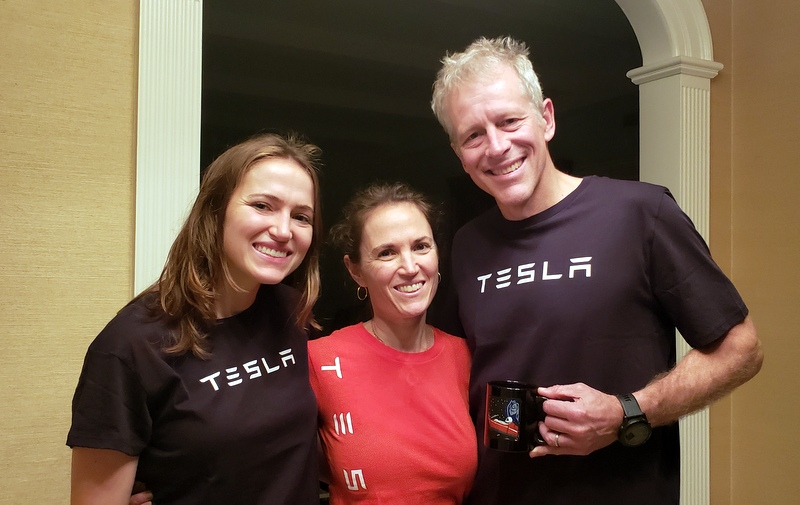
By the way... I had to confess to them (and my 17-year-old daughter, who took the picture) that I had lost $15,000. They looked at me, as they often do, like I was the dumbest guy on Earth.
"That's SO much money!" they said. "What did you do that for?!"
I lamely replied, "Well, I wasn't planning on losing the bet – I was planning on winning $15,000 for KIPP!" (KIPP NYC charter schools are my favorite charity.)
Best regards,
Whitney