

Fed Holds Rates Steady but Pencils In One More Hike This Year; Don't Buy the Fed's Rate Projections; The Billionaire Keeping TikTok on Phones in the U.S.; The Art of (Not) Selling; My watch thought I was dying
1) Yesterday the Fed did what everyone expected: Fed Holds Rates Steady but Pencils In One More Hike This Year. Excerpt:
Federal Reserve officials voted to hold interest rates steady at a 22-year high and revealed a divide over whether they should raise them once more this year, with most leaning toward another increase.
Fed Chair Jerome Powell said that officials didn't need to decide yet whether to lift rates again after a historically rapid series of increases over the past 18 months and as they await evidence that a recent inflation slowdown can be sustained.
"Really, what people are saying is, 'Let's see how the data come in,'" he said at a news conference Wednesday. "They want to be convinced. They want to be careful not to jump to a conclusion."
Fed officials also indicated they expect to keep rates higher for longer through 2024 than they anticipated earlier this year.
Powell wisely left himself a lot of wiggle room because he's hoping – and I expect – that the Fed is finished raising rates, as this WSJ Heard on the Street column notes: Don't Buy the Fed's Rate Projections. Excerpt:
Doth the Fed project too much?
Federal Reserve policy makers on Wednesday held to their target range on rates – no surprise there. If there was a surprise, it was how little they expect to cut rates next year.
Updated projections showed that most policy makers still expect to raise rates again in 2023, though with less conviction than before. Whereas, following their June meeting, a few officials anticipated raising rates by more than a quarter point above the current level, now none do. And seven of 19 officials don't expect to raise rates again at all.
Investors are even less convinced that more tightening is coming. Following the Fed's policy announcement, interest-rate futures put the odds of another rate increase by year-end at less than 50%.
The general sense is that by penciling in one last hike, Fed policy makers are hanging on to their option to raise rates, in case inflation really heats up again while the job market stays strong. It is easier to take that option away later than it is to do so now, and then end up having to reinstate it.
Projecting one last rate increase is also a way of preventing investors from immediately turning to the next question: When will the Fed cut? The risk is that as soon as investors start doing that, rate expectations will come down sharply, and with them long-term interest rates, providing the economy with a boost the Fed doesn't want it to receive just yet.
2) I've repeatedly called for the U.S. to ban TikTok entirely, mainly for national security reasons, but also because it's hurting our youth, as I wrote in my April 26 e-mail:
Run, don't walk, to read this heart-breaking, infuriating Bloomberg article – and then forward it to every parent and teacher of a teenager you know: TikTok's Algorithm Keeps Pushing Suicide to Vulnerable Kids.
Concerns about a deleterious impact on mental health, especially among teenagers, have been raised about Instagram, YouTube, and other social media platforms... but TikTok appears to be much worse.
It is both outrageous and ironic that TikTok doesn't operate inside China (TikTok's parent company ByteDance instead offers a similar version of the app, called Douyin, to customers there) but is foisted on us. According to the article, "two-thirds of American teens use TikTok every day, according to a 2022 Pew Research Center survey, with 16% saying they're on the platform almost constantly."
It's yet another reason we should simply ban it.
Earlier this year, it appeared that our government was going to finally act thanks to broad, bipartisan support. And then... nothing!
I didn't know what happened until I read this excellent piece of investigative journalism by the WSJ: The Billionaire Keeping TikTok on Phones in the U.S. Excerpt:
TikTok had hardly any friends in government earlier this year as the Biden administration, Congress and state legislatures were threatening to ban the Chinese-owned video giant.
TikTok now has many more friends, with something in common: backing from billionaire financier Jeff Yass. They've helped stall attempts to outlaw America's most-downloaded app.
Yass's investment company, Susquehanna International Group, bet big on TikTok in 2012, buying a stake in parent company ByteDance now measured at about 15%. That translates into a personal stake for Yass of 7% in ByteDance. It is worth roughly $21 billion based on the company's recent valuation, or much of his $28 billion net worth as gauged by Bloomberg.
Yass is also one of the top donors to the Club for Growth, an influential conservative group that rallied Republican opposition to a TikTok ban. Yass has donated $61 million to the Club for Growth's political-spending arm since 2010, or about 24% of its total, according to federal records.
Club for Growth made public its opposition to banning TikTok in March, in an opinion article by its president, at a time when sentiment against the platform among segments of both parties was running high on Capitol Hill. Days later, Sen. Rand Paul (R-KY) stood up on the Senate floor and quashed an attempt to fast-track a bill by Sen. Josh Hawley (R-MO) to ban downloading of the TikTok app.
"We will be acting like the Chinese government if we ban TikTok here," Paul said around that time.
In June, Yass donated $3 million to a political committee backing Paul. Including that contribution, Yass and his wife, Janine Yass, have donated more than $24 million to Paul or committees that support him since 2015, according to federal records. Club for Growth has given a Paul-supporting political committee $1.8 million since 2020.
Yass claims to be acting on principle...
"I've supported libertarian and free market principles my entire adult life," Yass said. "TikTok is about free speech and innovation, the epitome of libertarian and free market ideals. The idea of banning TikTok is an anathema to everything I believe."
... And if you believe that, please contact me, as I have a bridge in Brooklyn to sell you.
What a sickening indictment of our political system, whereby China is effectively able to bribe our politicians – via U.S. billionaires – to further its interests, at the expense of ours. Another example is Elon Musk, who regularly parrots Chinese talking points on Taiwan and the Ukraine war – no doubt because of Tesla's (TSLA) heavy exposure to China.
It reminds me of Charlie Munger's favorite saying: "Whose bread I eat, his song I sing..."
3) In yesterday's e-mail, I neglected to include the link to the Q&A with Chris Mayer, so here it is.
In the interview, Mayer links to this article by Chris Cerrone of Akre Capital Management, The Art of (Not) Selling, which has some great wisdom. It begins:
Of our most costly mistakes over the years, almost all have been sell decisions.
The mistake, in virtually every instance, has been selling too soon. Reflecting on these mistakes gave rise to this letter, and its title, "The Art of (Not) Selling."
Taking a step back, our investment philosophy involves concentrating our capital in a small number of what we believe to be growing and competitively advantaged businesses. These kinds of businesses are rare and are only periodically available for purchase at attractive valuations. With that in mind, we do our best to hold on for the long term, so that our capital may compound as the businesses grow.
Holding on means resisting the temptations to sell – and there are many. We tune out politics and macroeconomics. To the surprise of many, neither valuation nor price targets play a role in our sell decisions.
To be clear, there may be times when we believe it is appropriate to sell. In these instances, it is typically because of an adverse change in the business itself.
This determination to hold on is a critically important, and not always well understood, aspect of our investment philosophy. At its core, it relates to the power of compounding. We believe these two ideas – (not) selling and compounding – are inextricably linked. Getting the first wrong makes the second impossible.
Allowing our investments to compound uninterrupted is our North Star.
4) Here's a funny story from my Whitney-and-the-ladies running group yesterday morning...
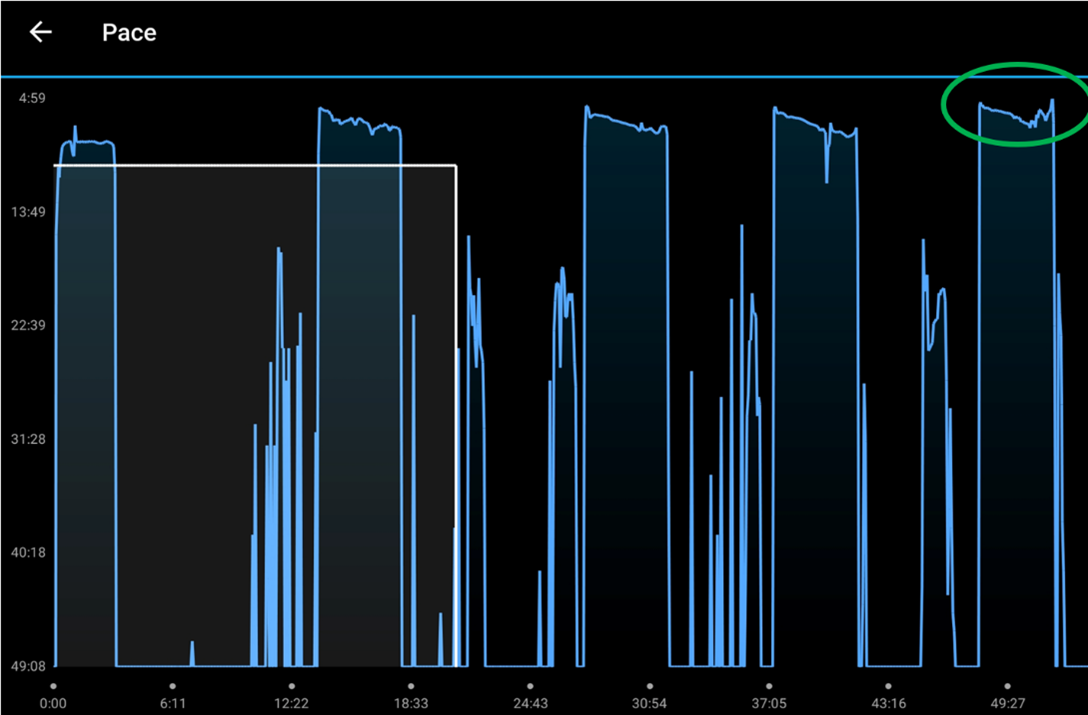
Ten of us were doing one-kilometer sprints and, as usual, Jen-the-jackrabbit was kicking my butt, running them in four minutes while my times were 4:14 to 4:20.
For the last lap of our workouts, I often shed my shirt, hat, fanny pack and headphones and go all out, trying to beat my best time of the day, so that's what I did yesterday morning.
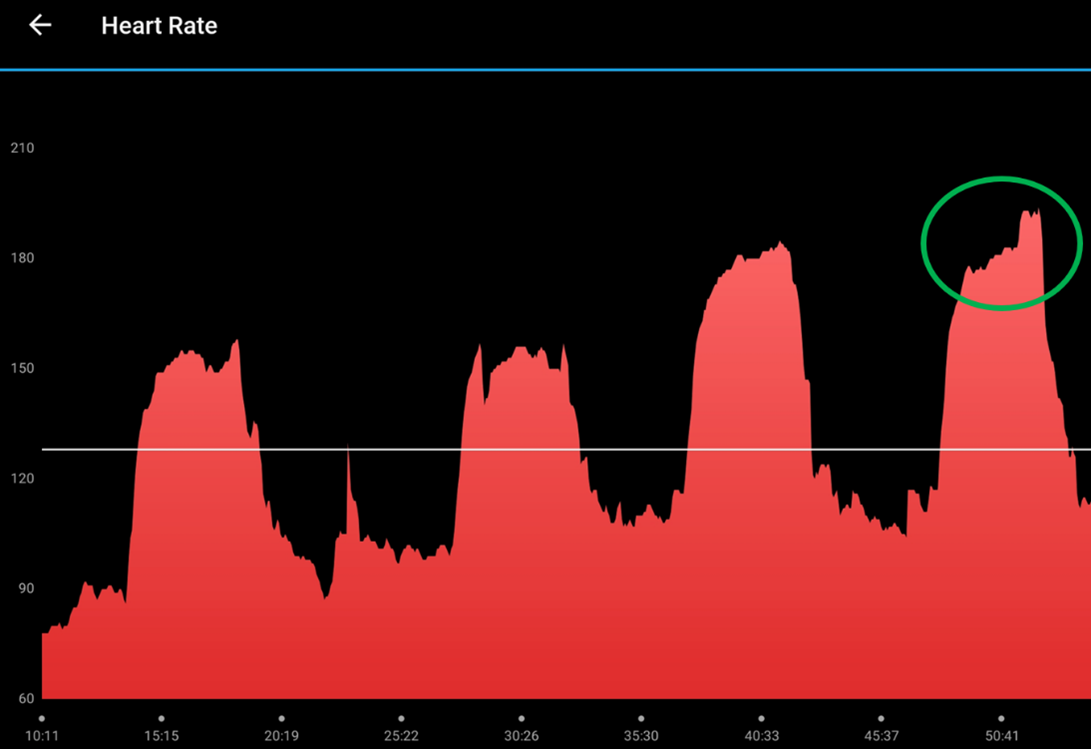
I kept up with Jen for the first 800 meters – as you can see in charts below (with our last lap circled in green), our pace started around a 5:30 mile and steadily slowed to around a 6:30 mile, while my heart rate ramped up from 178 to 183.
Jen, no doubt unaccustomed to having an old geezer on her shoulder, sped up to a sub-six-minute pace.
Me, being a slightly competitive type, hung with her. Our pace dropped a bit as we went up a small hill and then with 100 meters to the finish line, we both went into a full sprint – a 4:59 pace for a moment, according to my watch – and we crossed the line within an inch of each other.
Here's the funny part: my heart rate was so high – up to 194 beats per minute (the highest I've ever seen it – I'm happy to say that's the max heart rate of a 25 year old) – that my watch thought I was dying!
It started beeping like crazy, flashing "INCIDENT ALERT" and, had I not canceled it, would have sent an emergency text to Susan, Alison, and Emily (a great safety feature by the way, built into newer model Garmin watches and iPhone 14s and later).
Here's a picture of most of us from last year – our coach, Alan, is on the right, and Jen is in yellow, third from the right – she's a foot shorter than I am and her legs only come halfway up my thigh, but she's an amazing runner:


Best regards,
Whitney
P.S. I welcome your feedback at WTDfeedback@empirefinancialresearch.com.