

Feedback on my financial advice to retired readers; I bonds; Chris Brown's tweet on Cassava Sciences; Galloway and Theranos podcasts; Investing lessons on the tennis court
1) My e-mail last month with my financial advice to retired readers generated a great deal of nice feedback:
"Dear Mr. Tilson, I want to commend you on your letter of October 12th. I spent 35 years on the retail side of financial services as a broker, regional product manager, branch manager, and, finally, managing the wealth management group for my firm in the Western United States. I found your letter to be one of the most straightforward and easy to understand (which takes great writing skills) investment advice letters that I can recall ever having read. It is both practical and actionable. I would recommend it to any retail broker, retired person or person nearing retirement." – Don M.
"Today's article is the best yet. I've been with you since the start, and this was EXCELLENT!" – Mark M.
"Whitney, Your article is very helpful about people of my age (85). I am going to gradually sell most of my stocks and follow your suggestions, mostly about taking trips and having experiences. Just wanted to let you know how it started me on a new journey. I have been a member for a year or more and read most of your articles." – David D.
Most important, I wanted to share the e-mail that I received from Kent M. because I neglected to mention U.S. Treasury I bonds, even though I wrote about them in my June 2 e-mail, linking to this Wall Street Journal article: The Safe, High-Return Trade Hiding in Plain Sight. Kent wrote:
"Many of your readers may benefit from investing in U.S. Treasury I bonds. They currently pay 3.54% interest. You (and your spouse) may purchase $10,000 per year. Buy $10,000 now, and then another $10,000 each January. They act much like a certificate of deposit (CD) but with a much higher interest rate. You can't cash out until you've held for 12 months, and if you redeem within the first five years, you'll forfeit the last three months of interest. But there's nothing better or safer out there."
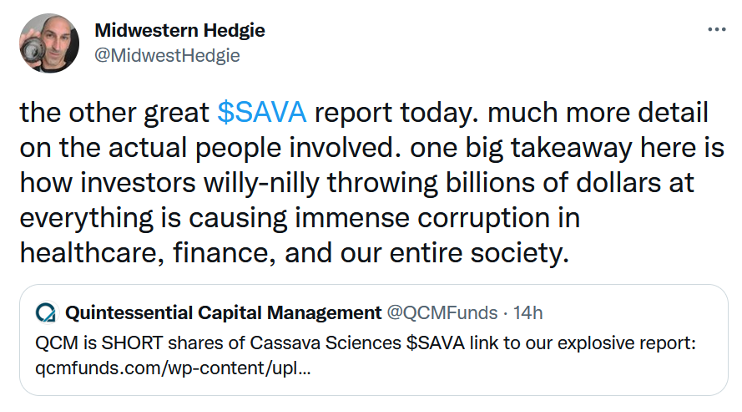
2) I'm amazed that Cassava Sciences (SAVA) was only down 2.6% yesterday after my friend and former student Gabriel Grego released his short report, which I covered in my daily. My friend Chris Brown of Aristides Capital nailed it in this tweet:
3) Another follow-up to yesterday's e-mail: I mentioned how much I'm enjoying the new podcast Pivot, hosted by two of my favorite tech sector commentators, New York Times columnist Kara Swisher and NYU marketing professor Scott Galloway.
I also want to recommend Galloway's other podcast, The Prof G Pod with Scott Galloway, as well as two podcasts that are following the fraud trial of Elizabeth Holmes, the disgraced founder of Theranos, a saga I've covered extensively over the years.
The first, Bad Blood: The Final Chapter, is by Wall Street Journal reporter John Carreyrou, who first exposed the fraud in 2015 and wrote a best-selling book about it: Bad Blood: Secrets and Lies in a Silicon Valley Startup. The other, by ABC News, is called The Dropout.
4) Longtime readers may recall that I'm an avid tennis player – I try to play every day when I'm not traveling and the public courts are open (in the winter, it's a lot harder – and more expensive! – to get a court).
I've written many times about business and investing lessons on the court:
- A lesson from the tennis court that applies in business and life (a funny story I told Andre Agassi when he was my doubles partner)
- Six terrible things that are sure to happen to every investor and tennis player
- Reader feedback on my "six terrible things" e-mail
The main lesson from my "six terrible things" e-mail was:
As in tennis, you need to mentally prepare yourself for all of these inevitable setbacks, so you don't get emotional and make the wrong decision – often at precisely the wrong time...
On Sunday, I was reminded of this when I won the 50-plus age group at a small U.S. Tennis Association tournament in New Jersey, beating a guy named John, who'd beaten me the last time I'd played in this tournament earlier this year.
He was a silent player. It was weird – he didn't announce the score, never said "good shot," and called balls out by pointing his finger.
Until the key point of the match...
We were playing an eight-game pro-set with no-ad scoring, which means at deuce, the winner of the next point wins the game. I'd lost the first four games, came roaring back to tie it 5-5, and we were at deuce. The winner of the next point would have a 6-5 lead and only need to win two more games to win the match (and the tournament).
I don't remember the details of the point, but I won it.
As we walked to our chairs for the changeover, the dam (and John's silence) broke: He cursed at the top of his lungs, slammed a ball into the fence, and cursed some more.
This was all music to my ears. I thought to myself, "I've got you now..."
Sure enough, he won only one more point as I swept the last two games.
Why am I telling you this story?
Because, as I wrote in my "six terrible things" e-mail, it's 100% certain that all sorts of terrible things are sure to happen to you at some point (probably many times) during your investing career:
- You'll carefully analyze a stock, but for some reason, suck your thumb and fail to buy it – and watch it go up and up and up.
- You'll buy a stock and, after it goes up a bit, sell it – and watch it go up and up and up.
- You'll establish a position via options, which expire worthless – and only then does the stock move.
- A stock you own declines so, thinking it's even cheaper, you buy more and more and more – as it goes to zero.
- You "round trip" a stock – meaning buy shares at, say, $10, they go to $20, you don't sell any... and the share price goes back to $10.
- You lose money on a stock and, feeling fatigued and frustrated, dump it – right before it skyrockets.
So the question is: When (not if!) one or more of these things happen to you, are you going to lose your cool (as John did) and spiral downward? Or keep your head on straight and your wits about you, raise your game, and recover?
Best regards,
Whitney
P.S. I welcome your feedback at WTDfeedback@empirefinancialresearch.com.