

From Crypto Art to Trading Cards, Investment Manias Abound; Sneakers are now an asset class; Being an investor in a time of speculation; Our experience with Virgin Galactic; Cheers to Scott Galloway and Jeers to McKinsey
1) Anyone with an ounce of common sense and a knowledge of history can see that there's a lot of speculation in various markets today, and that this is almost certain to end badly.
Here's a good article about it in the New York Times: From Crypto Art to Trading Cards, Investment Manias Abound. Excerpt:
Much of this investment momentum began last year, after the coronavirus spread and the global economy went into free fall. In response, the United States slashed interest rates, bought government bonds and passed stimulus packages. Germany, Brazil, Japan and other countries took similar actions.
Those moves had a twofold effect of increasing the amount of money in the global financial system while also encouraging people to spend. Deposits in U.S. bank accounts hit $16.45 trillion last month, more than $3 trillion above the level in January 2020, according to Federal Reserve data. The interest rate set by the Federal Reserve has been near zero since last March.
Low interest rates made traditional investments like bonds less attractive, while stocks, which have risen for a decade, became even more expensive. That was when more people started investing in nontraditional assets.
With NFTs, the hysteria escalated quickly. Last month, an NFT GIF of Nyan Cat, which shows an animated flying cat with a Pop-Tart body, sold for roughly $580,000. Other artists, including Grimes and Steve Aoki, began reaping millions of dollars from their digital artwork. Then on Thursday, Beeple, whose real name is Mike Winkelmann, sold his "Everydays: The First 5000 Days" NFT for a stunning $69.3 million.
Slava Rubin, founder of Vincent, a start-up that helps people find investments in alternative assets such as wine, collectibles and litigation finance, said his site has attracted tens of thousands of users. Last month, he said, interest in NFTs jumped by 44% and collectibles by 33%, making them the fastest-growing categories on the site.
"The public is really leaning into these new ways of thinking about how to invest, whether it's for pure profit, a hobby or based on nostalgia and interest," he said.
2) Who knew that even sneakers are now an "asset class"?! Here's the cover of a recent issue of Bloomberg Businessweek:
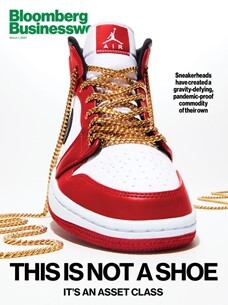
Here's the accompanying story: Sneakerheads Have Turned Jordans and Yeezys Into a Bona Fide Asset Class. Excerpt:
The sneaker boom has created opportunities for a new generation of speculator. Hebert and other young resellers are the first to treat footwear as a bona fide asset class, products as worthy of informed valuation and investment as any other commodity. The sneaker market, for them, is a lot like playing the market. In the hours after siphoning up stock from retailers, they essentially sell short-term futures based on street sentiment.
By the time prices plateau, ultra-rare shoes such as the Air Jordan 1 OG Dior – a collaboration between Nike and the Parisian fashion house that was limited to 8,500 pairs – have become "grails" worth $10,000 or more, while more attainable stock has been bundled into tranches and sold on to other resellers at a bulk discount.
Like their new fellow travelers, the day traders of Reddit, sneaker resellers have used community and technology to exploit a system that wasn't quite ready for them. But unlike the GameStop crowd, they aren't really making a point along the way; they're just making a profit.
3) So what is an investor to do when it seems like everyone else is a speculator?
First, understand that we've been through this before – not a few times, but many times – most recently as the housing bubble inflated from 2005 to 2007 (which I documented in my book, More Mortgage Meltdown) and as the tech sector went nuts during the Internet bubble in 1999 and early 2000.
Second, keep in mind that you don't have to participate in anything you don't understand or believe in. I've never been able to find the exact quote, but I recall Warren Buffett once saying (I think during the Internet bubble) something along the lines of: "Why should I care that someone's making a lot of money investing in cocoa beans?"
In other words, don't fall into the FOMO (fear of missing out) trap!
That's why I have no regrets about "missing" bitcoin. I'm not interested in investing in any cryptocurrency for the same reason I'm not interested in buying a Rembrandt: because I can't value it.
But I would never short anything in the cryptocurrency or art markets, either, because it's impossible to predict human emotions. If the price of something isn't connected to any sort of reality (such as future cash flows), then it could literally trade anywhere.
Which brings me to my third and final point...
It's possible to recognize a bubble, know it's going to end badly, and also make a ton of money on it on the way up. It's risky, however, because you need to have the judgment and discipline to not get swept up in the mania and instead get out somewhere near the top.
Here at Empire Financial Research, we played this perfectly with one of our best recommendations ever – space flight pioneer Virgin Galactic (SPCE). My colleague Enrique Abeyta and I visited the company's Spaceport near Las Cruces, New Mexico – here's a picture of us:

We correctly identified that the company has a good fundamental story – but, just as importantly, it's the only publicly traded company in a "sexy" sector, has master showman Sir Richard Branson behind it, and has a cute ticker. We figured there was a good chance that SPCE shares might get "hot" – and we were right!
We recommended the stock in our flagship newsletter, Empire Investment Report, in December 2019 at $10.20 per share. Less than two months later, the stock had doubled... so we recommended selling half on February 10 at $20.40.
Only nine days later, it had tripled, and smelling a bubble, we recommended selling half of the remainder at $37.64.
We nailed the top: a month later, SPCE shares had crashed back to our purchase price – but our subscribers had banked huge gains on the way up.
We recommended hanging on to a quarter of the original position... and, sure enough, there was another wave. After trading mostly between $15 and $25 for the rest of 2020, SPCE shares took off in January, likely driven by the dynamics that propelled many of the stocks in my "Short Squeeze Bubble Basket": a high short interest and a sexy story that appeals to the folks on Reddit's WallStreetBets forum.
This time, the stock soared to over $50 per share by late January, and we recommended selling the remainder. And again, the stock quickly got cut in half (though it has caught a recent bounce and closed Friday at $34.55 per share).
In summary, this case study perfectly captures what investors need to do if they're going to play in speculative sectors: try to find something that's "real" but also might prove popular with the "herd." Then, if you're right and the herd piles in, sell to them and lock in all or at least most of your gains!
Don't be like the oil prospector in this joke that legendary investor Benjamin Graham used to tell his students:
So this oil prospector dies and goes to heaven. At the gate, St. Peter reads the account of his life and tells him that he's qualified for heaven, but there was a problem.
"See that crowd over there? They're all oil prospectors who've arrived before you. And the way things work here, you can't get in until after them. So I'm afraid this looks like a long wait for you."
"Not a problem," replies the man. "I know how to get rid of that crowd."
So he turns towards them and shouts, "Hey, did you hear? Oil has been discovered in hell!"
And sure enough, as soon as they heard him, every single one of them ran off towards hell.
Impressed, St. Peter waved the prospector through.
But he instead replied, "I think I'll follow the guys. Maybe there's some truth to that rumor!"
4) Here's my latest edition of cheers and jeers:
Cheers to my friend, NYU marketing professor, bestselling author, blogger, and entrepreneur Scott Galloway, who appeared on HBO's Real Time With Bill Maher last Friday and, in this video clip, railed against crony capitalism. Excerpt:
Capitalism is, hands down, the best system of its kind. what young people are seeing today isn't capitalism. It's rugged individualism on the way up, and we have "we're all in this together" on the way down. We have socialism.
We have capitalism on the way up, where five CEOs of airline companies make $150 million, use all their excess cash flow to buy back stock so they can artificially inflate their own compensation, and then sh*t gets real and a pandemic comes and they don't have any money. And then, all of a sudden, "We're in this together."
When you have capitalism on the way up and you have socialism on the way down, that's not capitalism or socialism: It's cronyism. It's the worst of all worlds.
Capitalism is full-body contact and violence at the corporate level so that we can create prosperity and progress that rests on a bed of empathy.
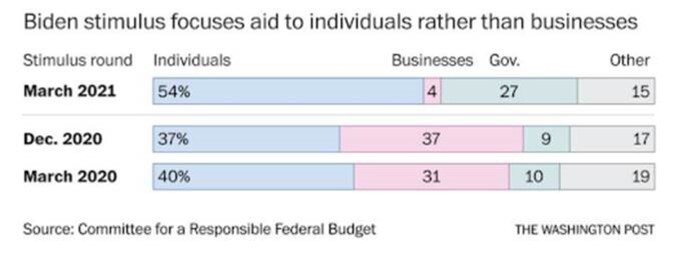
We have flipped the script here. We need to be more loving and empathetic with people and more harsh on companies. We should be protecting people, not companies.
F**king Delta: Burn, baby, burn!
To Scott's point, I think he'll like the distribution of spending in the latest stimulus bill relative to the first two:
And jeers to what was once the most elite consulting firm, McKinsey, which over and over again has sold its integrity to the highest bidders. Here's a Wall Street Journal article: McKinsey Partners Vote Out Leader in Wake of Opioid Settlement, Other Crises. Excerpt:
McKinsey & Co.'s partners voted to replace Kevin Sneader as the elite consulting firm's leader, after internal dissatisfaction over steps he took following a series of crises for the firm, people familiar with the matter said.
The decision – the result of a staggered voting process that McKinsey's approximately 650 senior partners undertake every three years to choose or reconfirm the firm's global managing partner – marks the first time in decades that a McKinsey leader hasn't won a second term. Mr. Sneader, who was voted global managing partner three years ago, failed to make it past the first round of voting, in part because partners chafed at changes aimed at keeping McKinsey free of scandal, but limited partners' autonomy, the people said.
Mr. Sneader, a 54-year-old Scot and McKinsey veteran of more than three decades, has spent much of his tenure trying to move the firm past controversies around McKinsey's previous work with clients, including this month's $573 million settlement with states over its work advising OxyContin maker Purdue Pharma LP and other drug manufacturers to aggressively market opioid painkillers.
The firm has also drawn scrutiny over its work with e-cigarette maker Juul, as well as some autocratic foreign governments, including Saudi Arabia. In December, it came to a settlement with Justice Department watchdogs over how the firm discloses potential conflicts of interest.
And here's one in the Financial Times: 'It needs to change its culture': is McKinsey losing its mystique? Excerpt:
The opioid litigation was no isolated challenge to McKinsey's golden reputation. Coming on the heels of hostile headlines about its work from South Africa to Saudi Arabia, it has raised a question its trusted advisers might ask a troubled client: is "the firm," as insiders know it, suffering from more profound cultural or leadership problems?
Best regards,
Whitney