

Google & FB; HLF report; TSLA no longer a bad short; Mark Spiegel's letter; Why you should get a new car; Ex-hedge fund founder teaches aspiring money managers; poker tournament July 18; Read This Story and Get Happier
1. We teach GOOG and FB (which we own; slides posted at: www.tilsonfunds.com/TilsonGOOGFB.pdf) in our seminars (next one in NYC starting a week from Tuesday!), and one of the most common questions is whether their business models could be impacted by new data privacy laws. Our view is that these laws are more likely to entrench GOOG and FB, similar to what happened when advertising restrictions were placed on tobacco companies. This article in last week's WSJ reinforces our view, Google Emerges as Early Winner From Europe's New Data Privacy Law, www.wsj.com/articles/eus-strict-new-privacy-law-is-sending-more-ad-money-to-google-1527759001. Excerpt::
GDPR, the European Union's new privacy law, is drawing advertising money toward Google's online-ad services and away from competitors that are straining to show they're complying with the sweeping regulation.
The reason: the Alphabet Inc. GOOGL +2.02% ad giant is gathering individuals' consent for targeted advertising at far higher rates than many competing online-ad services, early data show. That means the new law, the General Data Protection Regulation, is reinforcing—at least initially—the strength of the biggest online-ad players, led by Google and Facebook Inc.
2. This is an extraordinary (and brave) piece of research on Herbalife (HLF) by Christine Richard and Aaron Greenspan of PlainSite. It appears clear that, if Herbalife isn't a vast criminal money-laundering enterprise, at the very least it's been willfully ignorant in allowing itself to be used my many such enterprises, mostly drug cartels in Mexico and South America. www.plainsite.org/realitycheck/herbalife.html. Excerpt:
Executive Summary
Herbalife Nutrition Ltd., a Multi-Level Marketing (MLM) nutritional supplement company, has a long and highly publicized history of being accused of operating as a pyramid scheme. Less well known is the extent to which its global reach has overlapped with money laundering and narcotrafficking channels.
Based on numerous interviews, Freedom of Information Act (FOIA) requests, legal document searches, and internal Herbalife materials, this report presents a history of Herbalife's intersection with money laundering and the illicit drug trade, both directly and indirectly through its distributors. For decades, rather than address its entanglement with money laundering in ways that would dissuade further criminal involvement, Herbalife has structured its business in such a way that it remains vulnerable. Examples include:
- Allowing its products to be moved through the so-called "gray market," where products in one country are illicitly transported across borders to another
- Relying on poorly disclosed or undisclosed third parties to operate the Herbalife business in high-risk countries including Russia, Colombia, Panama and Mexico, creating blind spots throughout the company's vast operational footprint
- Allowing high-ranking distributors at the top of the pyramid to make decisions at Strategy and Planning Committee meetings that dictate the company's global expansion plans, vendors, and policies, even though members have questionable histories and, in at least one case, a narcotics trafficking conviction
- Building a complex business structure that permits the company and distributors to move money across international borders with little to no regulatory oversight
Herbalife's business has been linked to at least two notorious drug cartels, as well as the global bank HSBC, known for terrorist and narcotics financing. The company's extensive track record of compliance failures, in direct violation of multiple federal Anti-Money Laundering (AML) statutes, leaves open the door to those who would use Herbalife to move illicit goods and funds around the world.
Herbalife has carefully cultivated a public image as a purveyor of nutritional supplements that are designed to help its customers lose weight and stay fit. Thus far it has been successful in convincing the marketplace that it is a legitimate business, albeit one with a few deficiencies like any large company. Considerable evidence supports a different and darker view.
3. I haven't had a chance to write this up in detail yet, but I've changed my view on TSLA. Ever since I covered my short position at $205 in early 2014, I'd been pounding the table, warning my short seller friends that THIS IS A BAD SHORT. But starting with the company's last earnings call (what a doozy that was!), I now have a more nuanced view.
While I'm not yet convinced that it's a good short, I no longer think it's a bad one for a variety of reasons: the company is burning through cash at an alarming rate and the balance sheet is falling apart (see the end of my article, An Open Letter to Reed Hastings: Do an Equity Offering Now), so it will need to raise a lot of capital soon, continued missed deadlines (nothing new), mediocre reviews for the Model 3, a huge number of senior management departures, Musk's increasingly erratic behavior, etc.
For more on this, see Mark Spiegel's latest monthly letter, attached. (He also spoke at our shorting conference a month ago – see his 157-slide presentation here and you can watch the vide of it on the Kase Learning YouTube channel here.)
In short, I think the odds that the stock does a Valeant (that's now a verb, meaning "to collapse by 97%") have risen from 10% to 35%. But, as with Valeant, you don't have to be a hero here. There will be plenty of time to get in on the short side if it really does go into full-scale collapse.
4. Speaking of cars, I learned that a close friend, her teenage daughter and three of her friends were in a terrible car accident in California recently that could have killed them all (fortunately they're all OK), which inspired me to write this article that was just published on Yahoo Finance. Why you should get a new car, https://finance.yahoo.com/news/get-new-car-133542656.html. Excerpt:
Ever since my wife fell asleep at the wheel last November and got in a frightening accident, I've become a total zealot about car safety, telling anyone who will listen that if they're driving a car without the most advanced safety features, get a new car now (if they can afford it; if they can't, then get the safest car they can afford whenever they're getting a new one). (For more on car safety, see pages 26-35 of my slide presentation, The Five Calamities That Can Destroy Your Life — and How to Avoid Them, which I've posted here).
... Car accidents in 2016 killed 37,461 people on U.S. roads, up 14% in two years after a half-century of steady declines. Experts aren't sure why auto fatalities are rising, but I'm convinced that it's likely due to increasing electronic distractions. It's so easy for drivers these days — myself included on occasion, I'll confess — to take their eyes off the road because of an incoming call or text, looking at Google Maps, etc. Our smartphones are constantly ringing, chirping and vibrating, which is an irritating distraction most of the time — but when you're driving, it can be deadly!
The good news is that there's been a quantum leap in the past few years in safety technology that will both help you avoid many types of accidents and, if you're in one, make sure you walk away unscathed. The more I learn about the various technologies, the more amazed I am — and the more determined I become to persuade as many people as I can to upgrade to safer cars!
5. I did an interview with Crain's New York Business recently, which was published last week. Ex-hedge fund founder teaches aspiring money managers where he went wrong, www.crainsnewyork.com/article/20180530/FEATURES/180529914/ex-hedge-fund-founder-teaches-aspiring-money-managers-where-he-went. Excerpt:
When did you finally decide to quit?
My fund trailed the market badly for years before I closed it and returned investors their money. I managed to snatch defeat from the jaws of enormous success.
You seem amazingly at peace with this.
I'm not crying a river for myself. I didn't make enough to retire on, but my life is going great, and I love my new business.
Are people interested in learning from a washed-out hedge fund manager?
Listen, I did a lot of things wrong, but I did a lot of things right too. I can talk about both. There isn't much in the way of continuing education for money managers, so I'm attempting to fill that gap. I try to help people with their career, give them practical lessons and advice. If you're a great cook, that doesn't mean you should open a restaurant. Same for investors. Most are probably better off working for someone rather than being on their own.
What do you tell the entrepreneurial types who do want to open a fund?
We teach how to get your name out there and, above all, how to raise money and distinguish yourself from the 8,000 other hedge funds. For instance, it's really worthwhile spending a few thousand dollars on graphics so you have a professional presentation. I made that mistake for 19 years. And don't be secretive. Unless you're at the very top of the heap, no one is trying to steal your investment ideas.
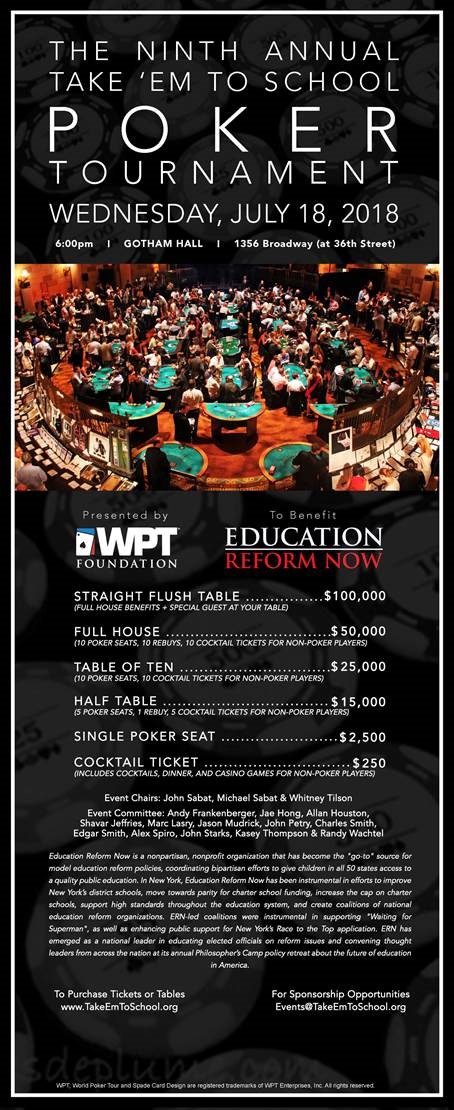
6. The 9th annual Take 'Em to School Poker Tournament, which I'm co-chairing, is coming up next month on Wednesday, July 18th. It benefits Education Reform Now, a non-partisan, non-profit organization committed to ensuring that all children can access a high-quality public education regardless of race, gender, geography, or socioeconomic status.
It's always a great night for players, spectators, and education reformers alike. The tournament will feature 250 poker players battling for prizes that in past years have included golf outings at exclusive clubs, a table at Rao's for 8, and power lunches with top investors. For those attending as cocktail guests there will be a variety of casino games and entertainment. The event also features a full swing golf simulator, which will host Long Drive and Closest to the Pin contests.
The event always includes specials guests and in the past has featured poker stars Phil Hellmuth, Erik Seidel, Sam Abernathy, and Layne Flack; sports icons James Blake, Alex Kovalev, Apolo Ohno, John Starks, Charles Smith and Allan Houston; America's Next Top Model contestant Jamie Rae; and award-winning actors Hank Azaria, Billy Crudup, Shannon Elizabeth and Seth Gilliam.
The event always sells out, so reserve your seat/table today by replying to this email or going to: www.TakeEmToSchool.org. I hope to see you there!
7. I really enjoyed this cover story in the current issue of New York Magazine about "the most popular course in the history of Yale University and the most talked-about college course in America", on happiness. Read This Story and Get Happier. The most popular course at Yale teaches how to be happy. We took it for you., www.thecut.com/2018/05/how-to-be-happy.html. Excerpt:
Professor Laurie Santos didn't set out to create the most popular course in the history of Yale University and the most talked-about college course in America. She just wanted her students to be happy. And they certainly look happy as they file into a church — a literal church, Battell Chapel, that's been converted to a lecture hall — on the Yale campus on a sunny April afternoon, lugging backpacks and chatting before taking their seats in the pews. They've just returned from a two-week spring break. The weather outside is gorgeous. Professor Santos is playing her pre-class get-pumped playlist featuring the Black-Eyed Peas' "I Gotta Feeling," And, let's not forget, all of these students are currently going to Yale. What's not to be happy about?
Quite a bit, it turns out.
The very fact that Santos's new course, PSYC 157: Psychology and the Good Life, is so wildly popular, with over 1,200 enrolled students, suggests that she's on to something when she tells me one day, pre-lecture, "College students are much more overwhelmed, much more stressed, much more anxious, and much more depressed than they've ever been. I think we really have a crisis writ large at colleges in how students are doing in terms of self-care and mental health." Then she adds, "Sadly, I don't think it's just in colleges."
Santos is right on both counts. College students aren't happy, and neither is anyone else. According to a recent survey by the American College Health Association, 52 percent of students reported feeling hopeless, while 39 percent suffered from such severe depression that they had found it difficult to function at some point during the previous year. At the University of Pennsylvania, there's even a slang term for the grim mask of discontent that accompanies this condition: "Penn Face." We could go further and diagnose a national case of "USA Face," given that America recently ranked 18th in the U.N.'s "World Happiness Report," trailing such national bastions of well-being as Finland (No. 1), Canada (No. 7), and Australia (No. 10).
In the face of this epidemic of unhappiness, Santos decided to design a course in "positive psychology" — i.e., the field of study that focuses on well-being, as opposed to psychological dysfunction. Such classes have been around for more than a decade, but they typically served as introductions to the field — sort of Happiness 101. Santos's course aims to do more. "The thing that makes this course different is that we also focus on what I call 'behavior change' — the science of how you move your behavior around," she says. "How do you actually change your habits and use your situation to your advantage?"
In her very first lecture, Santos emphasizes to her class that she wants to teach them not just the science of happiness but the practice of happiness. And happiness, it turns out, does take practice. But first you have to learn what exactly happiness is. If previous courses in this field might have been characterized as "Why Happy People Are Happy," this course could be called "What Is Happiness, Why Aren't You Happy, and What Can You Do to Change That?"
Of course, you don't have four months (or a Yale student ID) to take the entire course. So we've condensed some of the highlights and insights into a mini-course you can take right now. Let's get started: Are you ready for a pop quiz?
1. What is happiness?
2. Why aren't you happy?
3. What can you do to change that?
Class, please open your books to lesson No. 1.
... once our basic needs are met — lodging, food, etc. — the relationship between money and happiness becomes purely theoretical.
For Santos, the goal of such research is to prompt her students to reconsider their own priorities. She notes that in 1967, when incoming freshmen in American colleges were asked what they valued, 87 percent reported that "developing a meaningful philosophy of life" was important to them, while only 42 percent valued being "well-off financially." By 2005, those numbers had reversed: 71 percent of freshmen valued being well-off, while only 52 percent valued a meaningful life philosophy.