

How the 'Apple of Pot' Collapsed; Permanent Assumptions; James Altucher's follow-up on his controversial NYC post; Before and after pictures from my friend's repainted house
1) This in-depth look at the rise and fall of cannabis company MedMen Enterprises (MMEN.CN) – down 98% from its peak – is a rollicking tale that, in many ways, mirrors what happened in the entire sector.
You just can't make this stuff up! From Politico: Lavish Parties, Greedy Pols, and Panic Rooms: How the 'Apple of Pot' Collapsed. Excerpt:
Bierman, who styled himself the Steve Jobs of the "green rush" into legal weed, sported a red hoodie emblazoned with a white pot leaf. It was early June, 2018, barely a week since MedMen, the cannabis business he led, had gone public on a Canadian stock exchange, boasting an implied valuation of $1.6 billion.
"We want the world to walk in and see what the future looks like," he said. "And the future is right here on Abbot Kinney."
At the time, MedMen indeed looked to become the Apple of pot, the first mainstream, nationwide consumer brand for the product that drove so many Americans to ingest and invest. Marijuana liberalization was sweeping the country. A nascent industry was taking shape. No company was better poised to reap the rewards than MedMen was.
Then, just a few months after its Abbot Kinney opening, it all began to unravel. The company got hit with a class-action lawsuit from employees alleging labor law violations. Miffed investors sued the founders, accusing them of self-dealing and other underhanded tactics. A former chief financial officer filed a blockbuster complaint in a Los Angeles court accusing the founders of a slew of misdeeds, from manipulating MedMen's stock price, to bank fraud, to seeking private intelligence groups to get dirt on their enemies, to calling an L.A. city councilman a "midget negro" and making an illegal straw man contribution to a Nevada politician.
MedMen stands as a cautionary tale of American Wild West capitalism.
The suit alleged excessive spending on security – including installing a panic room in Bierman's home – as well as using company funds on the likes of a custom Tesla SUV, "pearl-white" Cadillac Escalades, and a salary for Bierman's personal marriage counselor.
MedMen and Bierman have denied wrongdoing in those cases, and are fighting the claims in court, but investors have lost their patience for nine-figure losses.
In January, Bierman resigned as CEO. The company's stock now trades for a fraction of what it did just months earlier.
The company's fall reverberates far beyond its stakeholders, because its glitzy rise was propelled by the promise of an entire industry. Its woes reflect the precarious status of the cannabis business: legalized by states but still criminalized by the federal government, its position makes traditional bank financing impossible and puts companies at the mercy of a patchwork of regulators.
The industry's promise has been tarnished, too, by business failures, corruption and concerns over an influx of foreign money.
2) I enjoyed this blog post, Permanent Assumptions, by blogger and venture capitalist Morgan Housel. (In Monday's e-mail, I reviewed his new book, The Psychology of Money: Timeless Lessons on Wealth, Greed, and Happiness.) Excerpt:
When you have something you know is true, you can afford to put a lot of energy into it. That's why permanent assumptions are important.
I have no idea what's going to happen next in the economy or society. But I have a handful of permanent assumptions I've put a lot of energy and faith into that guide almost everything I think about business and investing.
Here are nine.
1. More people wake up every morning wanting to solve problems than wake up looking to cause harm. But people who cause harm get more attention than people who solve problems. So slow progress amid a drumbeat of bad news is the normal state of affairs.
2. The world breaks about once a decade. There are so few exceptions it's astounding. It can be economic, political, military, social, or a mix. But it breaks all time, in ways few see coming. The breaks aren't as scary if you have a permanent assumption that they'll keep happening and don't preclude long-term growth.
3. Stories are more powerful than statistics. And most statistics are incomplete props to justify a story. Stories are easier to remember, easier to relate to, and emotionally persuasive.
4. Nothing too good or too bad stays that way forever, because great times plant the seeds of their own destruction through complacency and leverage, and bad times plant the seeds of their own turnaround through opportunity and panic-driven problem-solving.
5. Knowing there will be a reversion to the mean does not mean you know when things will revert. Unsustainable things can sustain for a long time, because of incentives and the power of storytelling that turns nonsense into influential action.
6. Incentives are the strongest force in the world. They cause good people to do bad things, which can make you overly cynical about how good people actually are.
7. A big group of people can get smarter and better informed over time. But they can't, on average, become more patient, less greedy, or more level-headed during periods of upheaval. That will never change. And it highlights the idea that edges, when they exist, usually come from behaving better than average rather than being smarter than average.
8. History is mostly the study of unprecedented events, ironically used as a map of the future. Stuff evolves, paradigms shift. So what worked in the past may not work today or tomorrow. The most valuable part of history is studying how people behave when the world changes, because it's the most consistent thing over time.
9. It's easy to take advantage of people. It's also easy to underestimate the power and influence of groups of people who have been taken advantage of for too long. The former is obvious, the latter surprises people in a life-changing way a few times per century.
I don't think I'll ever change my mind on those.
3) In Tuesday's e-mail, I linked to a provocative essay by James Altucher entitled: "NYC IS DEAD FOREVER. HERE'S WHY."
Here's his follow-up post: The Autobiography of My Past Two Days: A Saga of Sorrow and Hope. Excerpt:
I didn't expect all the hate. I've lost friends over this article. But, as the cliché goes, maybe they weren't friends to begin with. Reality is better to deal with than denial...
And many people liked it, sent me messages, and I hope I did what I intended, which was provide food for thought and for solutions. And in this article, food for hope...
I found nobody offered solutions to the problems mentioned in my article other than the typical:
- NYC still has a ways to go before it hits bottom.
- New leadership will be elected.
- Rents will collapse all over the city, making NYC affordable for young people for the first time in decades.
- Young people will move in.
- An energetic art scene will develop and thrive based on the new youth-based culture
- And as a result, cafes, restaurants, culture, businesses will begin to thrive again.
But this "solution" skips over and ignores many of the problems I outline.
For instance, the fact that bandwidth, for the first time ever, allows people to work fully remotely. It has also allowed companies like Google, Twitter, JPMorgan, Citigroup, and many, many others to go remote indefinitely, which means that many office buildings will remain empty.
This will damage the entire economic ecosystem that existed around the millions of workers who will now be remote (or evicted or no longer going to college campuses, etc.): the transit system, office maintenance, restaurants, etc.
That, combined with a rising deficit and lower revenues from lower personal and corporate taxes, is a huge bridge we're going to have to cross before there is any thriving youth culture.
Did you know that only 2,500 people (out of eight million people in NYC) pay 40% of all the taxes that NYC collects, and that this is the main income for NYC? Well, what happens if half, or even 1/10, of those 2500 are gone, precisely when expenses are going up?
I don't know the answer. I only point it out. NYC will be here 10 years from now. But it will be different.
That's why I don't call this period we are entering a "new normal"... I call it "The Great Reset."
4) During the summers after my junior and senior years of college, I used to run a College Pro Painters franchise in Wellesley, Massachusetts.
We painted roughly 60 houses in total. So whenever I see a house in need of painting, it brings back memories and makes my heart race.
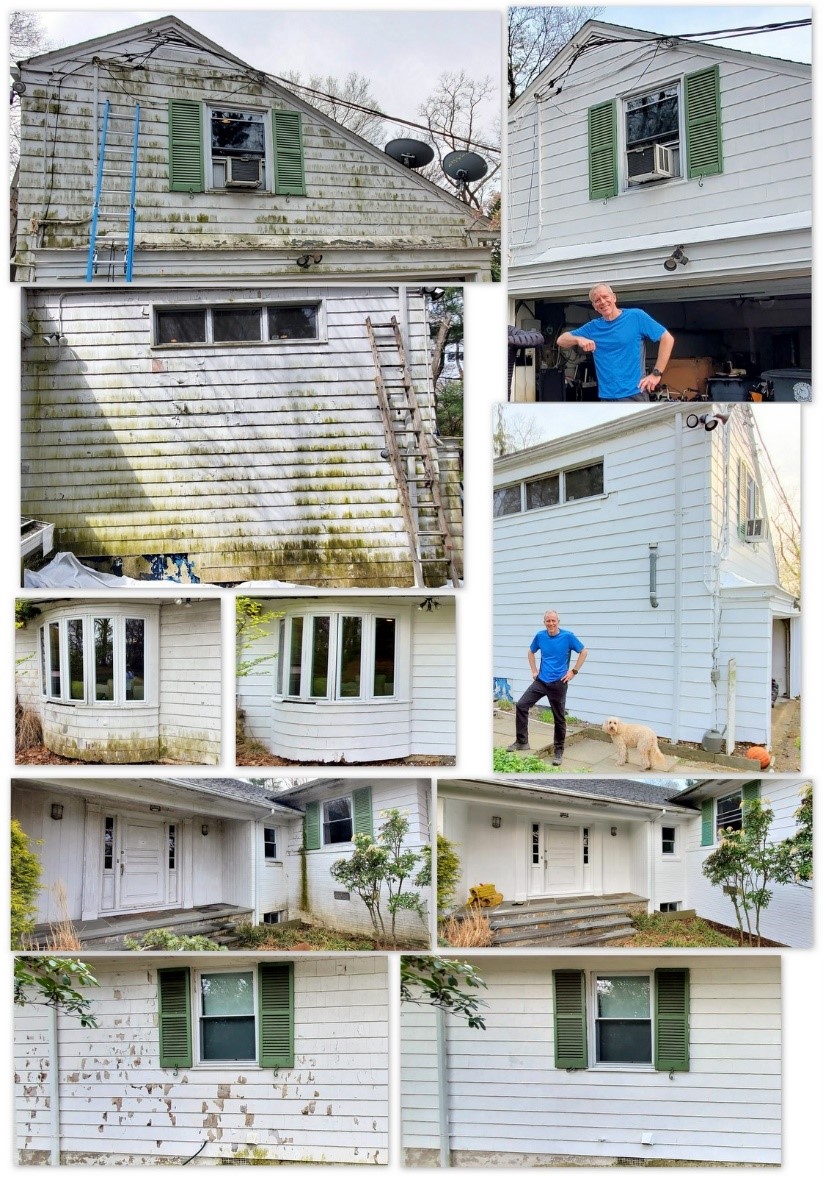
It happened again not long ago when I was visiting a friend at his weekend house outside the city and saw how dreadful the exterior of his house looked. So I went to Home Depot, bought nearly $1,000 worth of paint, brushes, a ladder, and other equipment... and showed up the next day to teach him, his friend, and his sons how to power wash, scrape, prime, and paint.
My friend took this picture of me climbing the ladder, about to do some scraping...

They cranked all week, and the final result was beautiful! Here are some before and after pictures:
Best regards,
Whitney