

I have increasing confidence that the pandemic will soon be over; Worried About Inflation? Here's What That May Reveal About You; Crypto letter; Elephants and giraffes
1) I covered all of the latest developments related to the pandemic in yesterday's e-mail to my coronavirus list, which you can read here (to subscribe, simply send a blank e-mail to: cv-subscribe@mailer.kasecapital.com). Here's the most important lead item:
Based on eight more days of data since my December 14 e-mail entitled, Will the pandemic soon be over?, I have a higher degree of confidence (perhaps 70%, up from 50%) that my theory is correct that "the omicron variant, rather than being a global nightmare, may actually soon lead to the end of the pandemic, morphs into something akin to the seasonal flu in the next month or two." Here's why...
The million-dollar question we're all grappling with is (as I wrote yesterday):
Are the mild symptoms we're seeing around the world among those who are infected with omicron due to the variant being less severe or the fact that there now far more people who are vaccinated and/or had a prior infection relative to the delta wave last summer? I'm cautiously optimistic that the former is the case, but there's evidence for both sides right now...
I am now even more optimistic after reading this Twitter thread a friend just sent me. It was posted yesterday by Andrew Lilley, an Australian research scientist, in which he presents data from the state of New South Wales. NSW is a near-perfect case study to compare omicron with delta because the adult population is nearly fully vaccinated (94%) and almost no-one has been exposed to COVID (2% to 3%) – and these numbers haven't changed over the past few months.
In his first chart, he shows how omicron cases have surged and rapidly displaced delta:

Yet at the same time, the hospitalization rate (on a five-day lag) has fallen by more than half (the second chart is age-adjusted):

He explains the charts as follows:
Delta had a steady 12.5% hospitalisation rate from Sep through Oct, and it then started to fall a bit in Nov as fully vaccinated breakthroughs + child cases went from 30% to 75% of all cases. Then in December it began falling much more sharply – from 6.9% ten days ago to 3.6% now.
But wait, the news is even better: given that omicron only accounted for roughly two-thirds of cases five days prior (the balance being rapidly declining delta cases), this means that the actual decline in the "case hospitalization rate" of omicron is 70%!
To make sure I wasn't missing anything, I asked Dr. Kevin Maki to take a look and he replied:
This is more good news. The information from South Africa and Australia are now pointing in the same general direction. Hospitalization seems to be 10% to 50% as likely with omicron compared to delta. It's too soon to tell regarding deaths but those should follow the same pattern.
The vaccinated are also much less apt to be hospitalized, so a big variable, which is important to assess, is the prevalence of vaccination and prior infection) in each of the populations studied.
It seems quite probable at this point that omicron's virulence is more toward the common cold coronavirus end of the spectrum than the MERS and SARS-1 end of the spectrum.
Here are other topics I covered in my e-mail:
- More data that omicron is mild
- Two doses and natural immunity don't work against omicron
- Data from the U.K., Denmark, South Africa, the U.S., and NYC
- Lockdowns work... but aren't always wise
- Schools should never close
- Joe Golton's forecast and the Spiderman superspreader event
- Donald Trump says he got booster shot
- FDA expected to approve COVID treatment pills within days
- Ten-day isolation is too long
2) Following up on yesterday's e-mail about inflation, this New York Times article highlights how different groups of Americans view it: Worried About Inflation? Here's What That May Reveal About You. Not surprisingly, older folks, who often live on fixed incomes, are more concerned:
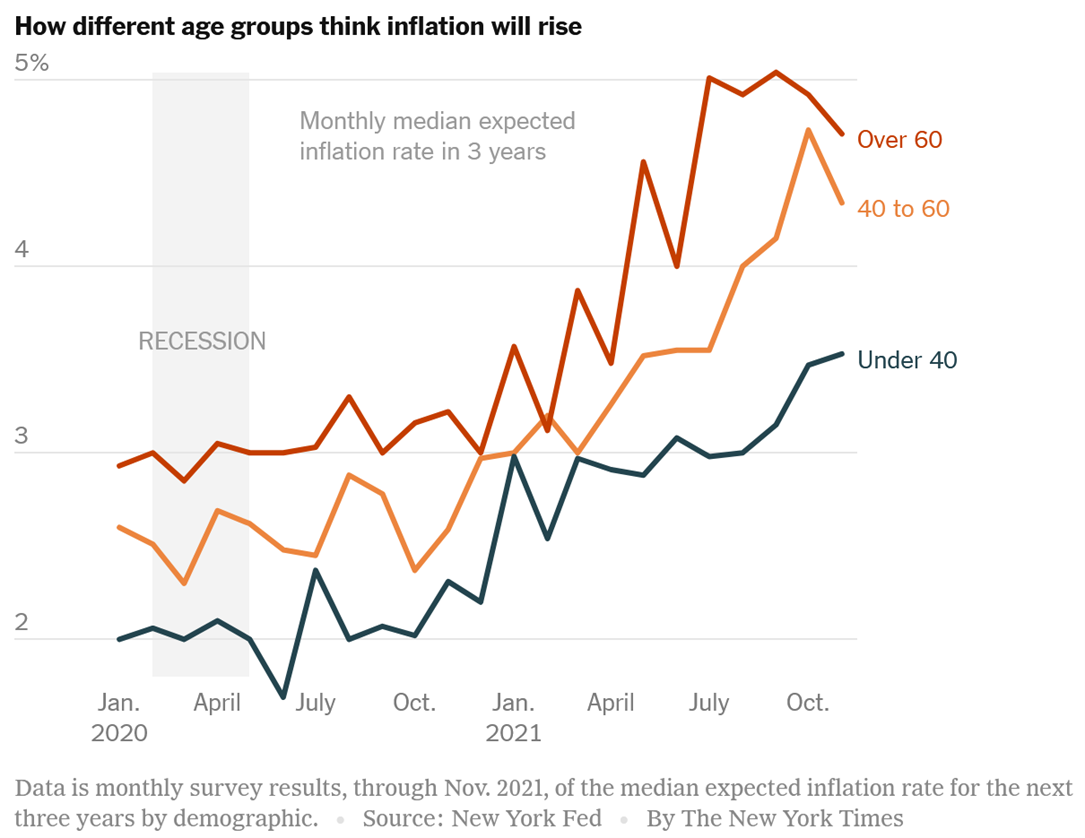
I also thought the political biases were particularly interesting:
n a Gallup poll in November, 53% of Republicans reported that recent price increases were causing personal hardship, but only 37% of Democrats did.
That's not because inflation necessarily hurts Republicans more than Democrats, or because the GOP may have a stronger ideological aversion to rising prices. A recent study by economists in Germany and Switzerland found that when Barack Obama was in the White House, inflation expectations in Republican states ran almost half a percentage point higher than in Democratic states. But they dropped three-quarters of a point when Donald J. Trump became president.
That is, as with impressions of the overall state of the economy, perceptions of inflation may be shaped by who's in power. This could be part of the reason that the Federal Reserve Bank of New York finds that inflation expectations in the South and the Midwest – where the overwhelming majority of Republican voters live – have jumped far more than in the West and the Northeast, home to most Democrats. But the inflation rates in the South and the Midwest have, in fact, been somewhat higher than elsewhere.
3) This post by my old friend Chris Irons (aka "Quoth the Raven") cracked me up: A Letter to Our Oh-So-Dearest Family and/or Friends Seeking to Talk Crypto at Our Holiday Dinner. Excerpt:
What I will volunteer is that I have spent the last few years looking at crypto/bitcoin/altcoins/shitcoins (circle one or all) and while I think their cause is noble, there is unfortunately also a greater than 0% chance that cryptocurrency in general will turn out to be a multi-trillion dollar air pocket worth precisely nothing.
Yikes, right?
This statement holds extra true for many of the altcoins more so than bitcoin and ethereum. Regardless, this investment is not "digital gold", as you may have referred to it as after imbibing numerous glasses of eggnog and/or red wine. Gold is tangible, is a commodity and isn't digital: that's one of the things that makes it gold. Bitcoin is a spot on a computerized digital ledger that ceases to exist without a power supply and an Internet connection. That makes bitcoin very different from gold...
The truth is that your crypto/bitcoin/altcoins/shitcoins (circle one or all) are part of a brand new asset class that almost anything can happen to that also may or may not be worth nothing at all. I don't like those odds, especially in an environment where they trade like risk assets...
But nothing that has only been around for a decade – and may or may not tangibly exist, while routinely moving 20% over the course of an hour or two – is a safe haven. End of story. A "safe haven" is somewhere that you place your money to preserve your wealth. And while you might be right in wanting to address your newfound discovery of the dollar losing its purchasing power as a result of inflation, there are far better choices, in my opinion, than putting it into something as speculative as bitcoin.
4) Today, in our only full day in Nairobi, we went to the elephant orphanage and the giraffe center. Here are some pictures and, as usual, I've posted more on Facebook here:

Best regards,
Whitney
P.S. I welcome your feedback at WTDfeedback@empirefinancialresearch.com.