

I'm hiring a junior analyst; Tesla's reckless Smart Summon; More on Whee: Sex, tequila, and a tiger; WeWork Still Needs Cash; WeWork's junk bonds tumble; Class participation strategy No. 4
1) As I mentioned in last Thursday's e-mail, I'm looking to hire a junior analyst.
The position is based in Baltimore, Maryland, at the headquarters of my corporate partner, Stansberry Research.
If you have a passion for investing, a nose for cheap stocks, and great writing skills, we want to hear from you! Click here for the job description and information on how to apply.
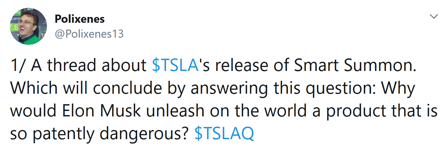
2) In yet another example of Elon Musk and Tesla's (TSLA) dangerous recklessness, the company released a "smart summon" feature as part of the version 10 software update that went out last week.
With it, Tesla owners can "summon" their cars from a maximum distance of 200 feet using their smartphones. Unfortunately, however, it's not yet ready for primetime. Numerous users are documenting fender benders, and it's only a matter of time before one of these unguided cars hits a person or runs over a baby.
Why would Tesla be so reckless? In part, it's in Musk's DNA. But more important, it allows the company to recognize some of the full self-driving revenue sitting on its balance sheet, in a desperate attempt to report better third-quarter numbers. What a total disgrace! My prediction: Regulators will quickly force Tesla to deactivate this feature.
For more, see this Twitter thread...
And here are some articles about it:
- The Verge: Tesla's Smart Summon feature is already causing chaos in parking lots across America
- New York Post: Tesla's 'smart summon' feature is causing fender benders, parking lot jams
- Electrek: Tesla owners are already doing dumb things with 'Smart Summon'
(If you'd like to be added to my Tesla e-mail list – roughly one e-mail per day – simply send a blank e-mail to: tsla-subscribe@mailer.kasecapital.com.)
3) Just when I think I've heard it all about "The Whee Company," another bombshell article drops...
This one by Business Insider really takes the cake! Sex, tequila, and a tiger: Employees inside Adam Neumann's WeWork talk about the non-stop party to attain a $100 billion dream and the messy reality that tanked it. Excerpt:
For Neumann and anyone who worked for him, WeWork was all consuming, a place where the boundary between work and play not only didn't exist, but was fused together.
From meetings laden with tequila shots to mandatory company retreats filled with sounds of people having sex, working at WeWork meant signing up for a lifestyle that embraced, to an extreme degree, the no-holds-barred "hustle" culture the company promoted to clients.
The non-stop party, combined with the promise of a big payday, was intoxicating – at least at first. In less than ten years, WeWork exploded to become a commercial real estate powerhouse, with more than 10,000 employees spread across 29 countries, and steaming ahead on a seemingly unstoppable trajectory to a $100 billion valuation. As the company's coffers filled with billions in funding and press coverage snowballed, Neumann's behavior and ambitions became increasingly unconstrained.
"A lot of WeWork feels like a never-ending party. It's always up or down, and Adam's screaming both ways, happy or not," one former employee said.
4) Whee is in big trouble, as this Wall Street Journal article documents: WeWork Still Needs Cash After Pulling IPO. Excerpt:
For years, WeWork's parent company was defined by big spending as it relentlessly pursued rapid growth.
Now, in the aftermath of a botched initial public offering attempt and the ouster of co-founder and chief executive Adam Neumann, it is facing a different reality: It needs to stop bleeding cash.
On Monday, We Co. said it would file a request with the Securities and Exchange Commission to withdraw its IPO proposal. The company said it is postponing the offering to focus on its core business and that it has "every intention to operate WeWork as a public company" but didn't provide a time frame.
To cut costs, the company's new co-CEOs, Sebastian Gunningham and Artie Minson, are planning thousands of job cuts, putting extraneous businesses up for sale and purging some luxuries from the previous CEO, such as a G650ER jet purchased for more than $60 million last year, people familiar with the matter have said.
New York-based We had $2.5 billion in cash as of June 30. At the current rate of cash burn – about $700 million a quarter – it would run out of money some time after the first quarter of 2020, according to Chris Lane, an analyst at Sanford C. Bernstein & Co. Mr. Lane and his colleagues projected in a recent note to clients that We would burn through nearly $10 billion in cash between 2019 and 2022, assuming it keeps growing.
Messrs. Gunningham and Minson said in a joint email to We staff last week that they "anticipate difficult decisions ahead."
5) Bondholders see the writing on the wall, as this Bloomberg article notes: Is the WeWork IPO Dead? Junk Investors Start to Think So. Excerpt:
WeWork says it's on an "official pause" from becoming a public company. Its bondholders might be thinking it's something more permanent.
The company's $669 million of junk-rated debt traded at an all-time low of 84.5 cents on the dollar on Monday after it announced it was formally withdrawing the prospectus for its initial public offering. It's the seventh consecutive day that the price of WeWork's bonds has declined, the longest losing streak in more than a year. The yield is close to 12%, more than double the average rate in the Bloomberg Barclays U.S. Corporate High Yield Index.
6) In conclusion, I reiterate the predictions I made two weeks ago – and note that prediction No. 4 has already happened:
- Whee never goes public.
- As the company tries to reduce its catastrophic $1.6 billion annual burn rate to survive, it ceases growth, lays off huge numbers of employees, and tries to sell assets.
- Existing investors, led by SoftBank and wanting to avoid a total wipeout, will throw good money after bad and invest $1 billion or $2 billion in a distressed round that values the company at $5 billion.
- As part of the capital raise, investors will demand that Neumann step down and will throw him out.
- None of this will make any difference, and the company will file for bankruptcy a year from now.
7) Here's my fourth strategy for winning the class participation game:
4. Don't ask or answer questions.
Air time is precious, so don't waste it asking questions. You can always get the answer later by asking one of your classmates. Even the best question won't impress a professor as much as an insightful piece of analysis. As for answering questions, unless you happen to have already prepared the answer, why would you blurt out an unprepared comment?
Best regards,
Whitney