

Inflation Eased to 3% in June; Paul Krugman: Dude, Where's My Recession?; The bear case on AI; Free tickets to the premiere of '20 Days in Mariupol' in NYC this weekend
1) The U.S. Department of Labor released an exceptionally good inflation report yesterday: Inflation Eased to 3% in June, Slowest Pace in More Than Two Years. Excerpt:
Inflation cooled last month to its slowest pace in more than two years, giving Americans relief from a painful period of rising prices and boosting the chances that the Federal Reserve will stop raising interest rates after an expected increase this month.
The consumer-price index climbed 3% in June from a year earlier, the Labor Department said Wednesday, sharply lower than the recent peak inflation rate of 9.1% in June 2022, when gasoline prices hit a U.S. record average of $5 a gallon.
The June rate declined from 4% in May. Inflation was last close to 3% in March 2021.

Here are two columns in the Wall Street Journal with additional commentary:
- How Fast Can Inflation Cool? Not Fast Enough (Yet) for the Fed, Justin Lahart
- Measure It Differently, and Inflation Is Behind Us, James Mackintosh
The inflation report came as a surprise to many people, but not to me or my readers...
I have been saying for months that the U.S. Federal Reserve's unprecedentedly rapid rate increases have done their job, inflation will decline rapidly, and we can stop worrying about it.
Unfortunately, however, the Fed doesn't appear to have figured this out yet and is therefore likely to do one more 0.25% rate hike at the end of this month, which is unnecessary and increases the risk that the economy will tip into a recession (though I still think it's unlikely).
Even if the Fed does so, the good news is that it will likely be the last hike, which will provide a tailwind for stocks in the second half of the year.
2) That said, it's important to remain humble in making forecasts with any degree of certainty in light of this extremely unusual and unpredictable economic environment.
Nobel Prize-winning economist and New York Times columnist Paul Krugman does a good job of capturing this: Dude, Where's My Recession? Excerpt:
So it sure looks as if economists made a bad recession call. Why were they wrong?...
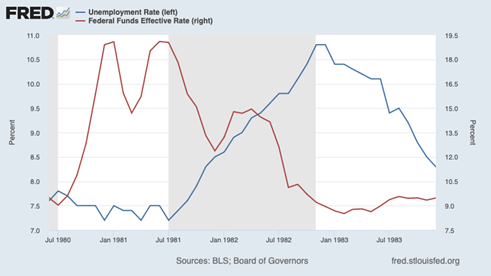
I think it's fair to say that most economists bought into the view that we were seeing a replay of the early 1980s. What happened then was that, faced with high inflation, the Fed sharply hiked interest rates, causing a recession; this recession brought inflation down, and the Fed then reversed course, cutting rates again:
Indeed, the Fed has, once again, raised rates sharply to fight inflation. But events since then have failed to follow the script in two distinct ways.
First, those rate hikes have so far failed to produce a recession. Instead, the economy has been remarkably resilient...
Whatever the reasons, the economy has shrugged off higher interest rates to an extent few expected.
Now, you might think that this means that the Fed will have to push interest rates even higher. After all, don't we need a recession to curb inflation? But here's the other place where things have gone off script: Despite steady job growth and continuing low unemployment, inflation has in fact subsided...
In any case, something really strange has happened. I can't think of another example in which there was such a universal consensus that recession was imminent, yet the predicted recession failed to arrive.
3) Longtime readers know that I like to think about – and present – both sides of complex issues...
So with that in mind, having written favorably about artificial intelligence and ChatGPT, I'd like to share the bear case, which is captured well in this ZeroHedge article: AI Is Being Overhyped. Excerpt:
"The intelligence of AI systems is being overhyped and, while we could get there eventually, we are currently nowhere near achieving artificial general intelligence (AGI)."
Those are the words of Gary Marcus, Professor Emeritus of Psychology and Neural Science at New York University, as he pours cold water on the "AI Boom" that has almost single-handedly supported the entire stock market for the last month.
We have seen these hype-cycles before...

My friend Doug Kass of Seabreeze Partners agrees, writing in a recent missive:
Over the last month I have warned about the AI speculation in my Diary.
Well, ChatGPT is already rolling over and shrinking.
ChatGPT is, today, a toy, a novelty. Everyone rushed to try it out and the fun has worn off. I suspect this reflects two issues:
- After the novelty wore off, people realized it is not that fun or useful.
- It also kind of stinks and is full of mistakes and is actually productivity decreasing, because you then have to double-check everything manually so you have made more work for yourself.
While the new order whisper numbers are growing daily at Nvidia (NVDA) (the investment community's favorite equity), this is a reminder that eventually things will need to normalize around reality as opposed to a trajectory that was not realistic or sustainable...
Seems like the word is out amongst the people that understand this stuff. That does not mean Wall Street, whose perceptions of AI will solely be a function of how much Nvidia beats their quarters by. I would guess 99.99% of Wall Street understands very little about how this stuff actually works and what it can do, and probably has no idea ChatGPT's usage has already turned down sharply. Heck, at least Wall Street understands that if Netflix (NFLX) or Meta Platforms (META) came in with a quarter where users were dropping 10% a month, it wouldn't be good.
One other thing Wall Street doesn't understand is there are very, very few people that are good at this stuff. Probably less than 100 scientists that are really good and difference makers when it comes to AI. It is just not easy, and there is not 100 years of institutional knowledge behind this stuff. We are still in the Einstein stage of AI, and there are very few Einsteins. Not to mention, we have been at it for about 80 years now. Although a lot of progress has been made, there is still a long way to go.
Another way of making the point is ChatGPT still has all sorts of obvious bugs and issues, despite seeming novel at first. To deliver very mediocre at best output, it takes a massive capital investment, along with massive operating cost (power and other overhead). Compare that to the human brain which does it well, does it for free and does it with very minimal power consumption – just the food you eat. There is a big gap. ChatGPT takes an enormous amount of cost and power to deliver dysfunctional output, via the use of sheer brute force – power and processing cycles. There is a long way to go, and very few people good enough to get it there.
It may happen, but it will take time. And I am not sure the money can keep being thrown at it as this rate, especially when it may become apparent that the current approach might actually have limited ability to get better and could be at a dead end, while also being incredibly and unrealistically resource intensive – which the chief scientist at Meta also acknowledged... I wouldn't be surprised if a lot of what we are seeing now is in the garbage can in five years.
4) Susan and I saw an amazing documentary at the Sundance Film Festival in January, 20 Days in Mariupol, which won the Audience Award for World Cinema Documentary and will be broadcast nationwide on PBS's Frontline later this year.
It was made by Mstyslav Chernov, a Ukrainian AP video journalist who was the only reporter (along with two colleagues) to remain in Mariupol after Russia's invasion began. At enormous risk to their own lives, they stayed and filmed what the Russians did – indiscriminately bombing civilian areas and hospitals and utterly destroying the city.
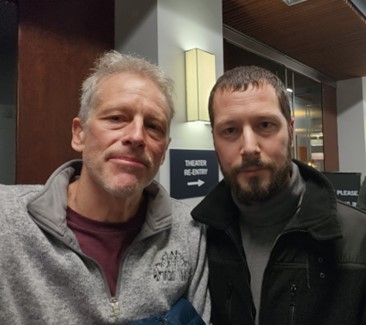
Chernov spoke the showing at Sundance and I had the honor of briefly meeting him. Here's a picture of us:
His powerful and gut-wrenching movie (here's the trailer) is premiering in New York City at the Film Forum starting this Friday.
I want as many people as possible to see this movie and meet Mstyslav, so I've purchased 30, 20 and 20 tickets, respectively, to three showings: Friday at 4:50 p.m., Saturday at 7:10 p.m., and Sunday at 2:45 p.m. Mstyslav will be speaking and taking questions after the latter two showings.
If you would like to attend as my guest, you can reserve your ticket(s) here:
Please do so quickly before the tickets are gone. (If my free tickets have been taken or you wish to go to another showing, you can buy them here.)
Best regards,
Whitney
P.S. I welcome your feedback at WTDfeedback@empirefinancialresearch.com.