

Inflation; 'Tech wreck' looks more like another dot-com bubble bursting; Aravt Global Shutting Down as Hedge Funds Get Hit by Unraveling of 'Growth Trade'; Tiger cub life
1) Inflation hit another 40-year high in February...
This by itself doesn't change my view that it will fade over the course of the year, but the war in Ukraine and the resulting spike in energy and commodity prices certainly do. These quotes in this Wall Street Journal article capture my current view well:
"We thought that inflation would come down, especially due to the untangling of the global supply chain, but we don't know how what's happening in Ukraine will re-tangle that," said Joel Naroff, chief economist at Naroff Economics...
Some economists believe that inflation is still likely to peak soon, perhaps as early as this month. But the war in Ukraine increases the chance that the peak will be higher, and the descent to lower levels will take longer, they say.
"Momentum on the supply-chain front is disrupted by the war," said Kathy Bostjancic, chief economist at Oxford Economics. She has now raised her expectations for annual inflation at the end of 2022 to closer to 4% rather than 3%.
"An eventual drop back in energy prices, gradually easing supply constraints and more favorable base effects mean that March should be the peak," said Paul Ashworth, chief U.S. economist for Capital Economics.
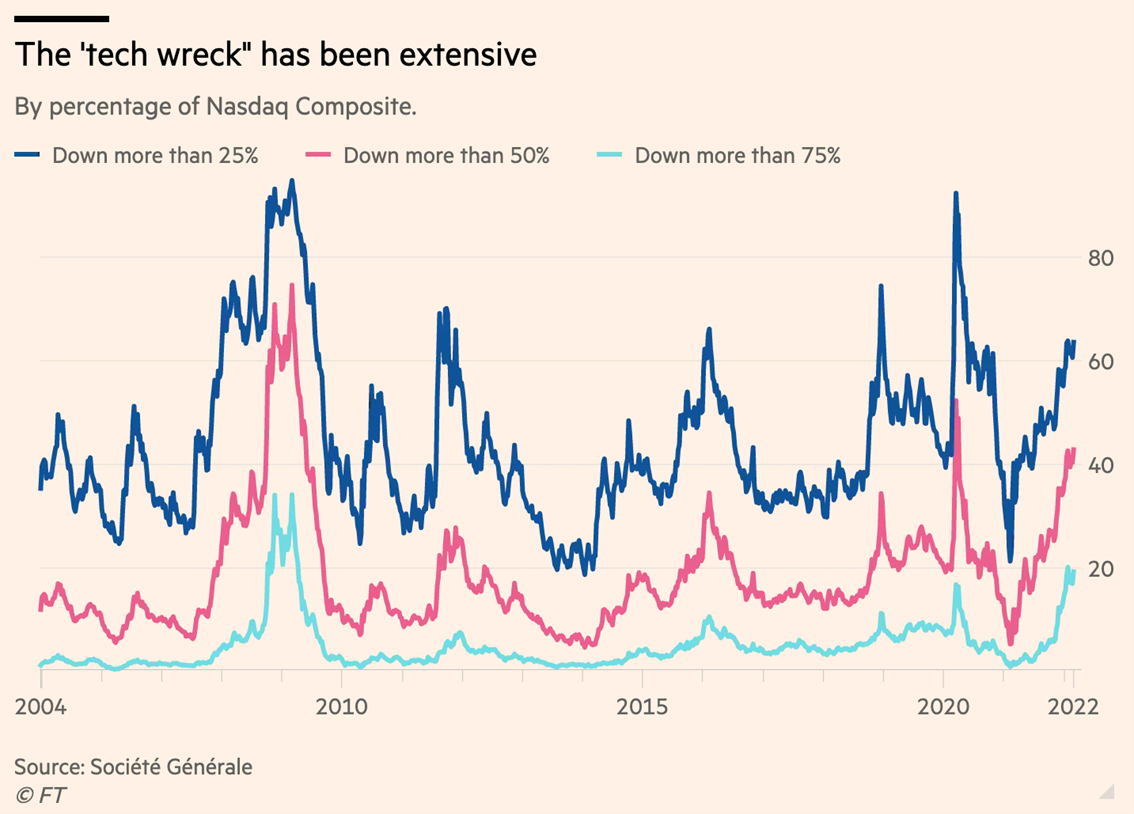
2) The collapse of tech/high-growth stocks in the past year is nowhere near what happened when the Internet bubble burst from March 2000 through October 9, 2002, when the tech-heavy Nasdaq fell by a staggering 80%. However, there are certainly parallels, as this Financial Times article notes: 'Tech wreck' looks more like another dot-com bubble bursting. Excerpt:
At what point does the slump in U.S. technology stocks stop being dismissed as a mere "tech wreck" primarily centered on the most speculative companies and become considered a fully-fledged dot-com crash 2.0?
The combination of increasingly hawkish central banks and Russia's invasion of Ukraine has been toxic for equity markets this year. The MSCI All-Country World index is now down 12% in 2022. However, as is often the case, headline indices miss a more fascinating story underneath.
The pain has been primarily focused in U.S. technology stocks. Despite a tepid bounce over the past week, the Nasdaq Composite index has already fallen nearly 20% in 2022. In dollar terms, the tech-heavy market has now lost well over $5 trillion in value since its November peak – more than the Nasdaq's dollar losses through the entire dot-com bubble unwinding in 2000-02.
Yes, the index is vastly bigger these days, but the scale of wealth destruction – and how painful it has been for many investors – is real and arguably under-appreciated, as the relative resilience of Big Tech is obscuring the extent of the damage.
Almost two-thirds of the Nasdaq's 3,000 plus members have fallen by at least 25% from their 52-week highs, according to numbers from Société Générale's Andrew Lapthorne. Almost 43% have lost more than half their value, and nearly a fifth have tumbled over 75% – the worst such ratio since the financial crisis. The $5.15 trillion that has evaporated from the Nasdaq in recent weeks is like the entire U.K. stock market going "poof".
3) My friend Yen Liow of hedge fund Aravt Global is one of the smartest guys I know and articulates his long-term growth-oriented investment approach better than anyone I've ever seen, which is why over the past year I've highlighted three of his talks.
So I was surprised to hear the news that he had decided to close his fund – it's certainly a sign of the carnage among growth stock investors (many of the bigger funds like Tiger Global Management and Coatue Management have suffered even bigger losses): Aravt Global Shutting Down as Hedge Funds Get Hit by Unraveling of 'Growth Trade'. Excerpt:
New York hedge-fund firm Aravt Global is shutting down after sustaining significant losses recently, a sign of the severe pain the selloff in growth stocks is inflicting.
Aravt's hedge fund lost 8.5% in 2021 and was down by double digits this year through February – in line with the tech-laden Nasdaq Composite's 12% loss including dividends for the period, said people familiar with the firm. Founded by former Ziff Brothers Investments principal Yen Liow, Aravt focused on what he called "horses," companies that would reliably post above-average growth.
In recent months, Aravt's concentrated stakes in growth companies including PayPal (PYPL) and GitLab (GTLB) have been pummeled. Other wagers have hurt the fund, too, including on cable operator Charter Communications (CHTR).
"When we launched in 2014, I made a promise to return capital if I ever lost conviction in our ability to deliver superior absolute returns sustainably. I believe our flagship long/short equity strategy has reached that point," Mr. Liow, 50, wrote in a letter to investors dated Feb. 28 that was viewed by the Wall Street Journal...
Tiger Global Management's hedge fund lost 36.7% from November through February, while D1 Capital Partners lost about 25% in its portfolio of public investments. D1's share class allowing up to half of clients' money to be invested in private companies lost 6%. Melvin Capital Management, which has been trying to recover from losses suffered in the meme-stock rally of January 2021, lost 18.6% for the period.
The first trading days of March have added to growth funds' losses, said portfolio managers. The popular reopening trade – a wager that hotels, cruises, airlines, and related companies would benefit as the economy reopens – has been hurt by soaring oil prices. Shares of Carnival (CCL) and American Airlines (AAL) have fallen by 13% and 18%, respectively, in March.
Managers estimate that growth-focused funds lost as much as 10% on Monday alone. As those funds look to limit losses, their reduction of exposure to markets in the prior five days was one of the most aggressive in the past decade, a Tuesday client note from Goldman Sachs (GS) said.
"March has been horrific," said one manager who asked not to be named. Some clients of growth-oriented hedge funds said they are re-evaluating their investments.
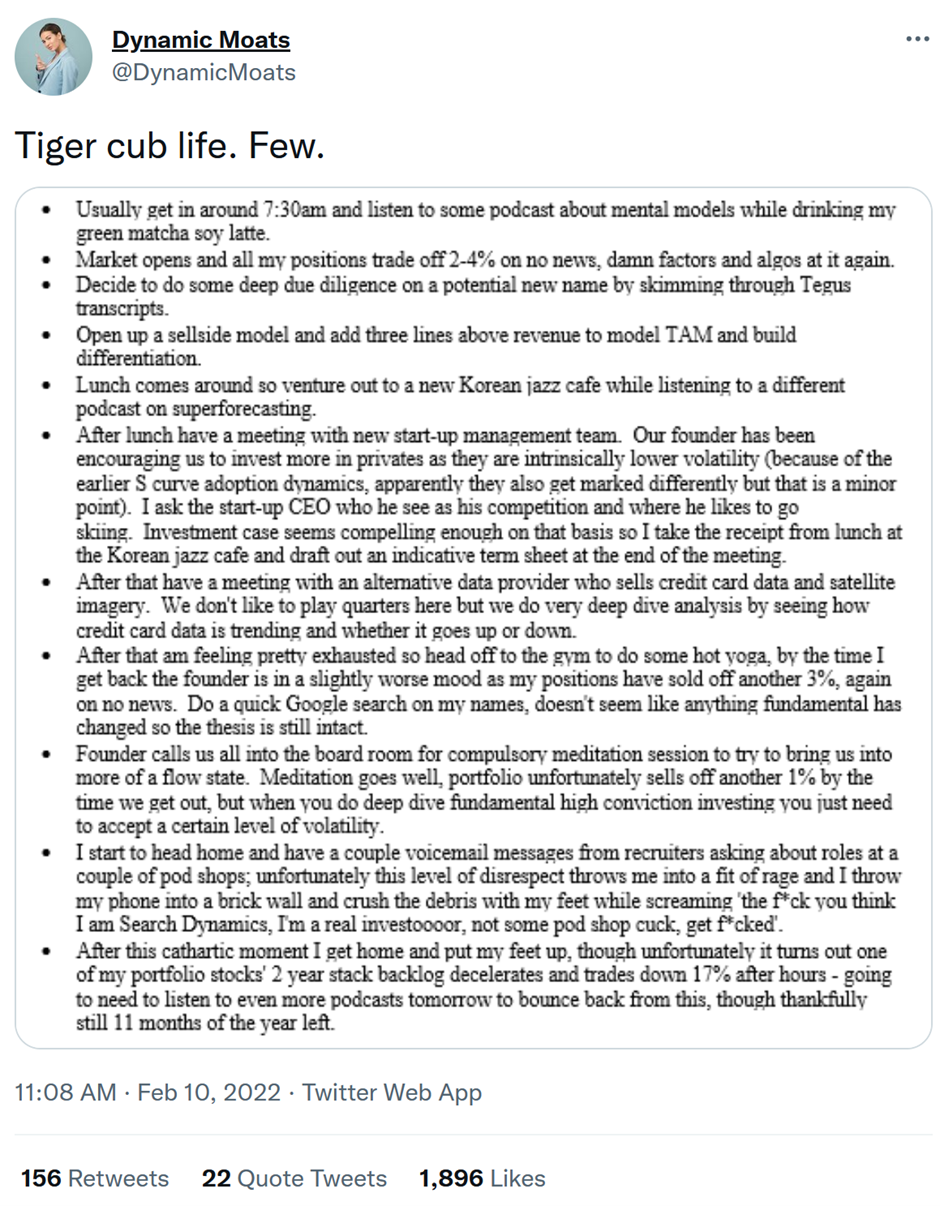
4) Speaking of big hedge funds, this meme about the life of analysts at such funds cracked me up:
Best regards,
Whitney
P.S. I welcome your feedback at WTDfeedback@empirefinancialresearch.com.